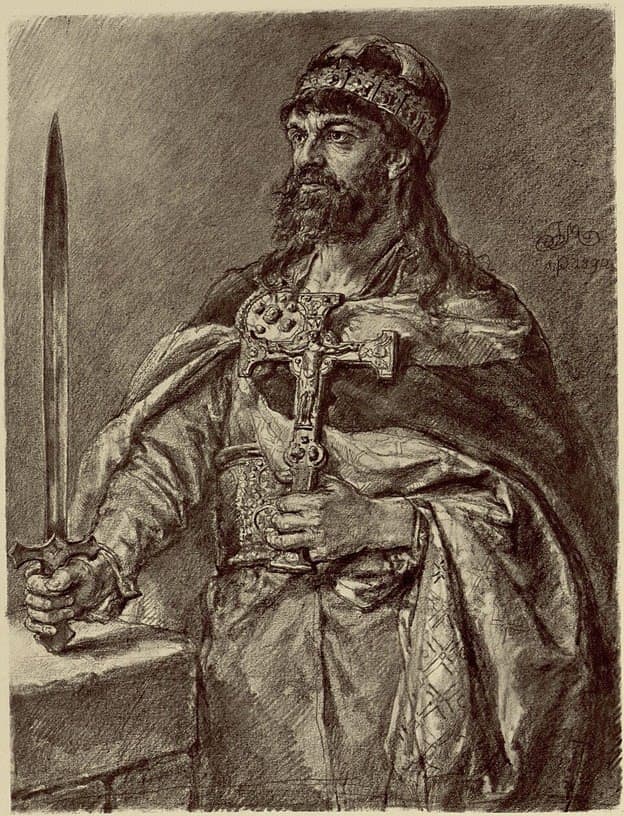

The history of the formation of the Polish state is inseparably linked with the name of Duke Mieszko I, who is rightfully regarded as its founder and one of the most farsighted rulers of the Early Middle Ages. As the son of the semi-legendary Duke Siemomysł, Mieszko assumed power around 960, inheriting a small but ambitious principality centered in Gniezno. In modern historical scholarship, particularly in the works of archaeologist Przemysław Urbańczyk, there is a well-founded hypothesis that Mieszko’s dynasty may have had roots in Great Moravia, which could explain the highly organized nature of his rule. From the very beginning of his reign, the young duke demonstrated remarkable talent as a strategist and unifier of lands: during the first years of his rule, he succeeded in incorporating the vast territories of Kuyavia, Masovia, and Eastern Pomerania into his domain, prompting European chronicles to mention the Polish state for the first time as a significant political force.

The foreign-policy environment of the time demanded the utmost caution and decisiveness from Mieszko. His first major conflict in the west dates to 963, when he launched an offensive against the Slavic tribe of the Lutici, or Veleti, in an attempt to gain control over Western Pomerania. Although the campaign ended in defeat, an event described by chroniclers such as Ibrahim ibn Yaqub and Widukind of Corvey, Mieszko did not lose heart. By entering the sphere of influence of the Holy Roman Empire and taking control of the Lubusz tribes, he faced a dilemma: either continue a dangerous war against Emperor Otto I or seek a compromise. Demonstrating political flexibility, Mieszko chose to agree to the payment of tribute and establish an alliance with the Empire, while simultaneously beginning a rapprochement with Bohemia. A crucial step in this process was his marriage in 965 to the Bohemian princess Doubravka, daughter of Boleslaus I the Cruel. The marriage helped neutralize a potential threat from the south and laid the foundations for a radical transformation of the state.

Realizing that pagan Poland remained vulnerable to expansion by neighboring Christian powers, Mieszko I made the momentous decision to accept baptism. In 966, acting in the interests of political survival and cultural development, the duke converted to Christianity according to the Latin rite. This event, known as the Baptism of Poland, was not merely an act of faith; it pursued clear political objectives: preventing Germanization by integrating Poland into the broader European Christian community on equal terms, strengthening the personal authority of the duke, and creating conditions for joint action with the Saxon rulers against the Polabian Slavic tribes.
Mieszko’s foresight was soon confirmed. With the assistance of his Bohemian allies, he decisively defeated the Veleti and their leader Wichmann. In 967, Western Pomerania was finally incorporated into Poland, and in 968 the first Polish bishopric was established in Poznań, strengthening the country’s ecclesiastical independence.

However, the growing strength of Poland inevitably led to new conflicts with German feudal lords. In 972, the forces of Odo, Margrave of the Eastern March, invaded the principality, but Mieszko demonstrated his military power in the famous Battle of Cedynia, where the invaders suffered a crushing defeat.
Even the forced visit to the imperial Reichstag at Quedlinburg in 973, where Mieszko had to hand over his son Bolesław the Brave as a hostage to guarantee peace, did not stop his systematic pursuit of his political objectives. By the 980s, the situation had changed: the threat of an uprising among the Baltic Slavs and the possibility of a pagan restoration compelled the duke to strengthen his relations with the Empire once again. This enabled him to suppress internal rebellions, repel Danish attempts to establish themselves along the coast, and, in 990, incorporate Silesia and Lesser Poland into his state.

Toward the end of his reign, Mieszko I undertook another extraordinary political step by issuing a document known as the Dagome iudex, dating to approximately 991–992. In this mysterious text, which has survived through eleventh-century papal registers, the duke placed Poland under the protection of the pope, effectively presenting it as a papal fief. This maneuver was probably intended to protect the territorial integrity of the country from Bohemian claims and to secure the rights of his second wife, Oda, and their children, although the throne ultimately passed to his eldest son, Bolesław.
The achievements of Mieszko I’s life were remarkable in scale: he nearly doubled the territory of the state, introduced his own coinage—the denarius—and established a complex system of social support.

Accounts by contemporaries, particularly Ibrahim ibn Yaqub, depict a prosperous and powerful country. According to his descriptions, Mieszko ruled the most extensive of the Slavic lands, rich in grain, meat, and honey. His authority rested on a powerful and well-trained army of 3,000 heavily armed warriors, whose maintenance was fully financed by the state treasury.
The duke also demonstrated a level of concern for his subjects that was unusual for the period, allocating funds for the support of newborn children and providing marriage gifts for young people. By the time of his death in 992, Mieszko I left behind not merely a loose tribal federation, but a centralized European state whose borders stretched from the Baltic Sea to the Carpathian Mountains and from the Oder River to the lands of Kievan Rus’, laying the foundations of the Polish nation for the millennium to come.


