
The history of the great schism that forever changed the face of the Islamic world began not on battlefields, but in the shade of Medina’s palm groves immediately after the Prophet Muhammad died in 632. While his closest relative and son-in-law, ʿAlī ibn Abī Ṭālib, together with his family, was absorbed in the sorrowful duties of preparing the Prophet’s burial, a political drama was unfolding in a place known as the Saqīfa. The gathering of the Anṣār the residents of Medina nearly turned into a spontaneous coup. Only the swift intervention of Abū Bakr as-Ṣiddīq and ʿUmar ibn al-Khaṭṭāb, accompanied by a handful of Meccans, managed to contain the situation. After a long and heated dispute, the Quraysh imposed their will, and Abū Bakr was proclaimed caliph.

To many, this event looked like a “backroom deal.” The name of ʿAlī who, in the view of many historians (including W. Madelung), had strong chances of leadership because of his kinship with the Prophet and his status as one of the earliest Muslims was not even raised. This decision produced the first muted discontent: some of the Anṣār and supporters of ʿAlī refused to pledge allegiance, leading to a harsh confrontation. Abū Bakr’s envoys even threatened the house of the Prophet’s daughter, Fāṭima, and this violence left a deep scar in the hearts of believers. Fearing a final rupture in the young community at such a critical moment, ʿAlī chose the path of passive resistance, placing the well-being of Islam above what he considered his lawful claim. It was then that two currents began to take shape those the world would come to know as Sunnis and Shiʿa.

Under Abū Bakr and, after 634, under ʿUmar, Islam expanded beyond Arabia, crushing Sasanian Persia and pushing back Byzantium. Vast wealth and fertile lands from Iraq, the Levant, and Egypt flowed into the treasury of the Caliphate. Yet with gold came social tension. ʿUmar tightly controlled the distribution of revenues, giving preference to those who had embraced Islam earlier than others. This created a form of stratification that only worsened after ʿUmar was killed by a Persian slave in November 644 and ʿUthmān ibn ʿAffān came to power.

ʿUthmān’s twelve-year rule became a time of great victories and great resentment. A man of gentle character, ʿUthmān began a process of centralizing authority while relying on his relatives from the Umayyad clan. Those very people who had once been fierce enemies of Muhammad and had accepted Islam only at the last moment now occupied key offices. Muʿāwiya ibn Abī Sufyān became governor of Syria, and Marwān ibn al-Ḥakam turned into the gray shadow behind the caliph. By around 650, nepotism and corruption had set a significant part of the community against ʿUthmān. Senior Companions such as Ṭalḥa and al-Zubayr, as well as the Prophet’s widow ʿĀʾisha, openly criticized the caliph perhaps also pursuing their own ambitions.

The storm broke in January 656, when hundreds of disgruntled Egyptians and Iraqis marched on Medina under the guise of pilgrims. The situation quickly spun out of control. ʿUthmān, trapped in his own house, wavered between promises of reform and Marwān’s influence. When the rebels intercepted a letter ordering the execution of their leaders, anger became uncontrollable. ʿAlī ibn Abī Ṭālib tried to mediate: he sent his sons, Ḥasan and Ḥusayn, to guard the gates of the caliph’s house and to provide him with water. But it was too late.
On June 17, 656, an enraged crowd broke into ʿUthmān’s quarters. As the elderly caliph was reciting the Qur’an, he was brutally killed. His blood splashed onto the pages of the sacred book, and his body was buried secretly in a Jewish cemetery, because the rebels would not allow his burial in the Muslim graveyard. This assassination became the point of no return.
On June 24, 656, ʿAlī was finally proclaimed caliph, but he accepted power over a fractured world. In Damascus, Muʿāwiya refused to pledge allegiance, displaying ʿUthmān’s bloodstained garment in the mosque as a banner of vengeance. Soon ʿAlī’s former allies Ṭalḥa, al-Zubayr, and ʿĀʾisha also rose against him. They accused ʿAlī of failing to punish ʿUthmān’s killers, even though they themselves had been among those who stirred the people toward rebellion.
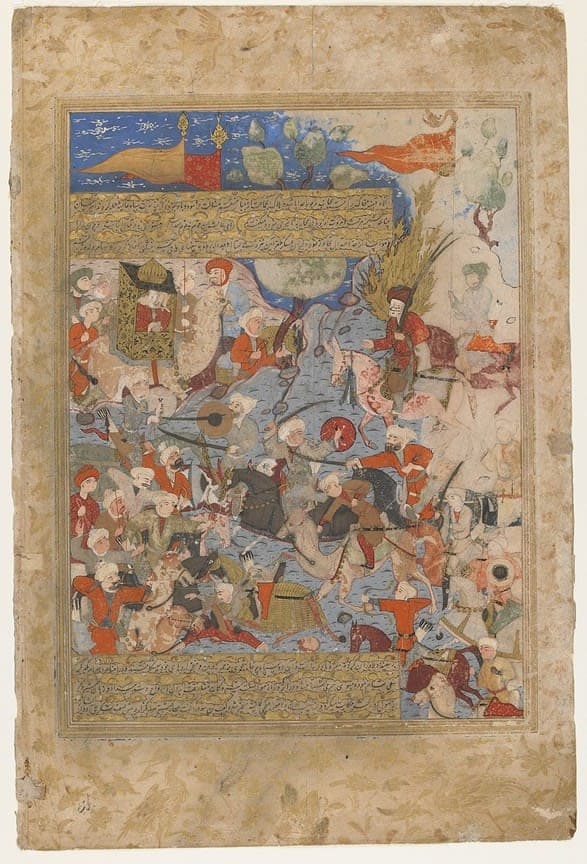
In December 656, the Battle of the Camel took place. In a brutal clash near Basra, ʿAlī emerged victorious: Ṭalḥa and al-Zubayr were killed, and ʿĀʾisha was honorably escorted back to Medina. But this was only the beginning. In July 657, the armies of ʿAlī and Muʿāwiya met in the colossal Battle of Ṣiffīn. When ʿAlī was close to defeating the Syrians, Muʿāwiya’s soldiers raised Qur’an scrolls on their lances, calling for God’s judgment. Under pressure from his exhausted troops, ʿAlī agreed to arbitration.


The decision to negotiate proved fateful. Some of ʿAlī’s supporters, outraged that the sacred right of authority had been submitted to human judgment, broke away and formed the sect of the Khārijites. In 658 the arbitration failed, and ʿAlī was forced to fight on two fronts. In July of that same year, Muʿāwiya seized Egypt, and in July 659 he officially proclaimed himself caliph in Jerusalem.
ʿAlī rapidly lost control. The Khārijites regarding both ʿAlī and Muʿāwiya as guilty of the schism organized an assassination plot. In early 661, ʿAlī ibn Abī Ṭālib was killed in the mosque of Kufa. After his death, his son Ḥasan became caliph. Although he enjoyed enormous support and assembled an impressive army, Ḥasan faced betrayal and mutiny within his own ranks. Unwilling to continue senseless bloodshed, he concluded an agreement with Muʿāwiya, handing over power in exchange for guarantees of safety and the right of succession after Muʿāwiya’s death.
Thus, ended the First Fitna. Victory remained with the Umayyads, and the community’s elective leadership gave way to hereditary monarchy. But the unity of the Muslims was lost forever.


