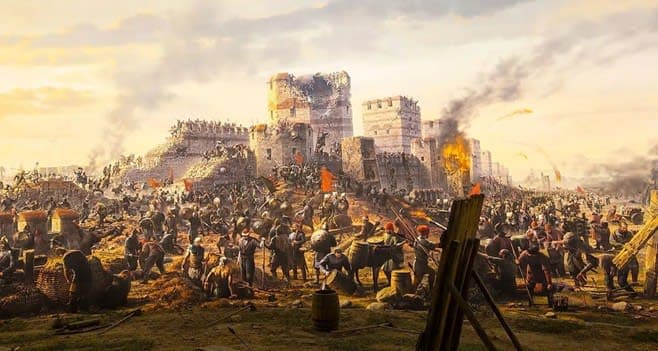

By the mid-15th century, the Byzantine Empire — once a mighty power and the heir to the Roman Empire itself — held only a small stretch of territory, including the city of Constantinople with its surrounding lands, a few islands, and part of the Peloponnese. Everything else had been seized by the Ottoman Turks, a new and formidable force that, from the moment of their emergence, had systematically conquered all Byzantine lands. Despite such a grave threat, this did not unite the ruling elite of the state, who, instead of focusing all their efforts on fighting the invaders, engaged in constant internal conflicts. The Byzantine throne was repeatedly occupied by weak rulers who were regularly overthrown through intrigues, and the empire’s wealth and power had long since faded into the past.
It was at this time that the last Byzantine emperor, Constantine XI Palaiologos, ascended the throne in 1449. He tried to save the city and the empire from final collapse, seeking support from European kingdoms, particularly from the Pope. However, the Europeans sent no real aid — only Venice provided assistance, and even that was symbolic. In 1453, Constantinople faced the threat of an attack from the Ottoman Sultanate, which had long sought to capture this strategically important city controlling the Bosporus and Dardanelles straits, serving as the link between Europe and Asia.
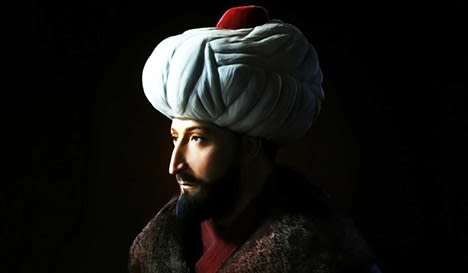
The Ottoman army was commanded by Sultan Mehmed II, later known as Mehmed the Conqueror. He had first become Sultan of the Ottoman Sultanate in 1444 at the age of 12, but due to his youth and the threats facing the state at the time, his father, Sultan Murad II, sent him to govern and study in Manisa, while Murad himself resumed the throne. In 1451, Mehmed’s father died, and he once again became Sultan. Immediately after ascending to the throne, Mehmed began actively preparing for the siege of Constantinople — gathering an army, building fortresses, and producing new cannons. Mehmed managed to assemble a force of about 80,000 soldiers. He also secured the support of a powerful fleet, which allowed him to control maritime routes and blockade Constantinople from the sea. In turn, the Byzantine forces numbered only about 7,000–10,000 men, including soldiers, mercenaries, and local defenders.

The siege began on April 2, 1453, when Mehmed II surrounded the city. The Ottoman army employed the latest siege technologies, including massive cannons capable of demolishing Constantinople’s walls. One of the most famous was the “Basilica” — a giant cannon weighing several tons, capable of firing projectiles up to 60 cm in diameter. This fearsome weapon was specially built to order by the Hungarian engineer Orban.
In addition to siege machinery, the Ottomans imposed a naval blockade, cutting off the city’s supplies and preventing reinforcements or provisions from arriving. Despite the desperate fight and heroic resistance of the defenders, the walls of Constantinople — built in antiquity gradually began to crumble under the pounding of Ottoman artillery, particularly from the Basilica.
Despite Emperor Constantine XI’s efforts, the city’s situation grew dire. Mehmed II offered a peace treaty, but the terms were too harsh, and the offer was rejected. On May 22, 1453, the siege entered its decisive phase. For a week, the Ottoman forces launched relentless assaults, and on the night of May 28–29, Mehmed II ordered the final, all-out attack.
During that night, the Ottomans breached the defenses in several places, and despite the defenders’ last efforts, the attackers entered the city. At that moment, Emperor Constantine XI, faced with a hopeless situation, urged the townspeople to fight to the end. The heroic resistance lasted until morning, when the city was nearly entirely overrun. In the final moments of the battle, Constantine XI, having abandoned hope of survival, removed his crown, plunged into the fray, and died among his soldiers. His body was later identified by the golden eagles embroidered on his boots.
With the fall of Constantinople, the Byzantine Empire ceased to exist. The city became part of what was now no longer merely a sultanate but the Ottoman Empire, becoming its capital and being renamed Istanbul.
By capturing Constantinople, the Ottoman Empire strengthened its position in Eastern Europe — particularly in the Balkans — as the region’s largest and most powerful state, securing control over key trade routes between East and West.
The fall of Constantinople also forced many scholars, artists, and writers to flee the city and move to Italy, helping spread ancient knowledge and cultural traditions, and becoming an important catalyst for the European Renaissance.
It also disrupted traditional trade routes between Europe and Asia. This pushed Europeans to search for new sea routes, as they no longer wished to trade with the Ottomans, who charged exorbitant duties — a situation that in turn stimulated the beginning of the Age of Discovery.
Despite the significant damage suffered by Constantinople during the siege and assault, the Ottomans carefully restored it, once again making it one of the richest and largest cities in the world.



