The English Revolution of the seventeenth century also known as the Puritan Revolution was a conflict driven by deep economic, political, and religious contradictions.
At the start of the seventeenth century England’s economy was undergoing profound change. The influx of silver from the Americas sparked a price revolution and inflation, enriching the merchant bourgeoisie and ruining landowners with fixed incomes. Henry VIII’s Reformation, which secularized church lands, turned land into a speculative asset and broke down old feudal relations in the countryside. Putting-out manufacture expanded in agriculture, and peasants fought to defend their customary rights to land.
Meanwhile, industry and foreign trade grew. England was transforming from a supplier of raw materials into a competitor to other European states. Old guild rules and royal monopolies intended to control trade hampered the development of capitalism and provoked the discontent of the bourgeoisie.
The conflict between king and parliament was the political expression of the struggle between the old feudal order and the new capitalist one. Royal power, backed by the traditional aristocracy and the church, held back capitalist relations. In response, parliament became the political instrument of the new class of gentry and wealthy merchants defending their interests.
In 1628 parliament adopted the Petition of Right, which forbade the king from levying taxes without parliamentary consent. King Charles I, however, dissolved parliament in 1629 and ruled alone for eleven years, imposing illegal levies such as ship money and expanding monopolies.


Religious contradictions played a decisive role in the escalation of the conflict. Royal authority embodied by Charles I and his chief adviser, Archbishop William Laud sought to unify the church and suppress religious debate. Laud held that the king ruled “by God’s grace,” and his reforms brought the Church of England closer to Catholicism.

This aroused the indignation of Puritan Protestants who wanted to “purify” the church of Catholic traditions. In parliament the Puritans split into two parties: moderate Presbyterians and the radical Independents led by Oliver Cromwell.
The crisis sharpened in 1641 with the Irish uprising. Parliament refused to entrust Charles with the army needed to suppress it, leading to a final break. On 4 January 1642 Charles I tried to arrest opposition leaders, but the attempt failed. On 22 August 1642 he raised his standard at Nottingham, beginning the First Civil War.
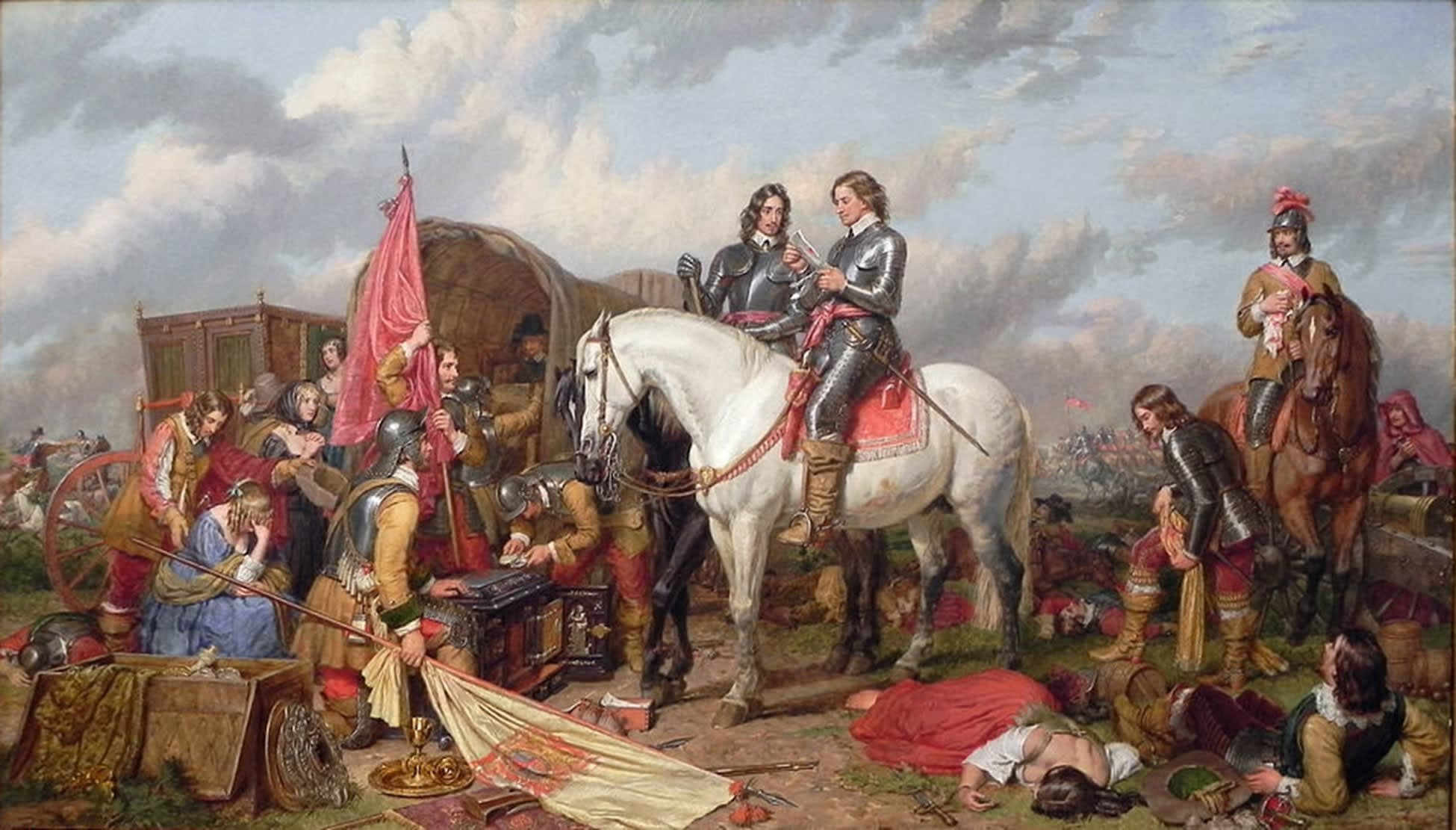
Backed by London’s wealth and popular support, parliament organized an effective army. Oliver Cromwell created the New Model Army, noted for its strict discipline and political commitment. His yeoman cavalry became parliament’s striking force and won decisive victories at Marston Moor in 1644 and Naseby in 1645. In 1646 Charles I fled to the Scots, marking the royalists’ defeat.


After victory, divisions emerged within the parliamentary camp. Presbyterians in parliament sought terms with the king and to disband the revolutionary army. The army where the radical Levellers were influential refused to comply. Representing small proprietors and the poor, the Levellers demanded an expanded franchise, a unicameral parliament, and complete freedom of conscience.
In 1647 the king was seized by the army, and the Putney Debates opened on the future constitution. Distrusting the army leaders, the king conducted secret talks with the Scots.
In 1648 royalists, supported by the Scots, rose again, launching the Second Civil War. Cromwell’s army quickly crushed the revolt and defeated the Scots at the Battle of Preston. After this victory, army leaders embittered by the king’s perfidy resolved that Charles I must be punished.

In January 1649 Charles I was brought to trial, found guilty of tyranny and treason, and on 30 January 1649 was beheaded before the Banqueting House at Whitehall. The monarchy and the House of Lords were abolished, and on 19 May 1649 England was proclaimed a republic.

After the king’s death, Oliver Cromwell came to power. He suppressed the Leveller movement whose demands were deemed too radical and focused on consolidating bourgeois interests. In 1651 the Navigation Act was passed, undermining Dutch trade and fostering the growth of the English navy. Establishing a military dictatorship, Cromwell took the title Lord Protector. After his death in 1658, his son Richard Cromwell failed to maintain power; the army deposed him and chaos ensued.

In 1660 General George Monck marched from Scotland, restored parliament, and invited the executed king’s son, Charles II, to take the throne. Thus came the Stuart Restoration.
The English Revolution was a turning point in the nation’s history. It shattered the foundations of feudalism and created conditions for the development of capitalism. Royal power was permanently limited by parliament, and the church lost its monopoly. Monopolies in trade and industry were dismantled, spurring further economic growth. The ideas of liberty, republicanism, and equality before the law that emerged during the revolution profoundly influenced political thought in Europe and beyond.


