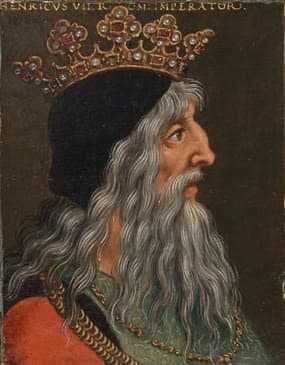
The future Holy Roman Emperor Henry VII was born sometime between 1275 and 1278 in the city of Valenciennes. He was the son of Count Henry VI of Luxembourg and Beatrice of the noble House of Avesnes.
The young count spent his early years at the French royal court, where he received an excellent education by the standards of his time.
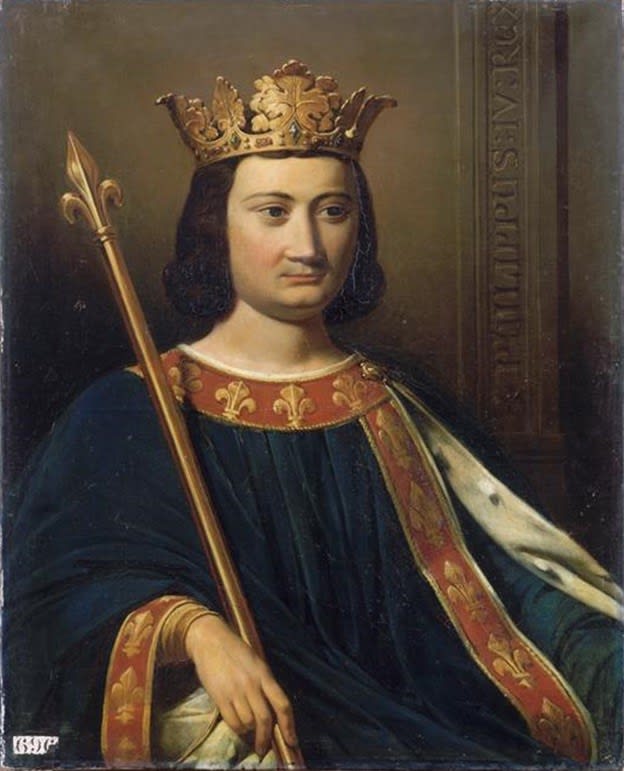
Initially, Henry ruled relatively small French-speaking territories located on the very edge of the Holy Roman Empire. A striking indication of the Empire’s deep decline and weakness during this period was the fact that the Count of Luxembourg, seeking protection, was forced to agree to become a vassal of the powerful French king Philip IV the Fair.
Nevertheless, within his own Luxembourgish domains Henry proved to be a highly effective ruler, particularly successful in maintaining peace and firmly settling long-standing local feudal conflicts.
The count’s fate changed dramatically after 1 May 1308, when the German king Albert I was assassinated.
The murder immediately drew Henry into the intense internal political struggle for the throne of the Holy Roman Empire.
Almost immediately after Albert’s death, the French monarch Philip IV launched a large-scale campaign to secure the election of his brother, Charles of Valois, as the new King of the Romans.
Philip IV was confident of success because he expected the loyalty of the French pope Clement V, whose residence was located in Avignon.
The French king hoped in this way to bring the Empire permanently into the political orbit of his dynasty. He spared no expense, distributing generous bribes and using French money to influence the German prince-electors.

The candidacy of Charles of Valois was actively supported by Archbishop Henry II of Virneburg of Cologne, who pursued a strongly pro-French policy.
However, many influential German princes were categorically opposed to any further growth of French influence.
Even Pope Clement V himself, contrary to Philip’s expectations, secretly feared the excessive power of France.
At that time, the principal rival to the French candidate was considered to be Rudolf I, Count Palatine of the Rhine.
In this political deadlock, Henry of Luxembourg—despite being a vassal of Philip the Fair—emerged as the ideal compromise candidate.
He had relatively weak connections to the major political factions within Germany.
The great territorial princes, who had already lived for decades without a crowned emperor, rejected both Charles of Valois and Rudolf.
An enormous role in Henry’s rise was played by his own brother, Baldwin of Luxembourg, Archbishop of Trier.
Through sophisticated diplomacy and substantial concessions, Baldwin succeeded in bringing several electors—including the Archbishop of Cologne—over to his brother’s side.
As a result of this brilliant political maneuver, on 27 November 1308 in Frankfurt, Henry received six of the seven electoral votes.
The only elector who refused to support him was Henry, King of Bohemia.

On 6 January 1309, Henry was solemnly crowned at Aachen, and in July of the same year Pope Clement V officially confirmed the legitimacy of his election.
The pontiff agreed to crown Henry personally with the imperial crown on the Feast of the Presentation in 1312.
This highest title had remained vacant since the death of Frederick II.
In exchange for this favor, Henry swore to defend the pope, pledged to respect the rights and privileges of the cities of the Papal States, and promised to embark on a crusade after receiving the imperial crown.
Before fulfilling his greatest ambition—receiving the imperial crown in Rome—the new ruler first had to deal with urgent problems within Germany.
Before long, influential representatives of the Bohemian nobility and clergy approached Henry.
They were deeply dissatisfied with the rule of Henry of Carinthia and simultaneously feared Habsburg dynastic claims to the Bohemian throne.
The delegation persuaded the king to arrange the marriage of his son, John of Luxembourg, to Elizabeth of Bohemia, daughter of the late King Wenceslaus II.
This brilliant dynastic marriage gave the House of Luxembourg its own legitimate claim to Bohemia.
By July 1310, Henry successfully organized the political removal of Henry of Carinthia.

As early as 15 August 1309, Henry VII had publicly announced his intention to travel to Rome and had sent envoys to Italy in advance to prepare for the grand expedition.
He expected his army to be ready to march by 1 October 1310.
Before leaving Germany, however, it was essential for Henry to normalize his increasingly tense relationship with the Habsburgs.
They had been forced to recognize the accession of young John to the Bohemian throne only under pressure and under the threat that Henry might make the Duchy of Austria dependent upon the Bohemian crown.
By October 1309, the two sides had reached a compromise.
Henry formally confirmed the Habsburgs in possession of their imperial fiefs, while Leopold of Habsburg promised in return to provide a military contingent and personally accompany the king on his Italian expedition.

Obtaining the imperial crown from the pope was of fundamental importance to Henry.
It would compensate for the relatively modest origins of the House of Luxembourg and justify the numerous concessions he had made in order to secure the German crown.
Moreover, the imperial title, reinforced by the crowns of Italy and Arles, was intended to serve as a powerful counterweight to the relentless ambitions of the French monarchy.
While preparing for the campaign, Henry attempted in the middle of 1310 to secure the support of King Robert of Naples by proposing a marriage between his daughter Beatrice and Robert’s son Charles, Duke of Calabria.
The marriage was intended to calm the long-standing conflict between the Guelphs—whose anti-imperial faction regarded the Neapolitan king as its leader—and the pro-imperial Ghibellines.
However, the negotiations collapsed spectacularly because of Robert’s excessive financial demands and the secret intervention of Philip IV of France, who did everything possible to prevent the alliance.
Despite this diplomatic failure, in October 1310 Henry VII crossed the Alps at the head of an army and began his historic campaign in northern Italy, leaving his eldest son John in Prague as imperial vicar.
When his forces entered the Lombard plain, nobles and clergy from both hostile camps—Guelphs and Ghibellines alike—hurried to welcome him.
The great Dante Alighieri responded enthusiastically to Henry’s arrival with an optimistic open letter addressed to the peoples and rulers of Italy.
Henry genuinely believed that he could restore the former greatness of the Holy Roman Empire.
Yet he fatally underestimated the depth of the divisions within Italian society.
Decades of bloody warfare had produced dozens of effectively independent city-states.
In Milan and similar communes, powerful aristocratic families ruled with the support of strong political leaders, while in Florence the merchant classes had seized power and established an oligarchic republic.
Henry’s idealism collided with political reality.
He demanded that all Lombard cities allow political exiles to return regardless of their factional affiliation.
He received both Guelphs and Ghibellines with equal courtesy, attempting to preserve neutrality and hoping that the rival factions would respond in kind.
At the same time, however, Henry uncompromisingly declared that all existing local rulers had usurped authority and demanded that their cities be placed under direct imperial administration.
Although many cities submitted, handed over the keys to their gates, and in return received titles and fiefs, Henry’s policies generated a quiet but rapidly growing resentment.
In November 1310, the king arrived in Turin.
His army numbered approximately 5,000 men, including 500 elite cavalrymen.
Soon afterward, while briefly stopping in Asti, Henry intervened in the city’s internal affairs, immediately provoking the anger of the local Guelphs.
The culmination of the northern campaign came on 6 January 1311, when in Milan Henry was solemnly crowned with the Iron Crown of Lombardy as King of Italy.
The Tuscan Guelphs openly boycotted the ceremony and began preparing for war.
Attempting to reconcile the opposing factions, Henry allowed the exiled Visconti family to return to Milan.
This decision provoked Guido della Torre, who had previously expelled them, into launching an open armed rebellion against the monarch.
The uprising was crushed in blood.
The Visconti regained control of Milan, and Matteo I Visconti was appointed imperial vicar of the city.
Henry appointed his brother-in-law, Amadeus V of Savoy, as vicar-general of all Lombardy.
But these authoritarian appointments, combined with enormous taxes and attempts to replace traditional municipal laws with imperial legislation—thus depriving the communes of privileges they had fought to secure—finally exhausted the patience of many cities.
Numerous Guelph communes took up arms.
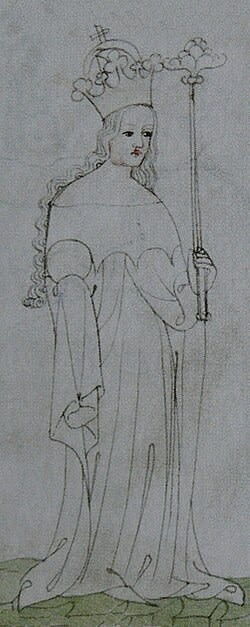
Although Parma, Lodi, Verona, and Padua recognized imperial supremacy, rebellious communes faced severe repression.
The first victim of the king’s anger was Cremona, where supporters of the Torriani family had taken refuge.
On 26 April 1311, the city fell, and Henry ordered its fortification walls to be demolished.
Yet brutality only produced further resistance.
The exhausting four-month siege of Brescia in 1311 proved particularly damaging.
It not only delayed Henry’s advance toward Rome for a long period but also caused public opinion to turn against him.
Florence, having formed a powerful alliance with Lucca, Siena, and Bologna, launched an effective propaganda campaign that achieved remarkable success.
Even Pope Clement V, unable to withstand the pressure of the French king, began distancing himself from Henry and increasingly looked toward the Italian Guelphs.
In September 1311, despite an epidemic raging through the imperial camp and widespread desertion, Brescia finally surrendered.
Henry then moved through Pavia toward Genoa, once again attempting to present himself as a peacemaker.
There, however, he suffered a terrible personal loss: the death of his beloved wife, Margaret of Brabant.
In Genoa, the king also received disturbing news.
Robert of Naples had decided to challenge him openly and had formally assumed leadership of the Guelph faction.
In response to Florence, Lucca, Siena, and Perugia swearing allegiance to Robert, Henry attempted to seize the initiative.
He ordered the Neapolitan king to appear at the imperial coronation and swear feudal allegiance for his lands in Piedmont and Provence.

The situation continued to deteriorate.
In December 1311 and January 1312, much of Lombardy rebelled against Henry, while Robert strengthened his position in Romagna.
The imperial faction nevertheless succeeded in capturing Vicenza, while Venice sent an embassy proposing friendship.
The uncompromising Henry initiated legal proceedings against Florence, accusing the city of lèse-majesté.
In December 1311, the rebellious city was formally placed under the imperial ban.
After spending two months in Genoa, Henry sailed to Pisa, a traditional stronghold of the Ghibellines and the sworn enemy of Florence.
There he was greeted with extraordinary enthusiasm.
Having finally abandoned hopes of reaching an agreement with Robert of Naples, Henry concluded a strategic alliance with King Frederick III of Sicily.
In 1312, Henry finally moved toward Rome to obtain the imperial crown.
On the way, however, he received unpleasant news: Pope Clement V had refused to attend the ceremony in person.
The Eternal City greeted Henry’s army with chaos.
Rome was divided.
The powerful Orsini family supported Robert of Naples, while the Colonna family fought for Henry in the narrow streets of the city.
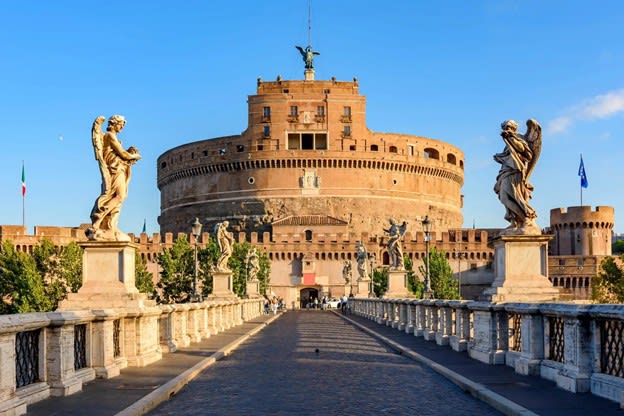
Castel Sant’Angelo and the Vatican district were held by a strong Angevin garrison from Naples.
On 7 May 1312, German troops fought their way across the Milvian Bridge into Rome, but they were unable to drive their enemies away from St. Peter’s Basilica.
Henry was therefore forced to content himself with territories around the Lateran Basilica, Santa Maria Maggiore, and the Colosseum, which were controlled by the Colonna family.
It was there, at the Lateran, that the long-awaited event finally took place.
On 29 June 1312, Henry VII was crowned Holy Roman Emperor.
The ceremony was conducted by three Ghibelline cardinals who had accompanied him on the campaign.
Tensions were so high that during the ceremonial banquet itself, arrows fired by enemy crossbowmen flew directly into the hall of the Lateran Palace.
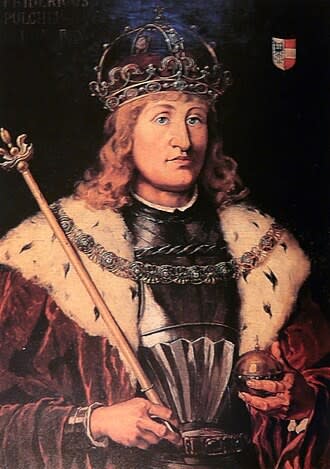
Robert of Naples issued ultimatums demanding that Henry hand Tuscany over to Robert’s son and leave Rome within four days of his coronation.
Henry proudly refused.
Declaring that imperial authority stood above papal authority and that all of Italy belonged to him by right, he rejected the truce proposed by the pope and threatened to invade Naples.
Having confirmed his alliance with Frederick of Aragon, Henry left turbulent Rome and, following the advice of the Tuscan Ghibellines, withdrew to Arezzo.
In September 1312, at Arezzo, the emperor issued a severe judgment against Robert, declaring him a rebellious vassal.
Pope Clement V, remaining safely at Carpentras near Avignon, refused to support this decision.
He feared both the influence of France—Robert was closely connected to the French monarchy—and the possibility that a victorious emperor might surround the Papal States with imperial territory.
Yet the road south passed through Florence, which continued to finance Lombard rebels and was preparing for a siege.
In mid-September, imperial forces—approximately 15,000 infantry and 2,000 knights—approached the city.
The Florentines possessed an army of roughly 64,000 men, reinforced by troops from Siena, Bologna, and Lucca.
They avoided open battle, tactically outmaneuvering the imperial army by remaining behind their walls.
The defenders did not even close the gates on the side of the city opposite the besieging forces, allowing supplies to continue flowing into Florence.
After six fruitless weeks, the emperor abandoned the siege.
Despite the failure before Florence, by the end of 1312 Henry had brought much of Tuscany under his authority and showed surprising leniency toward defeated enemies.
After returning to loyal Pisa by March 1313, however, he adopted far more radical measures.
He formally accused Robert of high treason for leading the Guelph League and ordered the widespread confiscation of property and execution by hanging of inhabitants from rebellious cities.
Henry attacked Lucca, Pisa’s traditional enemy, while simultaneously extracting from the Pisans the enormous sum of approximately two million florins.
After waiting for reinforcements, on 8 August 1313 the emperor finally began his long-awaited campaign against Naples with an army of 4,000 knights and a specially prepared fleet.
His first target on the route south was the Guelph city of Siena.
But here relentless fate intervened.
During the siege, Henry contracted malaria.
The illness progressed rapidly.
On 22 August, already in extremely serious condition, he left the camp and sought refuge in the town of Buonconvento.
There, on 24 August 1313, he died.
The body of the great dreamer was transported to loyal Pisa.
With his final breath disappeared the hopes for the restoration of unified and powerful imperial authority in Italy.
In the following decades, Robert of Naples, who outlived Henry, became the principal arbiter of Italian politics.
Meanwhile, Henry’s eldest son, John the Blind—who had already become King of Bohemia in 1310—continued the Luxembourg dynasty.
Within the Empire itself, a brutal struggle for the crown erupted between Louis the Bavarian and Frederick the Fair of Habsburg.
The conflict ended only on 28 September 1322, when Frederick suffered a crushing defeat at the Battle of Mühldorf.
Louis the Bavarian’s attempt to repeat Henry’s Italian triumph between 1327 and 1329 ended in failure.
Perhaps the most lasting political legacy of Henry VII in Italy was the brilliant careers of the imperial vicars he had appointed: Matteo Visconti in Milan and Cangrande I della Scala in Verona.
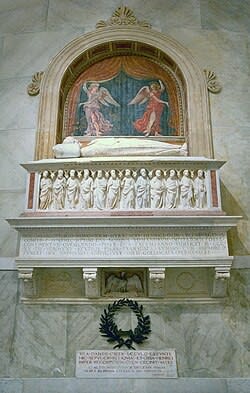
Ghibelline Pisa faithfully honored the memory of its emperor.
In 1315, the famous Sienese sculptor Tino di Camaino created a magnificent monumental tomb for Henry VII.
Originally, it occupied the most prestigious location in Pisa Cathedral—the apse directly behind the high altar.
The tomb was crowned by a statue of the reclining monarch surrounded by angels and saints.
Over time, political changes led to the dismantling of this masterpiece, and its components were scattered around the cathedral complex.
Only by 1985 was Henry’s burial place finally established in the right transept of the cathedral, beside the tomb of Saint Rainerius.
Today, sculptures and unique gold objects associated with the monument are displayed in the Museo dell’Opera del Duomo in Pisa.
The sculptures of Henry and his advisers had previously been kept in the monumental Camposanto cemetery.
A plaster copy of the tomb, produced in 1890, is preserved in the Victoria and Albert Museum.
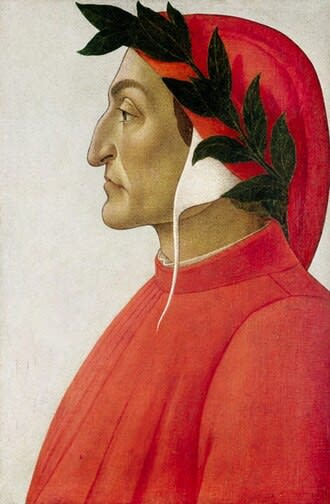
Yet perhaps the most magnificent monument to the emperor was created not in stone, but in literature by Dante Alighieri.
In his Divine Comedy, the poet immortalized the monarch as “great Henry” — alto Arrigo.
In Canto XXX of Paradiso, Dante depicts an empty throne in Heaven reserved for the ruler who “came to set Italy right before she was ready for it.”
In the pages of Purgatorio, the emperor appears as the long-awaited savior destined to restore secular authority and restrain the ambitions of the Church.


