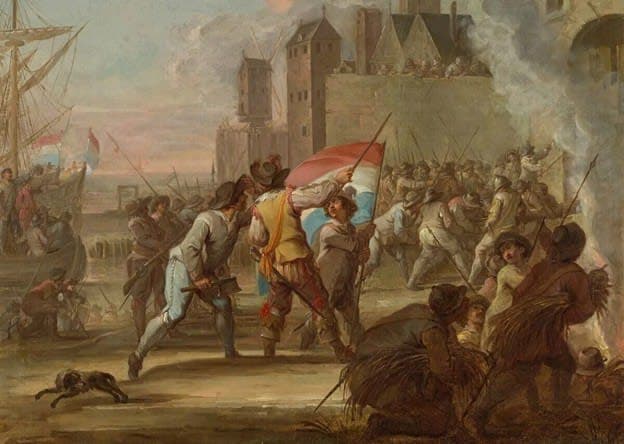

The Dutch Revolt of the 16th century, which led to the creation of an independent Dutch Republic, was the result of deep contradictions that had accumulated in society. These contradictions were rooted in history, the economy, and religious beliefs.
Initially, the Netherlands were part of the vast Habsburg Empire inherited by Emperor Charles V from his father. In 1549 Charles V issued the Pragmatic Sanction, which united the Seventeen Provinces, making them a hereditary possession of the Habsburgs. However, in 1555 he abdicated, transferring the Netherlands to his son Philip II. Unlike his father, who was born and raised in the Netherlands, Philip II was educated in Spain, did not know either the Flemish or the French languages, and his rule was perceived as alien.

One of the main causes of discontent was taxes. The Netherlands was an economically developed region with a high standard of living, but its prosperity was undermined by exorbitant taxes that went to finance Spain’s endless wars against France and the Ottoman Empire. For Dutch merchants and townspeople these wars were senseless and harmful, as they disrupted their trade connections.
The religious question became even more acute. In the 16th century, the ideas of Protestantism, especially Calvinism, spread rapidly in Northern Europe. The Dutch authorities, accustomed to freedom and tolerance in a trading society, at first treated Protestants with forbearance. However, for the devout Catholic Philip II, Protestantism was heresy to be combated. His policy of persecution led to rising tension, which in 1566 spilled over into the iconoclastic uprising.
A third important factor was the centralization of power. For centuries the Dutch provinces had enjoyed broad autonomy, but Charles V and Philip II sought to strengthen the central government’s control over local self-government, appointing professional jurists to key posts instead of the traditional aristocracy. This caused discontent among the nobility and townspeople, who were accustomed to their liberties.
The discontent of the aristocracy and the people reached its peak in 1565, when a group of nobles drew up the “Compromise of the Nobility.” In this document, which was presented to the stadtholder Margaret of Parma, they demanded an end to the persecution of Protestants and respect for traditional liberties. During the audience, one of the advisers, seeing the modestly dressed nobles, contemptuously called them “gueux” (beggars). The nobles proudly adopted this nickname, making it the symbol of their movement and struggle for freedom.


In 1566 the iconoclastic uprising, provoked by preachers and economic hardships, swept the Netherlands. Calvinists burst into churches, destroying statues and images of saints that they considered idols. This event finally convinced Philip II of the need for decisive measures. In 1567 he sent to the Netherlands a 10-thousand-strong army under the command of the ruthless Duke of Alba, who was given extraordinary powers.

Alba established the “Council of Troubles,” which the people nicknamed the “Blood Council.” Its task was to suppress the uprising and punish all involved. In just three months Alba executed up to 1,800 people, confiscated their property, and ruthlessly persecuted Protestants. Among those arrested and executed were such influential nobles as Counts Egmont and Horne.
These repressions only pushed the people to even more determined resistance. In response to the terror of the Duke of Alba, Prince William of Orange began a war against Spain, although at first his actions were unsuccessful. Meanwhile, Spain was forced to wage war on several fronts, which weakened its forces in the Netherlands. William even turned for help to the Ottoman Empire, which saw in the struggle of Protestants against the Habsburgs a way to weaken its main enemy in Europe. The rebels’ slogan became the words: “Better the Turks than the Pope.”
Alba’s bloody terror and the introduction of exorbitant taxes, including 10% on all trade operations, undermined the economy and trade of the Netherlands. This led to mass unemployment and hunger, and many men left the cities, joining the detachments of the “sea” and “forest” Beggars. These guerrilla units, supported by England and France, launched a full-scale war against the Spaniards.
A decisive turning point came on April 1, 1572, when the Sea Beggars unexpectedly captured the fortress of Brielle. This victory became a signal for an uprising in the northern provinces. One after another, the cities of Holland and Zeeland declared their loyalty to the rebels.
At the head of the uprising stood William of Orange, who was appointed stadtholder. He skillfully maneuvered between the interests of militant Calvinists and moderate Catholics, striving to unite them around the common goal the struggle for independence from Spanish tyranny. In 1573, in order to secure the support of the most determined fighters, William himself converted to Calvinism.

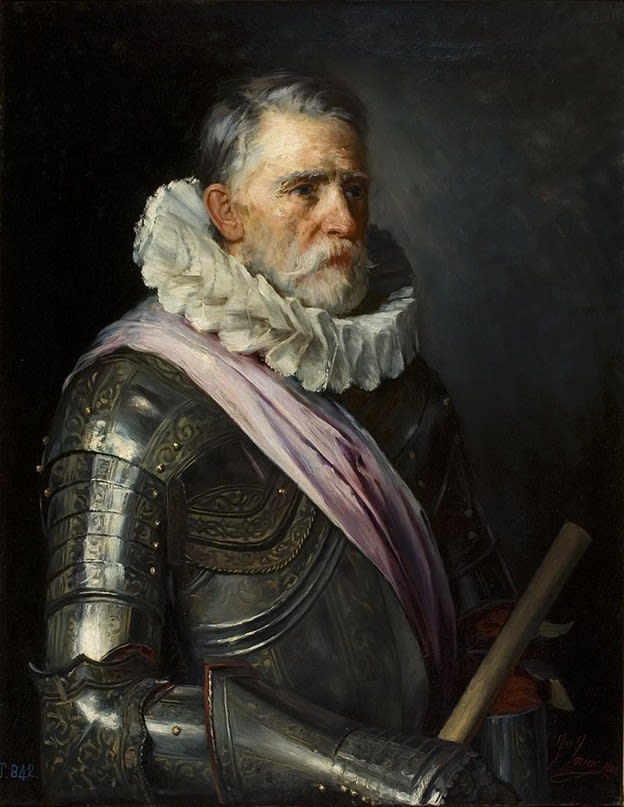
The terror of the Duke of Alba and the “Blood Council” could not break the spirit of the Dutch people. On the contrary, it only strengthened the resolve of all seventeen provinces to unite against Spanish oppression. In 1573 a new governor was appointed, Luis de Requesens, but he too could not reverse the course of the war. The economic situation in Spain was so bad that in 1575 it declared bankruptcy. Mercenaries, who had not received pay, mutinied.
In November 1576, the “Spanish Fury” occurred in Antwerp: Spanish soldiers plundered the city and killed about eight thousand residents. This event became the last straw. On November 8, 1576, in Ghent, representatives of the northern (Protestant) and southern (Catholic) provinces concluded the “Pacification of Ghent.” They agreed to unite in the struggle against the Spanish troops, proclaimed religious tolerance, and recognized William of Orange as head of the executive power.


In 1577 a new governor, Don John of Austria, arrived in the Netherlands, who agreed to the terms of the “Pacification of Ghent” by signing the “Perpetual Edict.” However, he could not find a compromise between the Catholics, who sought to preserve the power of Philip II, and the Calvinists, who demanded complete independence. In July 1577 he suddenly seized the citadel of Namur, resuming military operations. In January 1578 Don John of Austria defeated the rebels at the Battle of Gembloux, which exacerbated the split between Catholics and Protestants.

Meanwhile, in the south, especially in Flanders, power was seized by radical Calvinists, creating their own urban “republics.” The most famous of these was the Ghent Republic, which confiscated church property and executed supporters of the Spanish crown. These actions repelled the moderate Catholic nobility of the southern provinces, who feared religious fanaticism no less than Spanish rule.
The talented Spanish commander Alessandro Farnese, who replaced the deceased Don John of Austria in 1578, skillfully used this split. He began negotiations with the Catholic aristocracy of the south, which, frightened by the actions of the Calvinists, was ready to come to terms with the Spanish crown. On January 6, 1579, the southern provinces, including Artois and Hainaut, signed the Union of Arras, in which they declared their loyalty to Catholicism and their willingness to return under the authority of Philip II, on condition that their liberties be respected.
In response, on January 23, 1579, the northern provinces under the leadership of William of Orange united in the Union of Utrecht. This union became the foundation for the future state the Republic of the United Provinces of the Netherlands.
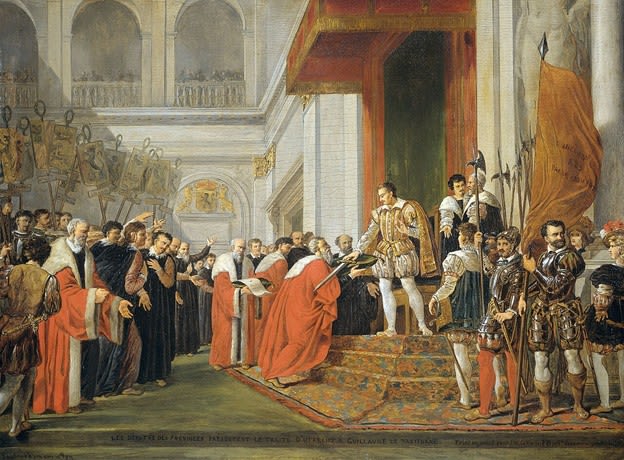

In 1581 the States General of the new state adopted the Act of Abjuration, which officially proclaimed that Philip II, having failed to fulfill his royal duties, was no longer their lawful monarch.
After the assassination of William of Orange in 1584 and the fall of Antwerp in 1585, the Netherlands finally split into an independent Protestant North and a Catholic South that remained under Spanish rule. Most Protestants fled north, which strengthened the religious and political identity of the new state.
In 1587 William’s twenty-year-old son, Maurice of Orange, became commander-in-chief of the army. He proved to be a brilliant commander and, using Spain’s weakness, which was occupied with war against England, began a large-scale campaign. Capturing one after another the most important cities on the border of modern Netherlands, Maurice created a protected territory that became the center of the future state.
The blockade of the mouth of the Scheldt, controlled by the northern provinces, led to the decline of Antwerp and the flourishing of Amsterdam. In 1602 the Dutch East India Company was founded, which marked the beginning of active colonial expansion and significantly strengthened the economy and fleet of the Netherlands.
In 1609, exhausted by wars, Spain agreed to the Twelve Years’ Truce. During this period, internal conflicts flared up in the young state between supporters of political and religious liberalism (the Arminians) and the more radical Calvinists (the Gomarists), who were supported by Maurice of Orange. The conflict ended with the execution of the Arminian leader Johan van Oldenbarnevelt in 1619.


The truce ended in 1621, and the war resumed, becoming part of the larger Thirty Years’ War in Europe. Under the leadership of Frederick Henry, Maurice’s half-brother, the Dutch army continued the offensive. In 1629 it captured the impregnable city of ’s-Hertogenbosch, and in 1632 Venlo, Roermond, and Maastricht. These victories finally secured the territorial boundaries. However, attempts to liberate the southern provinces failed, since their population, having converted to Catholicism, did not trust the Calvinists.
The war ended on January 30, 1648, with the signing of the Treaty of Münster, which became part of the Peace of Westphalia. This treaty officially recognized the Dutch Republic as an independent state and secured for it all the conquered territories.
Thus, the Dutch Revolt ended in complete success for the northern provinces, which, having defended their independence, entered a period of their “Golden Age.”



