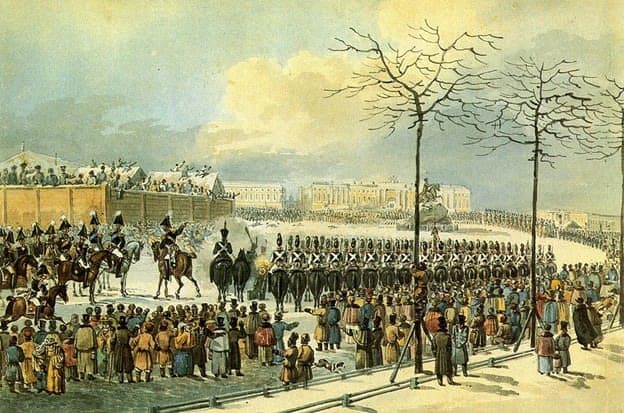
The events of the Patriotic War of 1812 and the subsequent foreign campaigns of the Russian army had a profound impact on Russian society. Officers who had been in Europe saw that life there was organized differently than in Russia and returned home with new ideas. Above all, they dreamed of abolishing serfdom and introducing constitutional limits on monarchical power.


Beginning in 1814, the first semi-legal associations began to arise among Guards officers, such as the “Order of Russian Knights” and the “Union of Salvation.” The latter, founded in 1816 in St. Petersburg by Alexander Muravyov, set out two main goals: the liberation of the peasants and reform of public administration. In 1817, Pestel wrote the society’s statute, in which the influence of Masonic rituals was evident. Internal disagreements especially over the permissibility of regicide led to the society’s dissolution as early as the autumn of 1817.

In January 1818 a new secret society, the “Union of Prosperity,” was created in Moscow. It included about 200 members and lasted until 1821. One of its chief tasks was to foster a liberal movement and advanced public opinion in society. Members of the Union sought to take posts in the army and in government institutions in order to influence the situation from within.
The membership of the secret societies was constantly changing: veterans who started families departed from politics, and their places were taken by younger officers. In January 1821 a congress of the Union of Prosperity was held in Moscow, at which it became known that the government was aware of the society’s existence. It was decided to dissolve it formally. This step made it possible to rid the movement of casual participants and lay the groundwork for reorganization. Thus, two new societies emerged: the “Southern Society,” created in 1821 and active in Ukraine, and the “Northern Society,” created in 1822 with its center in St. Petersburg.
The death of Emperor Alexander I on 19 November (1 December) 1825 created a unique legal conundrum. By the right of succession, the throne should have passed to the next brother, Grand Duke Konstantin Pavlovich. However, there existed a secret document in which Konstantin had long since renounced the throne in favor of the unpopular Nikolai Pavlovich.

Unaware of the secret document, Nicholas hastened to renounce his rights to the throne in favor of Konstantin. As a result, on 27 November (9 December) 1825, the entire country was sworn to Konstantin. A dangerous and tense interregnum arose, since Konstantin did not accept the throne but did not formally refuse it either.
Amid this uncertainty, Nikolai Pavlovich decided to declare himself emperor. A second, so-called “re-oath,” was set for 14 (26) December 1825. The Decembrists, who knew of Nicholas’s plans, decided the moment had come to act. They secured the support of about ninety officers and their soldiers from Guards regiments and began preparing an uprising. The principal slogan used to rally the soldiers was the defense of Konstantin Pavlovich’s rights, whom according to the conspirators the younger brother had unlawfully displaced. The soldiers were also promised a reduction in term of service.
A plan was devised to prevent the troops from swearing allegiance to Nicholas I and to force the Senate to publish a Manifesto with political demands. Prince Sergei Trubetskoy was appointed to lead the uprising. It was envisaged that troops under Aleksandr Yakubovich and Nikolai Bestuzhev would seize the Winter Palace and arrest the imperial family, while other regiments would gather on Senate Square. After the seizure of power, it was planned to demand that the Senate publish a nationwide Manifesto proclaiming the abolition of serfdom, equality of all before the law, and other democratic freedoms. The future of the state was to be decided by a National Assembly.
But even before the uprising began, the plan started to unravel. A day before the action, the leader of the Southern Society, Pavel Pestel, was arrested. On the night of 14 December, Pyotr Kakhovsky refused to kill Nicholas in the Winter Palace, and Aleksandr Yakubovich refused to lead sailors to seize it.
The early morning of 14 December brought new setbacks for the conspirators. Warned of the plot, Nicholas had the Senate and the generals take the oath at an earlier hour. Attempts by the Decembrists to stir mutiny in the Guards artillery and in the Izmailovsky Regiment failed. Despite this, by 11 a.m. Aleksandr Bestuzhev and Prince Dmitry Shchepin-Rostovsky led about 800 soldiers of the Moscow Regiment onto Senate Square. The rebels formed a square near the monument to Peter I, telling the soldiers that they would defend not only Konstantin’s rights but would also demand the introduction of a constitution.


By noon a company of the Grenadier Regiment under Lieutenant Aleksandr Sutgof joined the rebellious square, followed soon after almost in full strength by the Guards Naval Crew led by Nikolai Bestuzhev. In all, about 3,000 soldiers commanded by thirty Decembrist officers gathered on the square.
Yet the uprising was already doomed. The chief leader, Prince Sergei Trubetskoy, did not appear on the square. He judged that the forces assembled were insufficient for victory. His deputies Yakubovich and Bulatov also refused to assume command. The rebels were left without a leader and forced into inaction. Realizing the critical nature of the situation, Ryleev vainly tried to find Trubetskoy and bring other regiments onto the square.
Meanwhile, Emperor Nicholas I, upon learning of the revolt, assembled loyal troops, which ultimately numbered about 12,000 men, including infantry and cavalry. He sent the war hero Mikhail Miloradovich to the square to negotiate, but Miloradovich was bayoneted by Prince Yevgeny Obolensky and shot by Kakhovsky. Soon thereafter Metropolitans Seraphim and Yevgeny unsuccessfully tried to persuade the rebels to return to their barracks.

Realizing that negotiations were yielding no results and fearing that the approaching darkness would inflame unrest among the vast crowd of townspeople, Nicholas I ordered artillery to be used. A volley with blank charges had no effect, but when the first canister shot rang out, the mutinous soldiers began to flee in panic. The officers tried to stop them, but in vain. Those who rushed onto the Neva ice to cross to Vasilyevsky Island were fired upon with round shot; the ice broke, and many drowned.
By nightfall the uprising had been completely crushed. Hundreds of dead remained in the streets. By order of the authorities, their bodies were dumped that night into holes cut in the Neva ice, and many of the wounded died without medical aid. The events of 14 December shocked Nicholas I and his brother Konstantin, who called the conspirators “scum.”

Arrests began on the evening of 14 December. Hundreds of soldiers and sailors were incarcerated in the Peter and Paul Fortress. Arrested officers were brought to the Winter Palace, where Emperor Nicholas himself acted as interrogator.
By a decree of 17 December 1825 an Investigative Commission was established, and on 1 June 1826 a Supreme Criminal Court. In all, 579 people were brought under investigation, of whom 287 were found guilty.
Five leaders of the uprising—K. F. Ryleev, P. I. Pestel, P. G. Kakhovsky, M. P. Bestuzhev-Ryumin, and S. I. Muravyov-Apostol were sentenced to death and hanged. One hundred twenty Decembrists were exiled to hard labor in Siberia or to settlement. Thus ended the first attempt by the Russian nobility to change the country’s form of government.


