By the mid-19th century, the Ottoman Empire was in deep crisis. Its weakness became apparent after the Greek uprising of 1821, which was accompanied by horrific brutality by Ottoman troops. In 1826, the dissolution of the Janissary corps, while beneficial in the long run, left the empire without a combat-ready army in the short term. In 1827, the combined British-French-Russian fleet destroyed almost the entire Ottoman fleet at the Battle of Navarino, and in 1830 Greece gained independence.


Under the Treaty of Adrianople (1829), which ended the Russo-Turkish War, Russian ships received free passage through the Black Sea Straits, and Serbia and the Danubian Principalities came under Russian protection.
Taking advantage of Ottoman weakness, in 1831 its most powerful vassal, Muhammad Ali of Egypt, broke away. Ottoman forces were defeated, and to prevent the capture of Constantinople, the sultan was forced to accept Russian military aid. In 1833 a 10,000-strong Russian corps landed on the Bosporus, preventing the empire’s collapse. The subsequent Treaty of Hünkâr İskelesi established a military alliance between Russia and the Ottomans. However, under pressure from European powers, the London Straits Convention of 1841 deprived Russia of the right to block third-party warships from entering the Black Sea. This became an important precondition for the Crimean War.
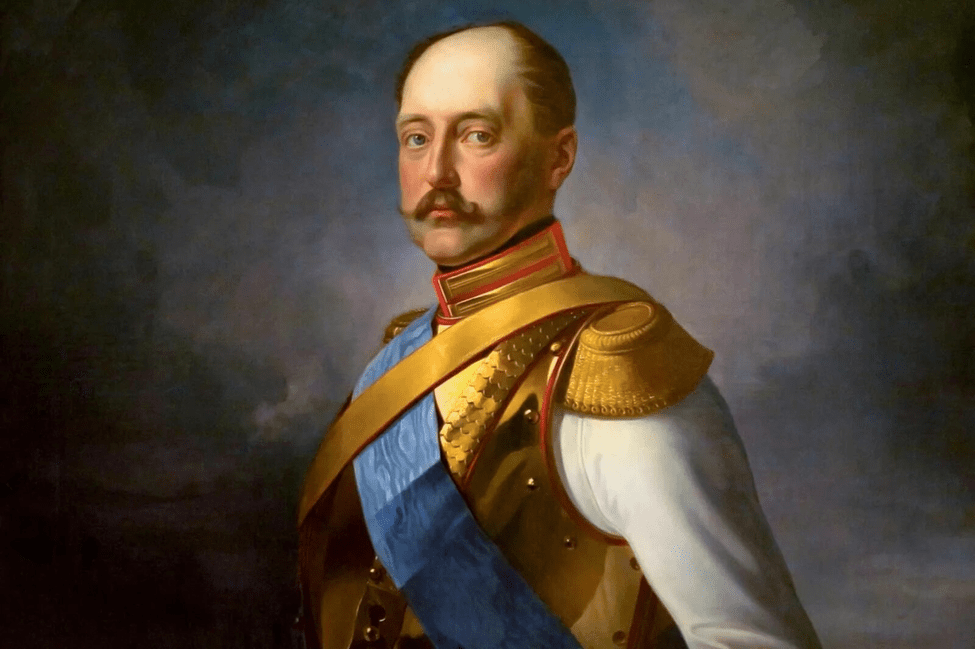
Russia sought to secure its southern borders, strengthen its influence in the Balkans, and obtain control over the Black Sea straits, important both militarily and economically. Emperor Nicholas I considered himself the protector of Orthodox peoples oppressed by the Ottomans. His policy aimed to “liberate” the Balkan nations, but as diplomat Konstantin Leontiev noted, the principal goal was not liberation per se but establishing Russian predominance in Turkey. Historian David Goldfrank argues that Nicholas’s “irrational” policy was the main cause of the war, since objective preconditions were insufficient.

Great Britain and its allies were interested in preserving the integrity of the Ottoman Empire and weakening Russia. British policy, led by Lord Palmerston, entertained far-reaching plans, including the partition of Russia and the detachment of Alaska, Finland, the Baltic provinces, Poland, the Caucasus, and Crimea. These plans were overly ambitious and not fully supported by allies, particularly France. Emperor Napoleon III wished to end the Holy Alliance, yet did not want to strengthen Britain too much or excessively weaken Russia.
Historian M. Pokrovsky argued that one of Britain’s key goals was to force Russia to abandon protectionism, which hindered British imports an idea supported by Russia’s adoption of a liberal customs tariff in 1857.
From the 1840s, anti-Russian sentiment grew across Europe (except Greece). The Western press portrayed Russia as an aggressor seeking to seize Constantinople. Though conservative, Nicholas I avoided encouraging revolutionary movements, but his defense of Orthodox peoples in the Balkans alarmed the West and created fertile ground for accusations of aggression and for war.
In 1838, Britain concluded a free-trade treaty with Turkey that effectively ruined Ottoman industry and placed the empire in economic and political dependence on Britain. Unlike the previous war, when Britain supported the Greeks Britain now wished to preserve Ottoman integrity because it had become an important market for British goods.
Britain also feared Russian expansion in the Caucasus and possible advances into Central Asia. Within the Great Game, British diplomats sought to prevent any growth of Russian influence. The British press mounted a sweeping anti-Russian campaign, casting Russia as “barbaric” and its new allies, France and Turkey, as the bearers of “civilization.”


For France, led by Louis-Napoleon Bonaparte (Napoleon III), war with Russia was needed to shore up his shaky international position. After the 1852 coup, when he became emperor, his rule was not recognized as legitimate in Europe, including by Russia. A victorious war would raise his prestige. Like Britain, France had undergone an industrial revolution and had access to the latest technologies, giving it military advantages. Much of French society supported the idea of revenge for the Napoleonic Wars.

Austria and Prussia, formerly members of the Holy Alliance, adopted a wait-and-see posture in the Crimean War and then openly opposed Russia. Despite the Russian army saving the Austrian Empire from collapse by quelling the Hungarian Revolution in 1849, Austria still feared Russian gains in the Balkans that could stir national-liberation movements in its multi-ethnic empire. In 1854, Austria and Prussia demanded that Russia withdraw from the Danubian Principalities, confirming their hostility.

The Kingdom of Sardinia, led by Victor Emmanuel II, had no direct claims against Russia but joined the anti-Russian coalition at Napoleon III’s urging. In return, France promised to help Sardinia unify Italy and fight Austria; Britain also promised material support. Sardinia’s participation in the Crimean War won French backing, ultimately leading to Italian unification.
Sweden and Norway, despite an 1812 treaty with Russia, concluded an alliance with Britain and France in 1855, seizing on Russia’s weakening.
The United States remained neutral, yet provided Russia with economic and logistical support: American merchant ships delivered food, powder, and other supplies to the Russian Far East and Russian America.
By the early 1830s, Russia had secured control over the South Caucasus and the Caspian, alarming Britain by threatening communications with India. Britain actively supported and financed Muslim tribes in the Caucasus and Central Asia, trying to draw Bukhara, Khiva, and Kokand into opposition to Russia. Despite British efforts, Persia remained under Russian influence and refused to aid Russia’s foes.


In the Far East, Russia’s Amur Expedition annexed the Amur and Primorye regions. This occurred during China’s interwar period; wary of the Anglo-French, China did not interfere. Meanwhile, Russia negotiated with Japan, which likewise sought to curb Russian influence. Despite an unfavorable international climate, Russia avoided open conflict in the Far East.
The conflict leading to the Crimean War began with a personal clash between Nicholas I and Napoleon III. Nicholas did not recognize Napoleon III’s legitimacy, since the Bonapartes were excluded from the French succession. In a congratulatory message, Nicholas addressed him as “dear friend” rather than “dear brother,” a public slight.
Napoleon III, seeking to consolidate power and distract public attention, decided to provoke war with Russia. The pretext was the long-standing dispute between Catholics and Orthodox over holy sites in Palestine, particularly the Church of the Nativity in Bethlehem. France, defending Catholic interests, demanded the church keys. Russia, protecting the Orthodox, insisted they remain with them.

When the Ottoman Empire, trying to please everyone, handed the keys to the French, Russia took it as an insult. In response, the French ship-of-the-line Charlemagne demonstratively arrived in Istanbul. Russian Chancellor Nesselrode declared Russia would not tolerate such humiliation. Russian troops began to concentrate on the border with the Danubian Principalities. Confident of Austrian and Prussian support, Nicholas deemed an Anglo-French alliance impossible. But British Prime Minister Aberdeen, fearing Russian expansion, came to an understanding with Napoleon III.
On 11 (23) February 1853, Prince A. S. Menshikov was sent to Turkey demanding Russian protection over the 12 million Orthodox Christians of the Ottoman Empire. Napoleon III responded by sending a French squadron to the Aegean. On 5 April, the new British ambassador Stratford Canning (de Redcliffe) arrived in Constantinople. He persuaded Sultan Abdülmecid I to partly satisfy Russia’s demands while promising military aid in case of war. The sultan issued a decree on Orthodox rights but refused a treaty of protection.

On 21 June (3 July) Russian troops entered the Danubian Principalities, prompting the sultan on 4 (16) October 1853 to declare war on Russia.
Subsequent events showed Russia was unprepared. The army’s combat strength was far below the nominal one million on paper. Appalling sanitary conditions and low meat rations produced high mortality among soldiers.
The biggest problem was technological backwardness compared to Britain and France, already through the industrial revolution. The Russian infantry’s main firearm was the smoothbore musket, greatly inferior to British and French rifled muskets. Rifled weapons made up only 4–5% of Russian arms, much higher among the allies.
Russia also had to keep large forces on its western frontier, fearing Austrian, Prussian, and Swedish intervention. Other troops were tied down in the Caucasian War and operations in Central Asia.
Despite shortcomings, some facts suggest Russia’s problems were overstated. The wars of 1826–1829 against Persia and Turkey ended quickly in Russian victory. In the Crimean War, Russian soldiers displayed remarkable courage and high morale despite the enemy’s technical edge. Allied losses in Crimea were even higher than Russia’s. The Russian army also fielded Konstantinov rockets, used effectively in the defense of Sevastopol.
At the war’s outset, Britain and France still relied on sailing ships-of-the-line, even though steamships had proven their worth. Early-war experience showed sail had lost primacy, yet in the Battle of Sinop and the defense of Petropavlovsk-Kamchatsky, sailing ships still played roles.


The allied fleet, first and second in the world by size, had major superiority over the Russian fleet, which ranked third especially in steam vessels, of which Russia had none.
Nevertheless, Russia armed its ships and coastal batteries with shell guns, effective against wooden and even iron ships. For Kronstadt’s defense, besides tube artillery, rocket batteries with ranges up to 2,600 meters were installed.
A peculiarity of the Baltic theater was its shallow waters, preventing large ships from approaching St. Petersburg. Russia thus built, in record time, 32 wooden screw gunboats, later 35 more, and 14 screw corvettes. Small but shell-gun-armed, they were formidable. French Admiral Pénaud later admitted: “The steam gunboats, so quickly built by the Russians, completely changed our position.” Russia also pioneered naval mines with chemical fuzes, developed by academician Boris Jacobi.

The Black Sea Fleet was led by distinguished admirals Kornilov, Istomin, and Nakhimov. Its main base, Sevastopol, was well protected from the sea but lacked landward fortifications. In 1853 the fleet fought actively, but after scuttling several ships in Sevastopol Bay, the rest were used as floating batteries. Naval mines were not employed in the Black Sea.
The war began with Russia’s occupation of Moldavia and Wallachia, announced by Nicholas I’s manifesto of 14 (26) June 1853. Russian troops advanced on Bucharest, where they were greeted as liberators.
On 27 September (9 October) Ottoman commander Omer Pasha demanded a Russian withdrawal within 15 days. In early October, the Ottomans began shelling Russian steamers on the Danube. War was officially declared on 4 (16) October 1853.
On 18 (30) November 1853, Admiral Nakhimov’s squadron destroyed the Ottoman fleet at Sinop. This victory served as the formal pretext for Britain and France to enter the war.
On 9 (21) February 1854, Russia rejected a French ultimatum, and on 15 (27) March Britain and France declared war.
In March 1854, Russian forces crossed the Danube and besieged Silistra. In late June, fearing Austrian intervention, the siege was lifted and Russian forces retreated.
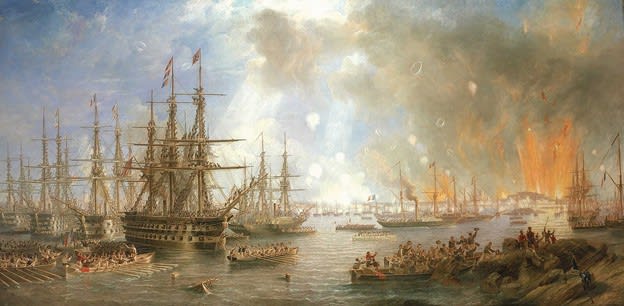
In April 1854, the allied fleet bombarded Odessa, damaging merchant shipping. In July, allied troops landed near Varna, but a cholera epidemic forced them to pause, pushing the allies toward their long-planned invasion of Crimea.


In 1853 in the Caucasus, the Ottoman army went on the offensive but was defeated at Akhaltsikhe. Russian forces also fought successfully at sea, seizing Ottoman vessels. In 1854, Russia beat the Ottomans at the Cholok River and at Kyuruk-Dara, but failed to take Kars.
Russia’s main success in 1855 was the capture of Kars. The siege that began in June ended with the garrison’s capitulation on 16 (28) November. This victory enabled Russia to secure the surrounding region.

The war also touched the Caucasian coast. On 28 February (12 March) 1855, the Anglo-French squadron bombarded Novorossiysk. The fortress suffered heavy damage, but the arrival of reinforcements forced the enemy ships to withdraw.
In late May, the garrisons of Russian forts on the Black Sea Coastal Line including Novorossiysk, Gelendzhik, and Anapa were evacuated and fortifications dismantled. Turkish detachments and pro-Turkish mountaineers exploited this, but Russian forces later repelled Anglo-French landings and defeated highlander forces rallied by Prince Sefer-Bey near Temryuk and the Varenikovskoe redoubt.
In September 1855, an Ottoman force under Omer Lütfi Pasha landed in Abkhazia, whose ruler Prince Mikhail Shervashidze had gone over to Turkey. The Ottomans invaded Mingrelia and seized crossings over the Inguri River, but their advance stalled. Omer Lütfi Pasha made no attempt to aid besieged Kars. After the war, under the Treaty of Paris, Russia handed Kars back to the Ottomans.
Sevastopol, the Black Sea Fleet’s main base, became the central theater. In June 1854, allied ships first approached the city. On 14 (26) September 1854, the allies began landing an expeditionary corps at Yevpatoria. Days later, on 8 (20) September, the Battle of the Alma ended in Russian defeat, opening the road to Sevastopol.
On 5 (17) October the first bombardment of Sevastopol took place; Admiral Kornilov was killed. That day, the allied fleet attempted to force entry into Sevastopol but failed.

On 13 (25) October, the Battle of Balaklava occurred, where Russian forces tried to relieve Sevastopol. Despite seizing positions, the attack failed and the city remained under siege. On 5 November, at Inkerman, Russian troops again failed to break through.

By early 1855, allied strength had grown substantially, with logistics and sanitation now well organized. On 17 February Russians made an unsuccessful attempt to liberate Yevpatoria.
On 12–13 May, the allied squadron bombarded and captured Kerch, sacking the city. This forced Russia to dismantle its Black Sea Coastal Line forts and opened the allies’ access to the Sea of Azov.
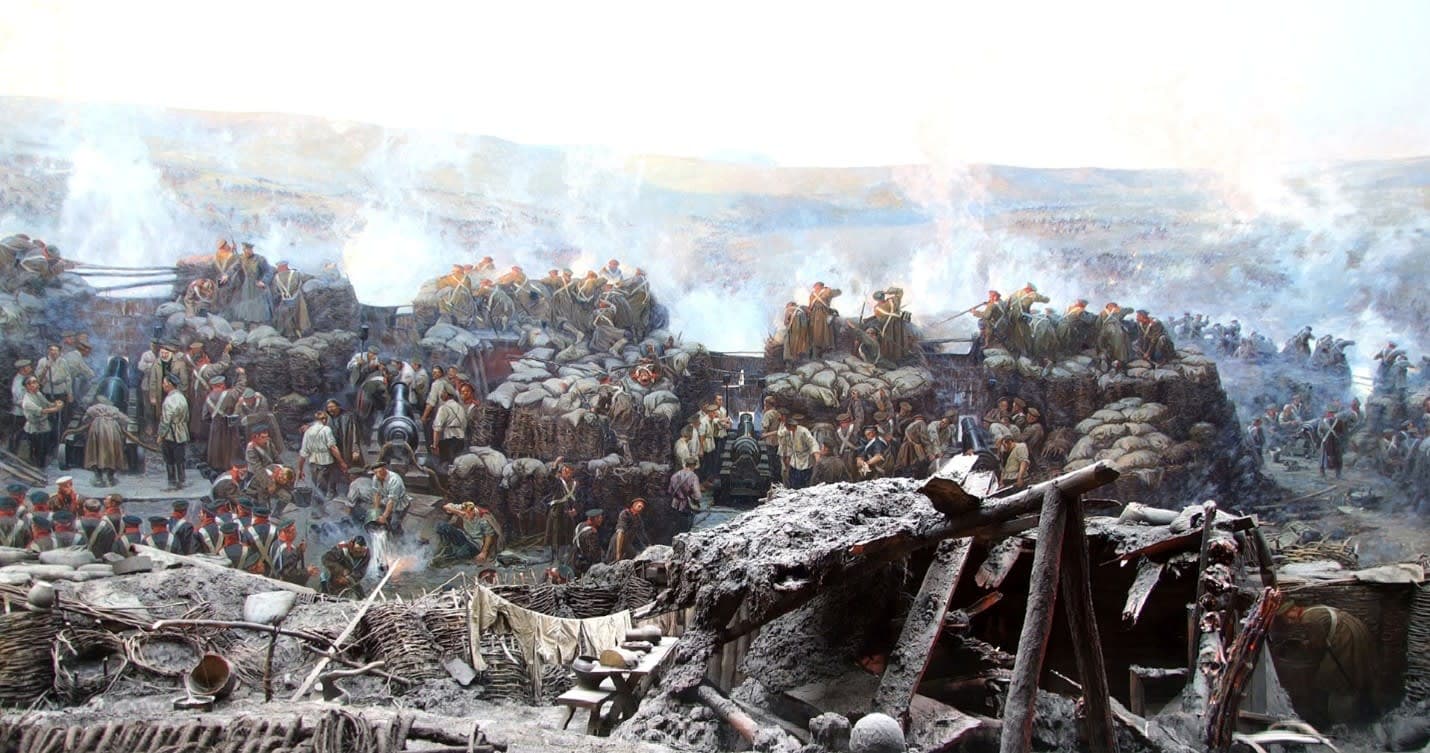
The defense of Sevastopol became one of the war’s most heroic chapters. From 28 March to 27 August 1855, the city endured six massive bombardments. During the third, the allies seized key works and pressed up to the Malahov Kurgan.
On 6 (18) June, Russian forces repelled the first general assault. But on 4 (16) August, Russia was defeated at the Battle of the Chernaya, preventing relief of the city.
On 27 August (8 September), French troops captured the Malahov Kurgan, a decisive event. Russian forces abandoned the South Side defenses, crossed by pontoon bridge to the North Side, and scuttled the last ships of the Black Sea Fleet. The 11-month siege ended.


After the fall of southern Sevastopol, the allies, unwilling to move deeper into Crimea, focused on threatening Nikolaev, Russia’s new naval base. On 2 (14) October 1855, a strong allied fleet approached Kinburn and, after a two-day bombardment, forced its surrender.
Leaving a small garrison there, the allies tried to push toward Nikolaev via the Dnieper-Bug estuary, but ran into Russian coastal batteries and, more importantly, minefields laid in summer 1854. Abandoning further attempts, the fleet withdrew to winter quarters. The Kinburn garrison, suffering from cold and shortages, was evacuated in February 1856; 119 died of disease and 48 were captured by the Russians. By mid-1856, allied troops had completely left Crimea.
The Crimean War was among the first to feature active propaganda, which profoundly influenced public opinion in all belligerent countries.
In Britain, thinkers like Karl Marx and Friedrich Engels provided ideological justifications. Engels accused Russia of seeking Constantinople and saw it as a threat to European revolution. The British press, notably The Times, mounted an anti-Russian campaign, portraying Russia as “barbaric.” After Sinop, newspapers falsely accused Russians of atrocities to rally support for war.

Russia, for its part, waged patriotic propaganda. Poet Fyodor Tyutchev wrote that “all the West has come to express its negation of Russia.” Yet some of his overly anti-Western poems urging the seizure of Constantinople were not allowed into print by Nicholas I, who did not wish to be seen as patron of pan-Slavism.
Military setbacks in turn birthed pacifist literature. The young Leo Tolstoy gained national fame with his Sevastopol Sketches, written on the spot. He criticized command decisions, coining the aphorism: “It looks smooth on paper, but they forgot the ravines.”

The war spurred numerous technologies:
Cigarettes spread among Europeans via Ottoman soldiers who rolled tobacco in paper; British and French soldiers adopted the habit.
After the Balaklava storm of 1854 devastated the allied fleet, Napoleon III ordered the creation of a weather-forecasting service; within three months the first synoptic chart appeared—birth of modern meteorology.
For the first time, photography documented military operations; Roger Fenton’s Crimean images were the first war photo-documents.
Militarily, the war hastened the shift from smoothbore to rifled arms and from sailing fleets to steam ironclads. Naval mines and the telegraph were first used extensively. The skirmish line emerged, supplanting outdated columns.
The war catalyzed reforms in military medicine:
Florence Nightingale introduced sanitary principles in hospitals, reducing mortality among the wounded from 42% to 2.2%.

Nikolai Pirogov was the first in Russian field medicine to use the plaster cast, speeding fracture healing.

For the first time, sisters of mercy (nurses) were mobilized for the care of the wounded.
Diplomatic talks began in 1854, but allies demanded that Russia abandon its Black Sea fleet and its protectorate over the Danubian Principalities terms Nicholas I deemed unacceptable.
After his sudden death on 18 February (2 March) 1855, his son Alexander II ascended the throne. After Sevastopol’s fall, the coalition split: Napoleon III wanted peace; Palmerston wanted to continue the war. Austria then issued Russia an ultimatum, demanding concessions on all disputed points. The new tsar, recognizing Russia’s isolation and exhaustion, was forced to yield.
On 15 (27) January 1856, it was decided to accept the Austrian ultimatum as preliminary peace terms.
The war ended with the Treaty of Paris, signed 18 (30) March 1856. Under its terms, Russia made numerous territorial and diplomatic concessions: it returned Kars, Bayazet, and Ardahan to Turkey and, in exchange, regained allied-occupied cities in Crimea, including Sevastopol and Balaklava. The Black Sea was declared neutral; both Russia and the Ottomans were forbidden to maintain a navy there, depriving Russia of active regional policy for 15 years. Russia lost its protectorate over Moldavia and Wallachia and its right to protect Ottoman Orthodox subjects. Part of Russian Bessarabia was annexed to Moldavia, and the Danube delta to the Ottomans. The allies did not achieve all their aims but did prevent Russian gains in the Balkans. Count Orlov, Russia’s delegate, managed to preserve Russia’s right not to disarm Nikolaev or destroy its shipyards, arguing it lay on the Bug River, not on the sea.


The war battered the Russian economy. Expenditures reached ~800 million rubles, leading to the issuance of unbacked paper money and a more than twofold devaluation of the ruble. Only in 1870 did Russia balance its budget, and a stable ruble returned only in 1897.
The war highlighted the difficulty of defending far-flung territories, becoming one argument for the sale of Alaska to the USA. Operations in the Caucasus and the Black Sea spurred a renewed slave trade. Yet the setbacks pushed the government toward decisive reforms, including the abolition of serfdom and military reforms.
The war also underscored the need to develop transport infrastructure; even before it ended, the government began revising railway policy.
In Britain, military failures led to the government’s resignation and army reforms.
The Ottoman Empire, despite “victory,” fell into debt, borrowing £7 million from Britain. In 1858 the sultan’s treasury declared bankruptcy. Under allied pressure, the sultan issued edicts on freedom of religion and equality, though they were not implemented.
Losses were enormous. Combined battle deaths and deaths from wounds and disease totaled 160–170,000 in the allied armies and 100–110,000 in the Russian army. Other estimates put total deaths on both sides, including non-combat losses, at around 250,000.


