In the mid-thirteenth century, the Rus’ principalities were living through one of the most tragic periods in their history. After the devastating Mongol invasion, the country lay ravaged and gravely weakened an opportunity its western neighbors sought to exploit.


In December 1237, Pope Gregory IX proclaimed a second crusade against the pagans of the Baltic, which served as a signal to advance. In June 1238, King Valdemar II of Denmark and Hermann Balk, Master of the Livonian Order, concluded the Treaty of Stensby, agreeing to divide Estonia and to undertake joint military operations against Rus’.

In 1240–1241 German and Danish knights launched an active expansion into Novgorodian lands. They seized the towns of Izborsk and Pskov, as well as the lands of the Vod people (Votes), drawing close to Novgorod. The knights erected a wooden fortress at Koporye, which allowed them to threaten the city from short range.
In response, the Novgorodians once again summoned the young prince Aleksandr Yaroslavich already renowned for his victory over the Swedes at the Battle of the Neva in 1240. Aleksandr moved swiftly: in 1241 he liberated and destroyed the fortress of Koporye, and in March 1242 he freed Pskov.
After these victories, Prince Aleksandr led his forces onward into the lands of the Chud (Estonians), under the authority of the Bishopric of Dorpat. His advance guard, however, was defeated. Learning that the combined forces of the Livonian Order and the Bishop of Dorpat were approaching, Aleksandr Yaroslavich drew his army back to Lake Peipus, where he prepared for a decisive battle.
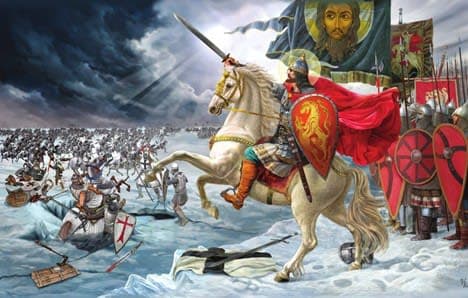
The engagement remembered as the “Battle on the Ice” took place on the morning of 5 April 1242. On the Rus’ side fought a combined Novgorodian host, the personal retinue of Aleksandr Yaroslavich, a contingent from Suzdal’ under his brother Andrei, and the men of Pskov. Opposing them were the warriors of the Livonian Order, together with the troops of the Bishop of Dorpat and Danish knights.
The Livonians attacked in their customary “wedge” formation, which Russian chroniclers called the “boar’s head” (svin’ya). They broke through the center of the Rus’ line; but contrary to the enemy’s expectations, Aleksandr had deployed two-thirds of his strength on the flanks. Thus, when the knights burst into the center, they found themselves trapped.
The Elder Livonian Rhymed Chronicle confirms that at the start of the battle a detachment of knights overcame the Rus’ archers, but was then encircled:
“It could be seen how the band of brother-knights
overpowered the bowmen;
there rang the clash of swords,
and helms were cleft…
Those who stood in the host of the brother-knights
were surrounded…”
The fighting ended in a complete rout of the crusaders. The Rus’ forces encircled and smashed them. The detachments of the Bishop of Dorpat, realizing the hopelessness of their position, withdrew. The Rus’ pursued the fleeing knights for seven versts. According to the chronicles, some who reached thin ice broke through and drowned.

Estimates of casualties vary. The Novgorod First Chronicle reports 400 or 500 Germans killed and 50 knights taken prisoner, along with countless Chud slain. The Elder Livonian Rhymed Chronicle gives far lower numbers: 20 knights of the Order killed and 6 captured. Historians believe the Rus’ chronicles likely counted not only members of the Order but other “notable” Germans who took part, whereas the German chronicle counted only full brethren of the Order.
Later in 1242 the Livonian Order was compelled to send envoys to Novgorod to sue for peace. A treaty was concluded by which the crusaders relinquished all their recent conquests on Novgorodian territory.
The Battle on the Ice proved fateful: it halted the expansionist designs of the Livonian Order at a moment of dire trial for Rus’. This victory played a key role in shaping the “Russian national myth,” in which Aleksandr Nevsky was cast as the defender of Orthodoxy and of the Rus’ land against the threat from the West.


