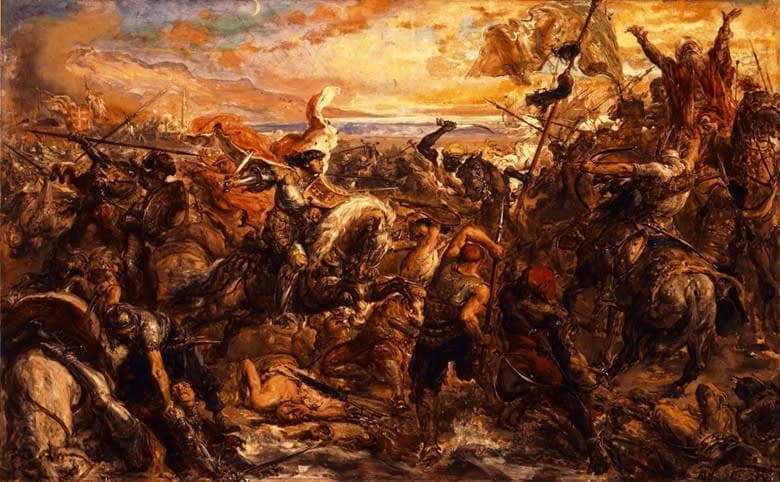

After the death of King of Hungary and Holy Roman Emperor Sigismund in 1437, Hungary entered a period of political crisis. His successor, Albert II, reigned only two years and died in 1439. The heir, Ladislaus the Posthumous, was still an infant, and the Hungarian nobles, unwilling to have a child-king, invited Władysław III, King of Poland, to the throne. Once crowned in Hungary, Władysław never returned to Poland; his chief adviser and commander became the talented voivode János Hunyadi.

In the early 1440s, Władysław and Hunyadi launched an active campaign against the Ottoman Empire. Their aim was to weaken Ottoman influence in the Balkans and restore Serbian independence. The combined crusader army won a string of victories—in November 1443 at Niš, in December near Yalovac, and in January 1444 at Kunovica. These defeats forced Sultan Murad II—who was simultaneously fighting Ibrahim of Karaman in Anatolia—to sign the Peace of Szeged in 1444. Under its terms, Murad recognized the independence of Serbian lands, and both sides pledged not to attack each other for ten years. Murad then handed the throne to his 12-year-old son Mehmed and withdrew from affairs of state.

As soon as Murad left the throne, Cardinal Giuliano Cesarini persuaded Władysław that an oath sworn on the Gospel was invalid. The treaty was thus treacherously broken, and the king resumed hostilities. Although his former ally, the Serbian despot George Branković, refused to take part, the crusader army marched south. It consisted of Hungarian, Polish, and Bohemian knights, Teutonic and papal knights, as well as contingents from Bosnia, Croatia, and Bulgaria. They were joined by about 7,000 Wallachian cavalry under Mircea II, son of Vlad Dracul.

The crusaders’ target was Edirne, the Ottoman capital. They counted on support from a Christian fleet of Venice and the Papal States to block the Dardanelles and the Bosporus, preventing Murad’s main forces from crossing out of Asia Minor. But the fleet could not perform this task effectively, as the shores of the straits were guarded by Ottoman artillery. As a result, the papal and Venetian galleys headed to Varna to rendezvous with the army there.
Murad, learning of the campaign, resumed command. With the help of a Genoese fleet he quickly ferried his troops from Asia Minor to Rumelia. The crusaders’ route south was cut off, and they found themselves in danger, surrounded by the enemy. Władysław and Hunyadi decided to move toward Varna to try to withdraw into Dobruja or embark on the ships. On 9 November 1444 both armies approached Varna. The Christian forces were hemmed in between the Black Sea, a lake, the steep slopes of the Franga Plateau, and the Ottoman army.
At a war council on 10 November, Cardinal Cesarini advocated a defensive tactic, but János Hunyadi insisted on open battle. His argument—that “it is unworthy of an army seeking victory to hide behind wagons”—convinced the majority, and they resolved to fight.
The Battle of Varna began on the morning of 10 November. The crusader army, up to 24,000 strong, formed a crescent. The center was commanded by the king; the left flank by Hunyadi and Szilágyi; the right by Jan Dominek, Cesarini, Ferenc Tallóci, and Mircea II. The Ottoman army—by some estimates up to 60,000—was deployed between Lake Varna and the Franga Plateau.


In the first phase, the Ottomans struck the crusader right. Four banderia were smashed by Davud Bey’s onslaught; their commanders, including Cardinal Cesarini, died in the marshes by the lake while trying to flee. On the left, however, the crusaders achieved success: Hunyadi and Szilágyi drove back the Ottoman forces under Karaca Bey. Karaca was killed and his troops fell back.
At that moment—while Hunyadi was pushing his flank forward—the elite units of the Ottoman army, the Janissaries and imperial azaps, entered the fight. Exhausted crusaders now faced fresh, well-equipped, disciplined troops. The Ottomans likely outnumbered them by three to one.
In this critical juncture, as Hunyadi tried to regroup the line, King Władysław made a fatal mistake. Heeding nobles jealous of Hunyadi’s glory, he decided to strike personally at Murad. With his knights he charged the sultan’s headquarters but was surrounded by Janissaries. His horse was killed; he fell to the ground and was immediately beheaded.
The king’s death was the turning point. His head, displayed on a spear to both armies, demoralized the Christians, who until then had believed themselves on the verge of victory. Hunyadi and the remnants of his army tried to retrieve the king’s body, but, failing, fled into the hills. Many crusaders died attempting to break out over the rough terrain. Losses were heavy: of 24,000 crusaders, more than 4,000 were killed.
The Battle of Varna was a crushing defeat for Christendom and firmly secured Ottoman power in the Balkans. Bereft of its king, Hungary fell into chaos, and the Polish throne remained vacant for three years. The new king of Hungary was the minor Ladislaus the Posthumous, while János Hunyadi was elected regent.
The rout led to yet another defeat for the crusaders at the Second Battle of Kosovo in 1448, after which they ceased making serious attempts to retake the peninsula from the Ottomans. Murad II, capitalizing on victory, subdued the Morea. The fate of Constantinople was sealed; its fall became only a matter of time. Varna marked the end of the era of crusades in the Balkans and opened the way for further Ottoman expansion into Europe.


