
After the victory at Marathon in 490 BC and the failure of the first Persian expedition, King Darius I began raising a vast army to subdue Greece completely. His plans were thwarted by an Egyptian revolt in 486 BC and by his own death. The throne passed to his son Xerxes, who, after suppressing the revolt in Egypt, continued preparations for the campaign.

He gathered an army drawn from many peoples of his vast empire and ordered a pontoon bridge built across the Hellespont for the crossing. At the same time, under Themistocles’ leadership the Athenians in 482 BC began building a powerful fleet, recognizing that they could not face the Persians on land alone. In 481 BC Xerxes sent envoys demanding “earth and water” to all the Greek poleis except Sparta and Athens. Late in the autumn of 481 BC a pan-Hellenic congress met at Corinth, concluded an alliance, and suspended internal wars in the face of the common danger.

In the spring of 480 BC Themistocles proposed a plan: stop the Persian army in the narrow pass of Thermopylae on land while simultaneously blocking the fleet in the narrow waters off Cape Artemisium. This strategy was adopted, although some Peloponnesian cities argued for defending only the Isthmus of Corinth. Holding Thermopylae was critical, as it neutralized the Persians’ numerical superiority.
Modern estimates put Xerxes’ army at 60–80 thousand men (ancient authors give fantastical figures up to 4 million). The Greek force numbered about 5,200–7,700, including 300 Spartans led by King Leonidas. In accord with Spartan custom, only 300 were sent because the festival of the Karneia and the Olympic Games were underway, but Leonidas specifically chose men who already had sons so their lines would not die out. The Greeks were better armed than the Persians and fought in a tight phalanx—ideal for a battle in a narrow defile.
The Thermopylae pass was perfect for the Greeks: only about sixty paces wide, it made Persian cavalry and their superior numbers useless. The only weak point was an alternative mountain path, which the Greeks knew about. Leonidas sent a thousand Phocians to guard it.
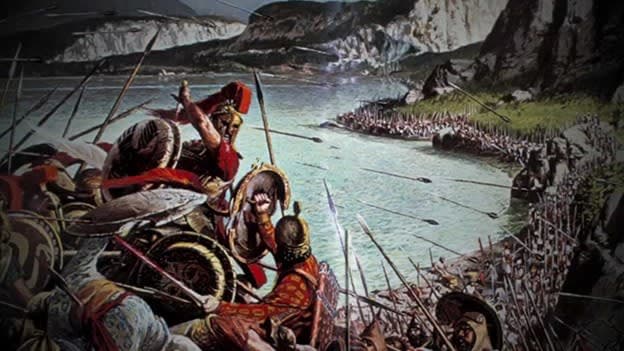
In mid-August the Persian army reached Thermopylae. The Greeks encamped behind a wall blocking the pass. When Xerxes demanded they lay down their arms, Leonidas, according to legend, replied: “Come and take them.” For the first two days the Persians, despite rotating their troops, could not break the Greek phalanx. The Spartans skillfully used feigned retreats to draw the Persians in and then counterattacked their disordered ranks. Persian losses were heavy, while the Greeks suffered only minimal casualties.


On the third day a local man, Ephialtes, came to Xerxes and, for money, showed him the mountain path around the Greek position. For his treachery he was despised throughout Greece. Xerxes immediately sent a 20,000-strong detachment under Hydarnes the Younger on the flanking route. The Phocians guarding the path were surprised but managed to withdraw to a hilltop.
When word reached Leonidas that Persians were coming up in the rear, he called a council. Part of the Greek force chose to withdraw, but Leonidas and his Spartans—along with 700 Thespians and 400 Thebans—stayed. According to Herodotus, Leonidas himself ordered the others to depart to save themselves, since the fight had become hopeless. Remaining to die in battle was a matter of honor.
Knowing victory was impossible, the Greeks accepted a last stand. Spartans and Thespians fought with extraordinary courage. King Leonidas fell in the fighting, as did two of Xerxes’ brothers—evidence of the battle’s fury. When the Persians led by Ephialtes appeared in the rear, the surviving Greeks withdrew to a small hill where, surrounded on all sides, they fought to the end. The Thebans surrendered to save their lives and were punished—branded as a mark of disgrace.
Up to 20,000 Persians and about 4,000 Greeks fell on the field. Xerxes, finding Leonidas’ body, ordered his head cut off and mounted on a stake. The fallen Greeks were buried on the same hill. Their grave bore the famous epitaph of the poet Simonides: “Stranger, go tell the citizens of Lacedaemon that, obedient to their commands, here we lie.” The Spartan warrior Aristodemus, whom Leonidas had sent home due to illness, survived but was branded a coward and lived in shame—though in the later Battle of Plataea he fought bravely and died seeking to atone.
Despite ending in a tactical defeat, the Battle of Thermopylae became a supreme symbol of courage and self-sacrifice. It bought the Greeks time to evacuate and prepare for the decisive battles to come and demonstrated that the massive Persian army was vulnerable. This heroic stand inspired continued resistance and ultimately contributed to Greek victory.


