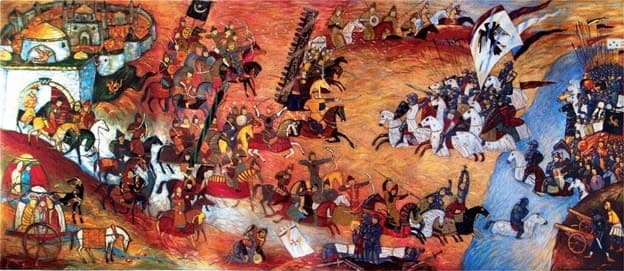

By the late 14th century, the Golden Horde was in a deep crisis. Its finest warriors had fallen in battles against the forces of Timur (Tamerlane), who dealt Khan Tokhtamysh two crushing defeats on the Kondurcha and Terek rivers. As a result, the Horde’s economy lay in ruins and its manpower was exhausted. The khan’s authority was undermined not only in the Rus’ lands but even in the core nomadic uluses.

In 1396, after yet another defeat, Tokhtamysh fled to the Grand Duchy of Lithuania and appealed to Grand Duke Vytautas for aid, promising in return to renounce his suzerainty over the Russian principalities in favor of Lithuania.
Vytautas an ambitious and far-sighted ruler saw a unique opportunity. In Tokhtamysh he found an instrument for an expansionist policy that might make him the ruler of all the Russian lands. He settled Tokhtamysh and his followers in Lithuania and then proclaimed a “Crusade against the Tatars,” receiving the blessing of Pope Boniface IX. In essence, this campaign was Vytautas’s bid to obtain a royal crown and elevate his prestige.

In the summer of 1399, Vytautas assembled a vast coalition army of about 38,000 men: roughly 10,000 Lithuanian and Rus’ nobles from the Grand Duchy of Lithuania; 4,000 Polish knights led by Spytko of Melsztyn; 1,600 Teutonic Knights; 1,500 Moldavian troops; and up to 15,000 Tatars loyal to Tokhtamysh. Vytautas’s army took up position on the Vorskla River—an unfortunate choice, since in the event of defeat the river at their backs could become a deadly trap.
Meanwhile their opponents, Khan Timur-Qutlug, who ruled in Sarai, and the powerful Golden Horde emir Edigu, gathered their forces. Edigu, whose army consisted mainly of Nogais, persuaded the khan to abandon negotiations and prepare for a decisive battle.
The clash occurred on 12 August. Edigu employed the classic Tatar tactic of a feigned retreat. After a duel that ended in victory for a Lithuanian knight, Vytautas’s troops began crossing the river. The Nogais fell back, luring the enemy onto open ground. Forgetting caution, Vytautas hurled his heavy cavalry in pursuit.
After running 10–12 kilometers, the Tatars suddenly wheeled about and struck a frontal blow. At the same time, a previously concealed cavalry force hit from the flanks and rear, cutting the Lithuanian knights off from their infantry. The heavily armored horsemen, their mounts exhausted, were almost helpless. The artillery Vytautas had brought proved ineffective against mobile mounted archers.
Vytautas’s army was utterly routed. Tokhtamysh’s troops were the first to flee the field. Vytautas himself was wounded and escaped with great difficulty. The Tatars pursued the fugitives as far as Kyiv, seizing the entire baggage train, the artillery, and numerous prisoners. Kyiv was forced to pay a huge ransom.
The defeat on the Vorskla shattered Vytautas’s ambitious plans to unite the Russian lands under his rule. Tokhtamysh finally lost political influence and, in 1406, was killed in one of his battles with Edigu.
Even so, the long-term consequences were not catastrophic for the Grand Duchy of Lithuania. Vytautas learned from the setback. In 1410, in alliance with Poland and with a Tatar contingent commanded by Jalal ad-Din (Tokhtamysh’s son), he crushed the Teutonic Order at the Battle of Grunwald—possibly employing the same tactic of feigned retreat.



