
In the first half of the thirteenth century, tension reigned in northern Europe. The various tribes inhabiting these lands were in constant conflict yet at times joined forces for raids. The Swedes sought to expand their influence, convert pagan tribes to Catholicism, and secure their borders against raids. History, however, knew the reverse as well: in 1187, Karelian and Finnish tribes together with Novgorodian troops burned the old Swedish capital of Sigtuna.
At the heart of this confrontation was the territory along the Neva River. The Neva linked the Baltic Sea with Lake Ladoga, opening the way into the heart of Novgorodian lands. Both sides Swedes and Novgorodians understood the region’s strategic importance and strove to establish complete control over it.
The conflict intensified in December 1237, when Pope Gregory IX proclaimed a second crusade in Finland. A year later, in June 1238, King Valdemar II of Denmark and Hermann von Balk, Master of the Livonian Order, agreed to joint actions against Rus’. At that time, the Rus principalities were gravely weakened by the Mongol invasion, which made them especially vulnerable to external aggression.

In the summer of 1240, Swedish ships entered the mouth of the Neva. According to the chronicles, their fleet included Norwegians and representatives of the Finno-Ugric tribes of the Sum and Yem. They landed at the place where the Izhora River flows into the Neva, set up camp, and planned to seize Ladoga and then Novgorod with all its lands.
Fortunately for Novgorod, a Novgorodian “sea watch” drawn from the Izhora tribe was operating along the shores of the Gulf of Finland. At dawn in July 1240, the elder Pelgusy was the first to spot the Swedish flotilla and immediately dispatched a messenger to Prince Aleksandr Yaroslavich.

Receiving the alarming news, the young prince decided to act at once, without waiting for help from his father. He gathered his small retinue, and along the way militia from Ladoga joined him. The force consisted mostly of mounted warriors, though there were also infantry who rode horses for speed.
Before setting out, the warriors assembled by custom at St. Sophia Cathedral and received the blessing of Archbishop Spyridon. Aleksandr inspired his men with a famous address, whose key phrase entered history: “God is not in might, but in truth!” These words became a symbol of faith in the justice of their cause.
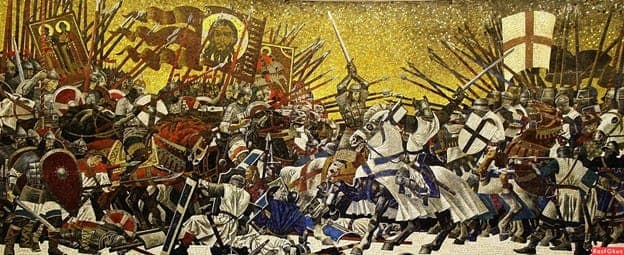
The battle began on 15 July 1240. The chronicle’s account of its course is brief. A fierce fight broke out immediately. According to “The Life of Alexander Nevsky,” the prince “left the mark of his sharp spear upon the king’s very face,” attesting to his personal courage and resolve.
The fighting continued until evening. The Swedes were defeated and, without waiting for dawn, withdrew. They loaded the bodies of their dead onto two ships and sent them out to sea, while the rest “whose number was beyond counting” were buried in a pit. The Russian historian A. N. Kirpichnikov believes the total number of Swedish dead may have been in the hundreds.
The Rus force also suffered losses, though not significant compared to the enemy. After the battle, Prince Aleksandr did not pursue the remnants of the Swedish army. This may have been dictated by the chivalric traditions of the time, by a reluctance to risk a force that had taken casualties, or simply by the desire to avoid further needless bloodshed.
The Battle of the Neva was an important victory that halted Sweden’s advance toward Ladoga and Novgorod and prevented coordinated action with the Livonian Order, which was already preparing its own offensive into Rus lands.
Yet despite the triumph, relations between the prince and the Novgorodian boyars again deteriorated. Fearing the growth of Aleksandr’s influence, they began to intrigue against him. In the end, the prince was forced to go to his father in Vladimir. But within a year the Novgorodians summoned him back, as a new threat loomed from the Livonian Order one that in 1242 culminated in the Battle on the Ice.



