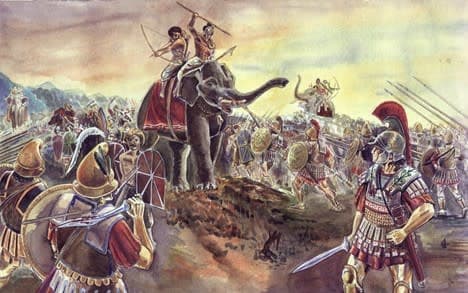
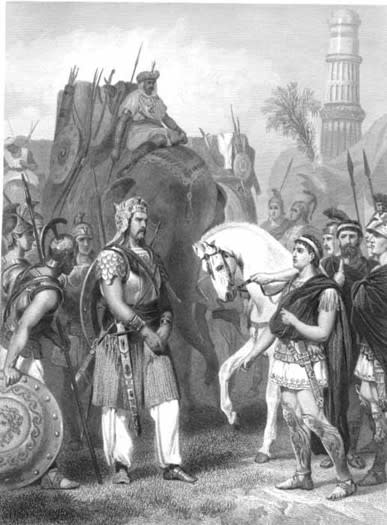
At first, the campaign through the lands of India resembled a triumphal march for Alexander: minor rulers, dazzled by the Macedonian’s glory or driven by the desire to strengthen themselves through alliance with him, surrendered their cities without a fight. However, in July 326 BC, on the banks of the Hydaspes River (the modern Jhelum River in Pakistan), Alexander encountered an opponent of an entirely different caliber. King Porus (or Puru-rava) had no intention of bargaining away his freedom. All the ancient authors describe him as a man of phenomenal stature — more than two meters tall, powerfully built, Porus upon his war elephant looked as natural as a horseman in the saddle. When Alexander’s envoy Cleochares demanded tribute and a meeting at the frontier, Porus replied with the dignity of a true ruler: he would meet the king at the border, but he would do so with arms in his hands.
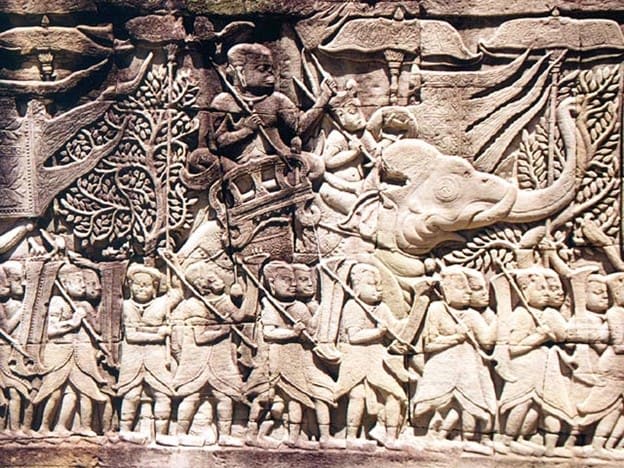
Porus’s army was formidable. Although the figures given by ancient historians differ, modern researchers tend to believe that he commanded:
Infantry: from 30,000 to 50,000 warriors, armed with enormous bows, heavy arrows, and clubs.
Cavalry: about 3,000–4,000 horsemen.
Chariots: around 300 heavy quadrigas, each carrying six men (archers, shield-bearers, and drivers).
Elephants: the chief “hallmark” of India — from 130 to 200 war elephants. These “tanks of antiquity” were surrounded by light infantry to protect their vulnerable points.
Alexander had comparable forces: about 8,000–10,000 cavalry and 25,000–30,000 infantry, including 5,000 Indian allies sent by the king of Taxila. But the main problem was not numbers — it was the river itself, about 700 meters wide, with a swift current and a terrifying line of elephants on the opposite bank.
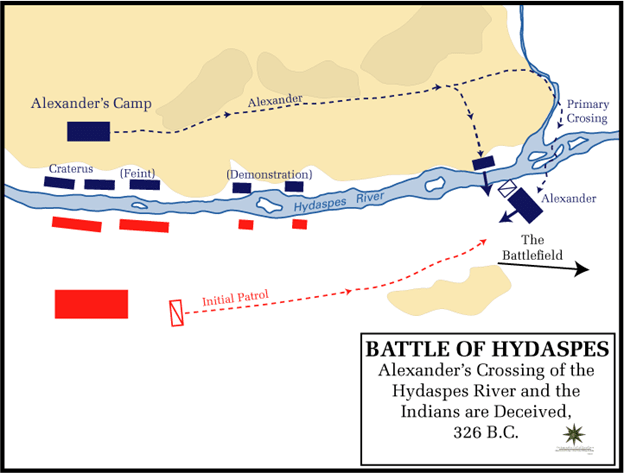
Alexander understood that a frontal crossing under the tusks of the elephants would end in catastrophe. A subtle psychological game began. The Macedonians spread detachments along the bank, simulating attempts to cross at different points, until the Indians grew accustomed to the constant maneuvers and stopped reacting to them. Alexander even spread the rumor that he would wait for the water level to drop so that he could ford the river.
When Porus’s vigilance had finally dulled, Alexander divided his army into three parts:
Craterus’s group: about 10,000 men remained in the main camp directly opposite Porus, to hold his attention.
The middle group: another 10,000 men were stationed 12 km from the camp with orders to begin crossing once the battle was already underway.
The striking force: Alexander himself, with 5,000 cavalry (including the elite Companions) and 6,000 picked infantry, made a concealed movement 25 km upstream under cover of a wooded hill.
At night, under heavy rain and thunder that masked the noise, the crossing began. By morning, when the storm had subsided, the Macedonians had unexpectedly appeared on the Indian bank. A navigational error forced them first to land on an island and then to ford the remaining branch of the river, but the effect of surprise had been achieved.
The first to rush to intercept Alexander was Porus’s son, with 2,000 horsemen and 120 chariots. A brief but fierce clash followed. The Indian chariots, bogged down in the mud after the night’s downpour, became easy prey. The Macedonian cavalry virtually wiped this force off the face of the earth: 400 killed, all the chariots captured, and the young prince himself fell in battle.
When Porus learned of his son’s death, he advanced with his main forces. His formation was classic for India: a wall of elephants in the center, infantry behind them, and cavalry and chariots on the flanks. Alexander, true to his style, did not launch a frontal assault against the elephants. Instead, he directed a powerful cavalry strike against the Indian left flank, while the commander Coenus moved around the right flank.
When the elephants charged the Macedonian horsemen, the latter skillfully evaded the unwieldy giants, showering them with javelins. The main burden of the fighting fell upon the Macedonian phalanx. The battle turned into a monstrous melee. Wounded and maddened by pain, the elephants ceased to distinguish friend from foe, trampling the Indian infantry that had sought protection behind them. Arrian describes it as chaos: the Macedonians, having room to maneuver, advanced and withdrew, while the Indians, trapped among their own animals, died by the thousands.
After eight hours of slaughter, the Indian army had turned into a scattered mob. Fresh detachments under Craterus, arriving late, completed the rout. King Porus, wounded but unshaken, remained upon his elephant to the last, until he was persuaded to surrender.
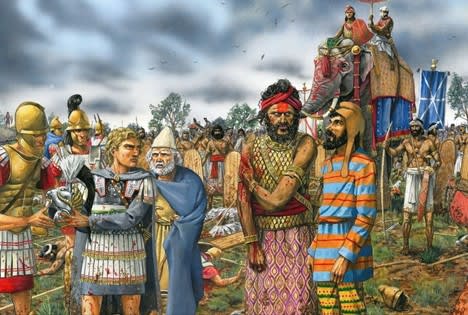
The dialogue between the two kings entered the annals of world history. When Alexander asked Porus how he wished to be treated, Porus replied: “Like a king.” Admiring such courage, Alexander not only spared his life and throne, but significantly enlarged his dominions. Yet the price of victory was high: the Indians lost up to 20,000 infantrymen and 3,000 cavalry. The Macedonians, according to various accounts, lost from 300 to 1,000 men, which for them was a very tangible loss.
The Battle of the Hydaspes became the last great triumph of Alexander the Great. Founding on the site of the battle the cities of Nicaea and Bucephala (in honor of his fallen horse), he marched on toward the Ganges. But it was here, after first confronting the organized power of war elephants, that the Macedonian army finally began to break. Hearing of even greater masses of elephants deeper within India, the exhausted soldiers refused to march farther. The great campaign ended not because of defeat by an enemy, but because of the exhaustion of the victors. The Hydaspes became that limit beyond which not even the will of the man who dreamed of conquering the whole world could pass.


