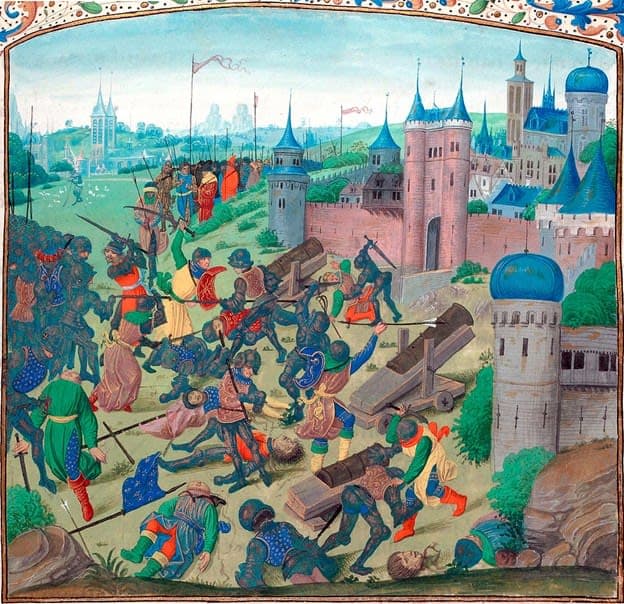

By the end of the 14th century, the tradition of crusades seemed to have faded, but the rising power of the Ottoman Empire in the Balkans forced Europe once more to think about defending the Christian world. After their victory at Kosovo in 1389, the Turks had all but pushed the Byzantine Empire to the brink, leaving it only Constantinople. In 1393 Nicopolis, the capital of the Bulgarian tsar Ivan Shishman, fell. His brother Ivan Sratsimir acknowledged Ottoman suzerainty, but for many independent Balkan rulers this became a call to arms.
Ottoman expansion now threatened the Kingdom of Hungary directly, and its ruler, King Sigismund, understood that without decisive action his country’s independence was at risk. The Venetian and Genoese republics also feared for their possessions and trade routes. Venice worried about losing the Morea and Dalmatia, which would undermine her influence in the Adriatic and Aegean. Genoa, for her part, saw a threat in Turkish control of the Danube and the Black Sea straits, which could end her trading monopoly with wealthy Black Sea colonies such as Caffa and Sinope.

In 1394 Pope Boniface IX proclaimed a new crusade. Though the call did not receive the sweeping response of earlier times, it won support from France and England, which had recently made peace. Burgundy, eager to enhance its prestige, played a special role in organizing the expedition. In August 1395 Sigismund’s envoys arrived in Paris to ask for help, speaking of a 40,000-strong Turkish army ravaging Christian lands. King Charles VI of France, who saw himself as responsible for the fate of the Christian world, responded enthusiastically, and the French nobility—fired by the constable Philippe d’Artois and Marshal Jean II Le Maingre “Boucicaut”—readily joined the campaign.

The exact numbers involved remain debated. Medieval chroniclers greatly inflated the figures to emphasize the event’s importance, speaking of 70,000 knights against 200,000 Ottomans. Modern historians, analyzing the sources, estimate that the crusading host numbered between 7,500 and 16,000 men, while the Ottoman forces counted 12,000 to 20,000, including a Serbian contingent under Stefan Lazarević.
The crusader army was a patchwork; its core was a Franco-Burgundian contingent of heavily armored cavalry. It also included Hungarians, Germans, Hospitallers, Poles, and Vlachs. The Franco-Burgundian knights proud and overconfident relied on elan and heavy cavalry, but their organization left much to be desired. Nominal command fell to the 24-year-old Duke John, and although experienced advisers such as Enguerrand VII de Coucy accompanied him, the young duke failed to grasp the need for unified leadership. The Hungarian army, by contrast, inherited ancient steppe traditions and included both heavy and light cavalry.

The Turkish and Serbian troops were marked by iron discipline and obedience. The Ottomans’ main strength lay in their cavalry: feudal sipahis and light akıncı who knew the terrain intimately. The infantry consisted of azaps and the elite janissaries. On the Ottoman side fought the Serbian army of Prince (later Despot) Stefan Lazarević, composed of heavy cavalry and mercenaries who bought armor in Italy.

On April 30, 1396, the crusaders departed Dijon, and on September 25, 1396, on open ground near Nicopolis, the decisive battle was fought. That morning Sigismund proposed delaying the advance by two hours so scouts could study the Ottoman positions, but the French knights—especially Count Philippe d’Artois—haughtily rejected the plan. Believing the Hungarian king wanted to seize all the glory, they resolved to attack on their own.
The French cavalry, led by Philippe d’Artois, charged first. Despite a hail of arrows and rows of sharpened wooden stakes that ripped horses’ bellies, the knights shattered the first Ottoman infantry line and sent it fleeing. Naively assuming they had routed the enemy’s main force, the young knights ignored seasoned commanders’ pleas to halt and regroup, and pressed on.
Upon reaching the plateau, instead of fleeing Turks they found fresh sipahi reserves that Bayezid had held back. To the blare of trumpets and drums, the Ottoman cavalry hurled itself at the exhausted knights, many now fighting on foot. The French were crushed. Repeatedly wounded, Admiral Jean de Vienne died heroically trying to rally his countrymen. The last knights were spared only because the Turks, eyeing rich ransoms, took them prisoner.
After the French collapse, Sigismund led his troops forward to aid them, but the decisive blow came from 1,500 Serbian knights under Stefan Lazarević, who struck the Hungarian flank. Sigismund’s army was routed. The king himself escaped by fleeing in a fishing boat to Venetian ships on the Danube.

The Battle of Nicopolis was a crushing defeat for the crusaders. On Bayezid’s orders, most captured knights were beheaded; only about 300 of the highest rank were kept alive for ransom. The Turks, for their part, consolidated their grip on the Balkans, becoming an even greater threat to Central Europe. Bulgaria finally lost its independence and remained a province of the Ottoman Empire until 1878.


