
At the start of the 16th century the Kingdom of Hungary was in deep decline. Internal feuds among magnates, peasant uprisings, and resistance by national minorities weakened it, while from without it faced Habsburg attempts to absorb its lands and constant Ottoman pressure. After the death of King Matthias Corvinus in 1490, anarchy set in.

Although the peace of 1503 briefly preserved Hungary’s possessions, the state—ever weaker—could not withstand the growing power of the Ottomans under the new sultan Suleiman I.

In the summer of 1526 Suleiman’s army—50,000–100,000 men with 160–300 guns by various estimates—marched from Istanbul and reached Hungary’s border by late August. King Louis II assembled only about 25,000 men with 80 guns. He hoped for the arrival of Transylvanian prince János (John) Zápolya and Croatian cavalry, but they never came.
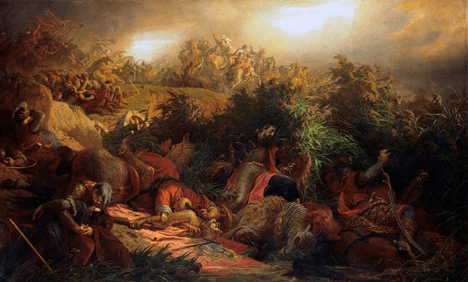
The battle was fought on 29 August on the plain near Mohács, on the right bank of the Danube. The Hungarian plan called for a cavalry attack supported by artillery. It opened with a successful charge against the Ottoman right. The Turks then feigned a retreat, luring the Hungarians into a trap; as the knights pressed on, they were raked by intense artillery and musket fire, and the attack stalled.
Ottoman reserves—backed by overwhelming numbers—entered the fight and drove the Hungarians toward the Danube, depriving them of any orderly withdrawal. In barely ninety minutes the battle ended in a complete Ottoman victory. About 15,000 Christians, including King Louis II and all senior commanders, were killed; the king’s body was found only two months later. The Hungarian army was annihilated, and within two weeks the Ottomans took Buda, the capital.


The victory at Mohács had catastrophic consequences for Hungary. The realm was effectively split: the central lands became Ottoman Hungary, while the western and northern regions with a new capital at Pozsony (today Bratislava) were annexed by the Austrian Habsburgs as a buffer zone.
For South Slavic peoples this meant a tightening of Ottoman rule that would last nearly two centuries. Yet, despite the tragedy, the Ottomans encountered in Hungary a socio-political order though weakened bearing strong Western European influences, unlike the Balkan states they had subdued more easily. Some Hungarian peasants, resentful of local magnates, initially welcomed the Ottomans as liberators; a few even converted to Islam and rose to careers within the Ottoman Empire.


