
In the 15th century the Middle East saw wars between the Ottoman Empire and the Mamluk Sultanate. Both powers sought control over buffer zones, especially the Ramazanoğulları and Dulkadiroğulları beyliks in northern Syria. Conflicts flared periodically, but in 1491 the first Ottoman–Mamluk war ended with a division of spheres of influence, and peace held through the end of Sultan Bayezid II’s reign.
In 1512, however, his son Selim I far more warlike came to the Ottoman throne. He launched an energetic expansion and, first of all, crushed his chief rival, the Safavid shah Ismail I, at Chaldiran in 1514. Selim then decided to punish his own grandfather, the Dulkadirid bey Ala’üddevle Bozkurt, who had refused to aid him against the Safavids and even attacked Ottoman supply trains. Selim defeated him at Turnadağ and sent the severed heads of the bey and his sons to the Mamluk sultan Qansuh al-Ghawri in Cairo a gesture the Mamluks took as a direct challenge.

War became inevitable. Qansuh al-Ghawri began large-scale preparations for an Ottoman invasion, assembling forces in Syria. Selim, for his part, marched his army out of Constantinople toward Syria, demanding the sultan’s submission. When Selim’s envoys were insulted and imprisoned by Qansuh, war was formally declared.

On 18 May 1516 Qansuh al-Ghawri left Cairo at the head of a huge army—well equipped but with very little firearms. Along the way Syrian and Bedouin contingents joined him. In Aleppo, the local governor Khayr Beg, already in secret contact with the Ottomans, quietly threw in his lot with Selim.
On 5 August 1516 the Ottoman army invaded Syria. On 24 August the armies met on the plain of Marj Dābiq north of Aleppo. The forces were roughly comparable in size—about 60,000 to 80,000 men on each side.
The Ottoman center, commanded by Selim I himself and Grand Vizier Sinan Pasha, was shielded by 300 wagons chained together. Behind this barrier stood 12,000 Janissaries with matchlocks and the artillery crews. The Mamluk army, by contrast, consisted of brave but technologically outdated heavy cavalry, with no effective answer to firearms.
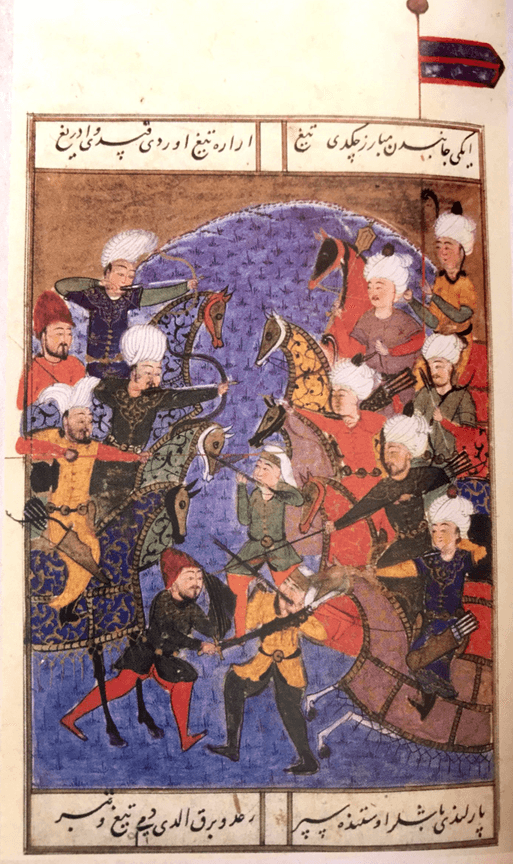
The battle opened with fierce Mamluk cavalry charges that inflicted heavy losses on the Ottoman ranks; at one point Selim even considered retreat. But the onrushing Mamluks were met by devastating volleys from Janissary muskets and Ottoman guns. Firing from behind the wagon line, the Ottomans methodically cut down the charging horsemen and denied them any breakthrough. In the midst of the fight, governor Khayr Beg and his contingent quit the field and went over to Selim. This demoralized the Mamluk troops and triggered a panicked rout. Sultan Qansuh al-Ghawri, about eighty years old, remained on the field with his guard; he fell while attempting to escape, and his severed head was later brought to Selim.
The Mamluk Sultanate was shattered: its commanders were killed or defected. Selim I entered Aleppo in triumph and then Damascus, where he was welcomed as a liberator from Mamluk misrule.
This victory opened the road to Egypt. Seizing Qansuh al-Ghawri’s treasury deprived the new Mamluk sultan, Tuman Bay II, of the means to raise another army, and Egypt itself soon fell to the Ottomans.



