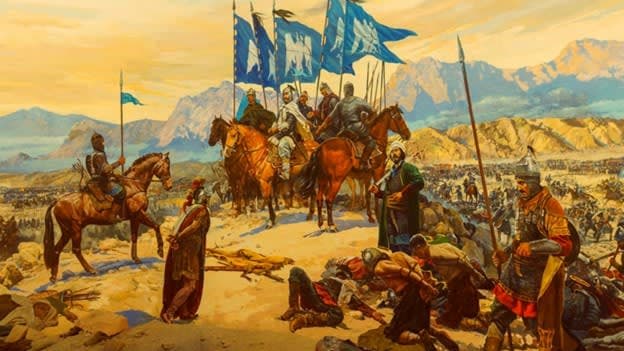

The first clashes between the Byzantine Empire and the Seljuks began back in the 1060s. In 1064 the Seljuks seized the city of Ani, and their detachments penetrated deep into Asia Minor, reaching as far as Iconium and Chonae. At that time the Seljuk sultan Alp Arslan was occupied with campaigns against Egypt and Syria and avoided a full-scale war with Byzantium. However, after the death of the Byzantine emperor Constantine X, uncontrolled Seljuk bands began to threaten Caesarea and Antioch.

Emperor Romanos IV Diogenes, who ascended the throne in 1068, took decisive measures to stop the Seljuk advance. He managed to assemble a battle-ready army quickly, despite his predecessors having weakened and demoralized the Byzantine forces. During the 1068 campaign his army took Manbij and defeated a Seljuk detachment near Cappadocian Larissa.

In the emperor’s absence—he had to return to Europe because of the threat posed by the Norman Robert Guiscard in Italy—the Turks defeated the Byzantine army under Manuel Komnenos and captured the key fortress of Manzikert. On his return, Romanos Diogenes led a 100,000-strong army to recover the lost lands.
By various estimates the Byzantine army numbered from 40,000 to 70,000. It included 10,000 Byzantine soldiers from the western and eastern provinces; 500 Frankish and Norman mercenaries under Roussel de Bailleul; bands of Oghuz and Pecheneg mercenaries; troops from Bulgaria, Georgia, and Armenia; and part of the famous Varangian Guard. Romanos was accompanied by his rival Andronikos Doukas, which proved a fatal mistake. Meanwhile Sultan Alp Arslan assembled 30,000 Turkic horsemen and allies from Aleppo and Mosul.
In August 1071 the Byzantine army reached Lake Van and retook Manzikert. On August 25 Romanos Diogenes’ forces advanced on the Seljuk positions, arrayed in a crescent. During the battle Seljuk archers inflicted severe damage on the Byzantine flanks, while the Turkish center slowly fell back, luring the enemy on.
When Romanos ordered the right wing to cover the withdrawal, his command was misinterpreted. At this critical moment the reserve commander, Andronikos Doukas, not only failed to render aid but spread rumors that the emperor had been killed, then rapidly withdrew with his part of the army. Panic and disorganization swept the Byzantine ranks.
The Byzantine right wing collapsed, and the Oghuz and Pecheneg contingents went over to the Seljuks. The surrounded remnants of the center—including the emperor and his guard—were crushed. Romanos IV was wounded and captured. He remained a prisoner of Alp Arslan for a week until he agreed to a ransom of 1.5 million gold pieces and annual payments of 360,000, as well as the marriage of his daughter to the sultan’s son.
The defeat at Manzikert had catastrophic consequences for the Byzantine Empire. While Romanos was in captivity, his stepson Michael VII Doukas was crowned in Constantinople. After Romanos’ return he was tricked into abdicating. In 1072 he was besieged in Adana and, after surrendering to Andronikos Doukas, was blinded. Romanos IV soon died of his wounds.
The Battle of Manzikert led to Byzantium’s final loss of Armenia and the eastern territories of Asia Minor. The Seljuk victory opened the way for the nomadic Oghuz and Turkmen tribes into the heart of the peninsula. Over the next ten years almost all of Asia Minor fell under Turkish control, leading to the formation of the Sultanate of Iconium (Rum).



