
In the 1360s, the Grand Principality of Moscow under Dmitry Ivanovich was rapidly gaining strength in northeastern Rus’, while the power of the Golden Horde was coalescing under the beglerbeg Mamai. Mamai’s rise was aided in part by the successes of the Russian princes against his rivals: in 1365 they defeated Tagai near the Shishevsky Forest, and in 1367 they beat Bulat-Timur on the P’yana River. A campaign to the middle Volga in 1370 likewise contributed to the Horde’s consolidation under Mamai.
The turning point in Moscow–Horde relations came in 1371. Mamai transferred the yarlik (patent) for the grand princely throne of Vladimir to Mikhail Aleksandrovich of Tver, seeking to weaken Moscow. In response Dmitry Ivanovich made a decisive statement to Mamai’s envoy Achihozha: “I will not go for the yarlik; I will not let Prince Mikhail rule in the land of Vladimir; and for you, envoy, the road is clear.” This challenge marked an open break with the Horde. Escalation continued in 1374 and 1375, when in Nizhny Novgorod the prince ordered Mamai’s envoys slain—headed by the murza Sarayka, who was then killed while attempting to flee. In the spring of 1376 a Russian host under D. M. Bobrok-Volynsky invaded the middle Volga, levying tribute of 5,000 rubles on Mamai’s appointees.

In 1377 the khan of the Blue Horde, Arapsha—Mamai’s ally—devastated the Principality of Novosil and then, on the P’yana River, routed the Moscow–Suzdal host, which had failed to ready itself for battle. Nizhny Novgorod and the Ryazan principality were then ravaged. In 1378, however, Mamai suffered a crushing defeat on the Vozha River, where his army under Murza Begich was smashed by the Russians. Though Mamai again plundered Ryazan thereafter, his position on the lower Volga weakened as Tokhtamysh advanced.

At the same time Grand Duke Jogaila of Lithuania acted in alliance with Mamai against Moscow. In response, in 1374 Dmitry convened a council at Pereslavl-Zalessky to form an anti-Horde coalition. After the death of the Lithuanian duke Algirdas in 1377, a succession struggle broke out among his heirs; his sons Andrei and Dmitry Olgerdovich entered Moscow’s service, strengthening Dmitry Donskoy’s forces.
In 1380, Prince Dmitry learned—through the envoy Zakhar Tyutchev—of the alliance among Mamai, Jogaila, and Oleg of Ryazan. Couriers were immediately sent to muster troops, followed by two forward screens for reconnaissance. Intelligence on the alliance and the approximate timing of the invasion—autumn—was confirmed. According to the Life of Sergius of Radonezh (1417), Dmitry Ivanovich received a blessing for battle from St. Sergius of Radonezh, which had immense spiritual and symbolic significance.
The mustering of Russian forces was set for Kolomna on 15 August 1380. The core host set out from Moscow in three groupings: the grand prince’s own retinue; the regiments of his cousin Vladimir Andreyevich of Serpukhov; and the regiments of the princes of Beloozero. At Kolomna an initial battle array was formed: Dmitry took command of the Main (Bolshoi) Regiment; Vladimir Andreyevich with the men of Yaroslavl led the Right-Hand Regiment; and Gleb of Bryansk headed the Left-Hand Regiment. The Vanguard Regiment consisted of the men of Kolomna.
The formal casus belli was Dmitry’s refusal to raise tribute payments to their former level. Mamai counted on Dmitry not daring to lead his army south of the Oka, but the prince made a bold decision. On 26 August he swiftly crossed the Oka into Ryazan lands, moving toward the Don not by the shortest route but along a wide arc to avoid Jogaila. He ordered his men not to molest the Ryazans, so as not to provoke their prince, Oleg. En route to the Don, the regiments of the Lithuanian princes Andrei and Dmitry Olgerdovich joined the Russian host.
Estimates of troop strength remain debated. Russian chronicles give grossly inflated figures of 100,000–400,000. Modern historians, based on mobilization potential and logistics, reckon the Russian army at roughly 20–30 thousand warriors. Mamai’s host—composed not only of Tatars but also of mercenaries such as Genoese, Circassians, and Alans (Asi)—is estimated at 30–50 thousand.
To preclude retreat and force Mamai to a decisive battle before his allies could arrive, the Russians crossed to the right bank of the Don and destroyed the bridges behind them. On the evening of 7 September the Russians formed their battle lines: the Main Regiment in the center; the Right-Hand Regiment under Andrei Olgerdovich; and the Left-Hand Regiment. Ahead stood the Screen (Advance) Regiment, while in an oak grove upstream on the Don an Ambush Regiment was hidden under Vladimir Andreyevich and Dmitry Bobrok-Volynsky.
The morning of 8 September was foggy. The battle began around noon with the legendary single combat between the monk Alexander Peresvet and the Tatar champion Chelubey, in which both fell.


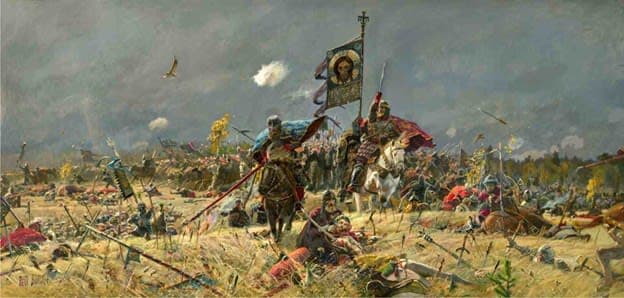
Mamai directed his main blow at the Russian Left-Hand Regiment, which failed to withstand the onslaught and began to fall back toward the Nepryadva River. At this critical moment, as the Horde’s cavalry, pursuing the retreat, exposed its rear, Voivode Bobrok ordered the Ambush Regiment into action. The sudden strike of the cavalry from ambush into the enemy rear proved decisive. The Tatar horsemen were driven into the river and utterly routed. Viewing the battle from a hill, Mamai fled with a small escort as soon as he saw the ambush strike.
The Russians pursued the retreating Tatars for fifty versts to the Krasivaya Mecha (“Beautiful Sword”) River. After the battle, the dead were buried over several days, 9–16 September. The body of the monk Alexander Peresvet was interred in the Church of the Nativity of the Most Holy Theotokos at Old Simonovo. For this great victory the people named Dmitry “Donskoy” (“of the Don”) and Vladimir “the Brave.” A legend holds that the prince received from the Cossacks an icon later known as the Don Icon of the Mother of God.
Despite the triumph, the victory on Kulikovo Field could not be consolidated by the complete destruction of the Horde. Dmitry refused to pay tribute, provoking Tokhtamysh’s counter-campaign against Moscow in 1382. The city was burned, and Dmitry was forced once again to acknowledge vassalage.
Even so, the Battle of Kulikovo had far-reaching political consequences. In 1389 Dmitry for the first time bequeathed the grand principality to his son Vasily I—without a khan’s yarlik. This was an important step toward independence. The Grand Principality of Vladimir thereafter became the hereditary possession of the Moscow princes, ending the internecine struggle for the grand princely seat and fostering the gradual unification of the Russian lands.


