After the Battle of Maritsa in 1371, the Ottoman Empire began expanding its influence across the Balkans. Subjugating towns along the Aegean coast and controlling key trade routes, the Turks advanced steadily. In 1383 they captured Serres, drawing close to Thessaloniki. Their strategy was subtle and shrewd: they meddled in the civil strife of Christian rulers, offered “assistance,” and then, once their allies were weakened, gradually absorbed their lands. The death of a local ruler or turmoil within his family became a convenient pretext for domination.


Ottoman detachments had been probing into the Balkans long before their state became a direct neighbor. They first appeared on the lands of Prince Lazar Hrebeljanović in 1381, but the prince’s voevoda Crep defeated them at Dubravnica. By 1386, however, Sultan Murad mounted a far more serious incursion, reaching Pločnik and even attacking the Gračanica Monastery.

The noose around Serbia drew tighter. In August 1388, exploiting King Tvrtko of Bosnia’s feud with the Balšić family, an Ottoman force under Şahin invaded near Bileća—but was defeated. The lands of Prince Lazar and Vuk Branković were effectively cut off from the broader Christian world by internal conflict in Hungary, where the Serbian rulers had backed Ladislaus of Naples.

Preparations for the Ottoman campaign against Serbia were known in advance. In early summer 1389 Sultan Murad led an army composed not only of Turks but also of troops from vassals and mercenaries. Marching through the lands of his Macedonian vassals, he reached the strategically vital Kosovo Field, which, as the Serbian Byzantinist Dimitrije Bogdanović observed, “is the key to all communications.”

Upon learning of the enemy’s approach, Prince Lazar and Vuk Branković mustered their forces. They were joined by a substantial Bosnian contingent under Vlatko Vuković, sent by King Tvrtko I. The exact size of the armies remains debated, but estimates place the Ottoman host at 27,000–40,000—janissaries, sipahis, and akıncı—while the allied army under Lazar was smaller, at 12,000–33,000 men.
Unlike the Ottomans, the Serbian army lacked a single unified command, being divided among three leaders—Lazar, Vuk Branković, and Vlatko Vuković. Its core was heavy cavalry, only lightly supported by infantry. The Ottoman army, by contrast, was seasoned by nearly three decades of victorious campaigning, while the Serbs had mostly fought one another in internal conflicts.
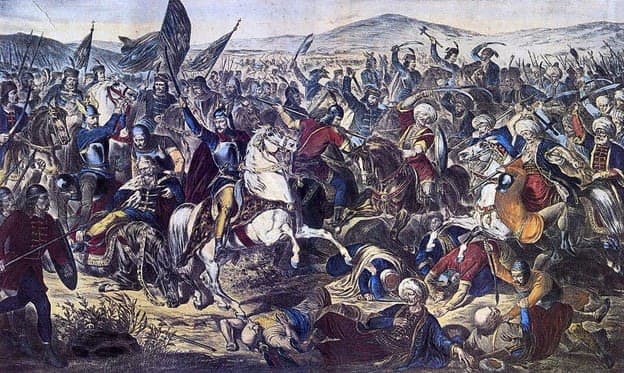
The battle took place on 15 June 1389 near Priština. The armies deployed with Sultan Murad in the Ottoman center and his sons Bayezid and Yakub on the flanks. Opposite them, Prince Lazar commanded the Serbian center, with Vuk Branković and Vlatko Vuković on the wings.


The fighting opened with Ottoman archers bombarding the Serbian positions, after which the Serbian heavy cavalry charged. Though they broke through the Ottoman left, they failed to exploit this success in the center and on the right. Ottoman light cavalry and infantry counterattacked, throwing back the mail-clad Serbian horsemen.
In the center the Serbs initially pushed the Ottomans back, but on the right Bayezid launched a counterstroke. The Serbian infantry line was pierced and began to give way. Seeing the hopelessness of the situation, Vuk Branković left the field—a move later condemned as treachery. The remnants of Vlatko Vuković’s and Lazar’s contingents withdrew after him. Lazar was wounded, captured, and executed that same day.

Sultan Murad was also killed, though the circumstances remain uncertain. According to the most famous version, the Serbian knight Miloš Obilić, feigning defection, entered the sultan’s tent and stabbed him to death. Other sources, including Ottoman ones, claim Murad was slain after the battle while surveying the field. Upon his death his son Bayezid became sultan and, tradition holds, ordered his brother Yakub strangled to remove a rival.

Despite the deaths of both rulers—and despite Bayezid’s immediate departure eastward rather than remaining in Serbia—the Battle of Kosovo proved fateful for Serbia. For months afterward, Europe did not know who had won. King Tvrtko I of Bosnia even informed the citizens of Trogir and Florence of a “great Christian victory,” and Murad’s death was taken in Byzantium as confirmation of that success.
In Serbia itself, however, the true meaning of the battle was understood at once. Prince Lazar fell, leaving as heir his underage son Stefan; with him, nearly the entire high nobility perished. Losses among the common soldiery were enormous. It became clear the country no longer had the strength to resist a renewed invasion.
Vuk Branković, on whose lands the battle had been fought, maintained power for a time, but eventually he too was forced to submit to the Turks. In 1390–1391 the remains of Prince Lazar were moved to the Ravanica Monastery, where they are preserved to this day.


