In the 13th century the Teutonic Order, having established itself in the Chełmno (Culm) Land, launched crusades against the pagan Prussian tribes. After subduing them, the Order turned its attention to the pagan Grand Duchy of Lithuania. Samogitia (Žemaitija) was of particular importance, as it separated the Order’s Prussian lands from its holdings in Livonia.
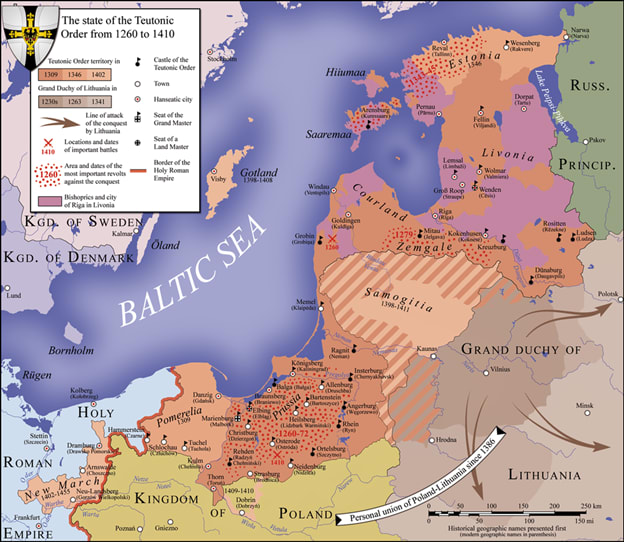

In 1385 the Union of Krewo was concluded, under which the Grand Duke of Lithuania Jogaila (Władysław II Jagiełło) married the Polish queen Jadwiga, accepted Christianity, and became king of Poland. Though formally head of both states, he handed real power in the Grand Duchy of Lithuania to his cousin Vytautas by the Ostrów Agreement of 1392. The Christianization of Lithuania deprived the Order of its formal pretext for aggression; nonetheless, territorial disputes especially over Samogitia and Danzig (Gdańsk) continued.

In May 1409 an anti-Teutonic rising broke out in Samogitia, supported by Poland and Lithuania. The Order’s Grand Master, Ulrich von Jungingen, declared war on both powers. A truce was concluded for several months, which the sides used to prepare for full-scale war. In December 1409 Jagiełło and Vytautas agreed on a joint strategy: their armies would unite and march on the Order’s capital, Marienburg (Malbork).
The exact sizes of the armies are unknown, but historians estimate about 39,000 on the Polish-Lithuanian side and about 27,000 on the Teutonic side, including roughly 250 knight-brothers.
The Teutonic army was made up of well-trained, disciplined heavy cavalry—among the best in Europe—comprising the knight-brothers and mercenaries from Germany, Austria, and France. It deployed in two battle lines, with a third held in reserve.
The Polish-Lithuanian host had two main components: Polish forces centered on knightly heavy cavalry, and Lithuanian forces centered on light cavalry. They were joined by Tatars under Jalal ad-Din, son of Tokhtamysh, as well as Rus’, Czech, and Moldavian contingents.
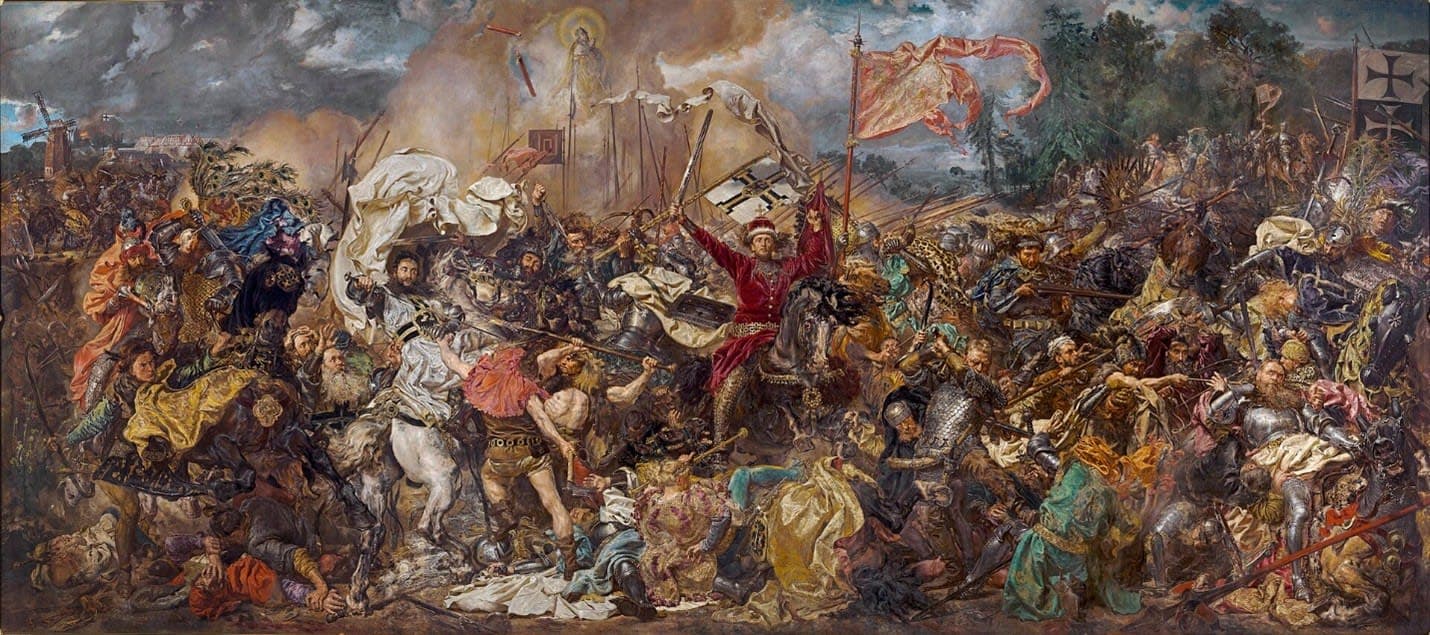
On the morning of 15 July 1410, the armies met on ground between the villages of Grünfelde (Grunwald) and Tannenberg. To provoke his opponents, Grand Master Ulrich von Jungingen sent Jagiełło and Vytautas two bared swords—an insult that became famous.


Without waiting for orders, Vytautas first hurled the Tatar and Lithuanian light cavalry into action. The Order’s heavy cavalry under Friedrich von Wallenrode counterattacked. To avoid being crushed, the Lithuanians employed the tactic of feigned retreat, borrowed from the Golden Horde. Some Teutonic knights, believing victory at hand, broke formation in a disorganized pursuit.
While the Lithuanians drew off part of the Order’s strength, a fierce fight raged on the other flank between the Polish and Teutonic forces. At the height of the struggle the Polish banner even fell, but it was immediately raised again, heartening the Poles. Seeing the Lithuanians in apparent retreat, Grand Master von Jungingen committed his last reserve. At that moment the remaining Lithuanian units—including the Smolensk regiment, which had fought bravely and had not withdrawn—returned to the field.
In the decisive advance, Lithuanians and Tatars enveloped the Order’s main forces from the flanks. The Teutonic army was surrounded. Nearly all the Order’s senior commanders fell, including the Grand Master himself. The Order lost about 8,000 killed and 14,000 captured.

Victory at Grunwald had enormous consequences. Although the allied armies failed to take Marienburg, the First Peace of Thorn (1411) significantly weakened the Order: it ceded Samogitia and the Dobrzyń Land and was forced to pay a huge indemnity.
The virtual destruction of its field army and the ensuing financial crisis undermined the Order’s power. Over the following decades it continued to lose territory and influence, and after the Thirteen Years’ War it ultimately acknowledged vassalage to Poland. In 1525 the last Grand Master, Albrecht (Albert) of Hohenzollern, embraced Protestantism and created the Duchy of Prussia, ending the Teutonic Order’s existence as a sovereign state.


