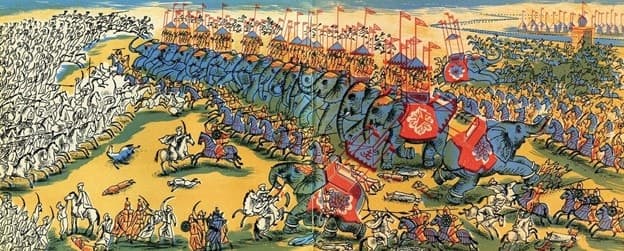
In the early 630s the young, ascendant Arab Empire began its invasion of the lands of powerful Sasanian Iran. Over several years the Arabs—despite setbacks such as the “Battle of the Bridge” in 634 dealt the Persians defeat after defeat. The Arab threat was clearly serious. Caliph ʿUmar, grasping the moment’s importance, mustered a levy of some thirty thousand men and placed one of the Prophet Muhammad’s most experienced companions, Saʿd ibn Abī Waqqāṣ, in command.


The Persian high command, for its part, also recognized the scale of the danger. The realm’s de facto ruler, the general Rostam Farrokhzād, assembled a vast army with levies from all the provinces and even war elephants and marched to meet the Arabs. The two armies encamped near al-Qādisiyyah and for months neither dared open battle. Rostam hoped for a negotiated peace, but when talks failed he chose to attack.

On the first day the Persian army crossed a canal and formed for battle, its center anchored by eighteen war elephants with archers in howdahs. The Arabs, unfamiliar with such beasts, were shaken, and their cavalry fell back under a hail of arrows. Saʿd steadied the line by committing his main forces. Warriors of the Tamīm tribe distinguished themselves, fearlessly rushing the elephants striking at their eyes and trunks and cutting the girths to topple the howdahs. Despite heavy losses, the Arabs threw the Persians back and forced them to withdraw.

On the second day an advance contingent of reinforcements from Syria under al-Qaʿqāʿ ibn ʿAmr reached the Arabs. They again prevailed in single combats, while the Persians struggled to bring their elephants into play because many howdahs had been damaged. The Arabs in turn used camel-mounted archers to frighten the Persian cavalry. By evening the Persians had suffered huge losses, though their infantry still held.
On the third day the Arabs employed a ruse: al-Qaʿqāʿ’s detachment, which had slipped out during the night, returned in small groups at dawn, creating the illusion of constant fresh reinforcements. The Persians managed to field their elephants again, but the assault broke when two lead beasts, blinded, wheeled about and trampled their own ranks. The fighting devolved into a general hand-to-hand melee that continued into the night.
At daybreak on the fourth day, with both sides spent, a gale sprang up, blowing sand into the Persians’ faces. The Arabs took this as a sign of divine aid, surged forward, and burst through the Persian center. Rostam was killed in the fighting, and his standard the symbol of Sasanian sovereignty was seized. Demoralized by their commander’s death, the Persian army broke. Many were cut down, and those chained together could not flee and were slaughtered.
Despite immense losses, the Arabs won a complete and unequivocal victory. The Battle of al-Qādisiyyah proved the turning point of the war: the largest Persian host was destroyed, sealing the fate of the Sasanian state, which the Arabs conquered in the following years. The victory opened the road of Islam into Persia and became one of the signal triumphs of the early caliphs.


