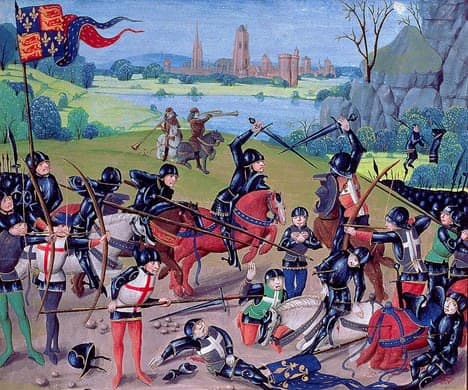

The English king Henry V invaded France, laying claim to the French throne and to the restoration of the Duchy of Normandy. His army—about 4,000 strong—landed at the mouth of the Seine on August 13, 1415, and besieged the port of Harfleur, which capitulated only on September 22 after a long and exhausting siege.
Having lost a significant portion of his forces to disease, Henry V decided to withdraw to the English stronghold of Calais. He directed his weakened army—by then about 2,800 men—northward. Meanwhile, the French nobility gathered a large force at Rouen and began to pursue him, aiming to block the English at the River Somme. After the English succeeded in crossing the river, they encountered the French army on October 24 near the village of Agincourt. The English were worn out and suffering from illness, but Henry V understood that he had to fight in order to break through to Calais. Confident of victory because of their overwhelming numerical superiority, the French preferred to wait for the following morning.


The French army was much larger than the English, though exact figures are unknown. Various sources estimate its size between 3,000 and 40,000, implying a four- to sixfold advantage over the English. The core of the French host consisted of heavy cavalry and dismounted men-at-arms, along with poorly trained infantry made up of peasants and mercenaries. The battle plan drawn up by Marshal Boucicaut and Constable Charles d’Albret called for an assault by dismounted men-at-arms on the English positions. However, owing to chivalric notions of honor, the archers and crossbowmen were placed behind the main line, rendering them ineffective. The French drew up in a dense column, and the narrow ground between woods and marshes hampered their movement.
The English army consisted of professionals, the majority being longbowmen. King Henry V deployed his forces defensively, making use of the terrain. His troops held a narrow front about 700 meters wide. Archers were positioned on the flanks, and to protect against cavalry they drove rows of wooden stakes into the ground. This tactic proved decisive.
On the morning of October 25, the French, despite their numerical advantage, remained inactive for three hours, allowing Henry V to advance his line to a more favorable position. The English archers opened the battle, raining arrows down upon the French. The French cavalry, mired in the ploughed field’s mud, could not mount an effective charge; wounded horses knocked down their own men-at-arms. The dismounted knights, exhausted by slogging through the clinging mud, came to hand-to-hand combat already spent and were unable to fight effectively. Lightly equipped English archers and infantry, armed with war hammers and knives, held the advantage over the unwieldy French men-at-arms.


At the height of the fighting, a detachment of French peasants led by a local seigneur attacked the English baggage train, where the king’s personal valuables were kept. Fearing a strike from the rear and a possible uprising among the many prisoners, Henry V ordered all captured men-at-arms killed. His knights refused prisoners were a valuable source of ransom so 200 archers carried out the order. This brutal episode led to the deaths of most of the lesser French captives.
French losses were catastrophic. Though exact numbers vary, most sources indicate 4,000–10,000 French dead, and only a few hundred on the English side. Among the French slain were three dukes, eight counts, and all the senior commanders, including the constable Charles d’Albret. The English lost about 112 men, including Edward, Duke of York.
Despite the sweeping victory, Henry V returned to England to rebuild his forces. The destruction of France’s military leadership and nobility, however, allowed him to launch a new, more successful campaign in 1417. Under the Treaty of Troyes in 1420, Henry V was recognized as regent and heir to the French throne. He married Catherine of Valois, the French king’s daughter, which appeared to strengthen his claim to the crown of France though he never lived to wear it.


