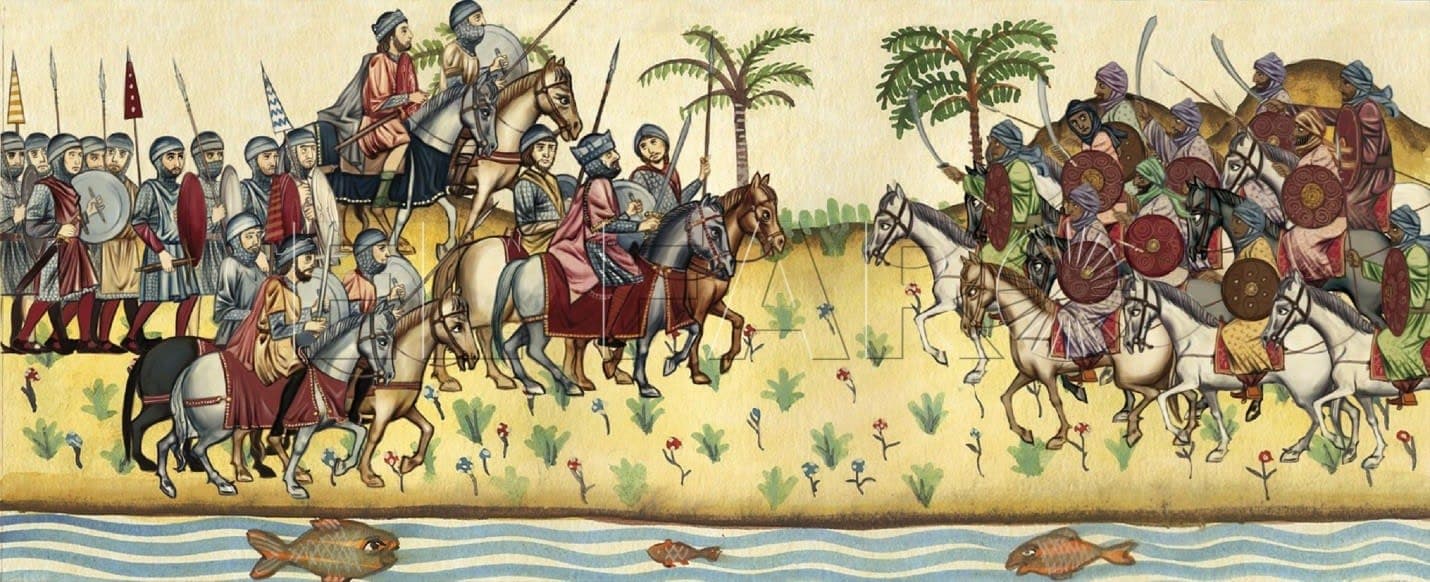

At the outset, the Arab rulers of the Maghreb did not plan a full-scale conquest. The troops led by the Berber commander Ṭāriq ibn Ziyād, who landed in Iberia on April 27, 711, most likely aimed to carry out another large-scale raiding expedition. This view is supported by the fact that Ṭāriq’s vessels resembled merchant ships, and the locals, fearing a pirate raid, fled into the hills without attempting resistance.
The outcome of the decisive Battle of Guadalete in July 711 changed everything. King Roderic’s army, weakened by internal conflicts, suffered a crushing defeat, and the king himself was killed. The victory was so complete that it left the Visigoths without a leader and without organized resistance. The remaining Visigothic nobility took refuge in the fortress of Écija and soon surrendered. The resulting power vacuum allowed Ṭāriq and his Berber army—numbering 9,000—to advance rapidly into the interior of the peninsula.


Startled by Ṭāriq’s sudden success, the Arab governor of Ifriqiya, Mūsā ibn Nuṣayr, hastened to support him in order to secure the conquered territories for himself. In 713 Mūsā captured Mérida after a lengthy siege, and in 714 he moved north, reaching León and Palencia with virtually no resistance.

After the initial military campaign, the Arab rulers set about building a new administration. Unlike in some other conquests, they did not force the Christian population to adopt Islam. In Murcia, for example, the Visigothic commander Theodemir concluded a treaty with the Arabs that allowed him to establish an autonomous principality, which lasted into the 740s.
Such agreements—known as the “Treaty of Theodemir”—set a precedent for all Iberia. Cities that surrendered without a fight received special terms under which Christians could live by their own Visigothic laws (Forum Iudicum), retain property and their faith, but were obliged to pay the jizya (tax on non-Muslims). Cities taken by storm (for example, Córdoba and Toledo) were subjected to direct Umayyad rule.
The administrative foundations of the new state—soon called al-Andalus—were laid by Governor al-Ḥurr al-Thaqafī in 717. He dispatched officials to the cities and began collecting taxes, an important step toward centralized governance. By the 720s most of the Iberian Peninsula was under Arab and Berber control, marking the end point of their territorial expansion.
The Arab conquest brought profound social and cultural change. Arab settlers established themselves in the wealthy southern cities, while Berbers populated the less fertile interior. Many Christians, to avoid taxation and attain higher status, embraced Islam, becoming muwallads.
Despite the new order, al-Andalus was not a monolithic state. In 756 the independent Emirate of Córdoba was founded, the first step toward separation from the Umayyad Caliphate. In the north, in the Ebro valley, a semi-independent emirate of the Banū Qasī dynasty emerged by the late eighth century.
The conquests also spurred the consolidation of Christian resistance. In the northern regions, where the Muslims failed to entrench themselves, the movement of the Reconquista arose—an effort that would struggle for centuries to reclaim the peninsula.


