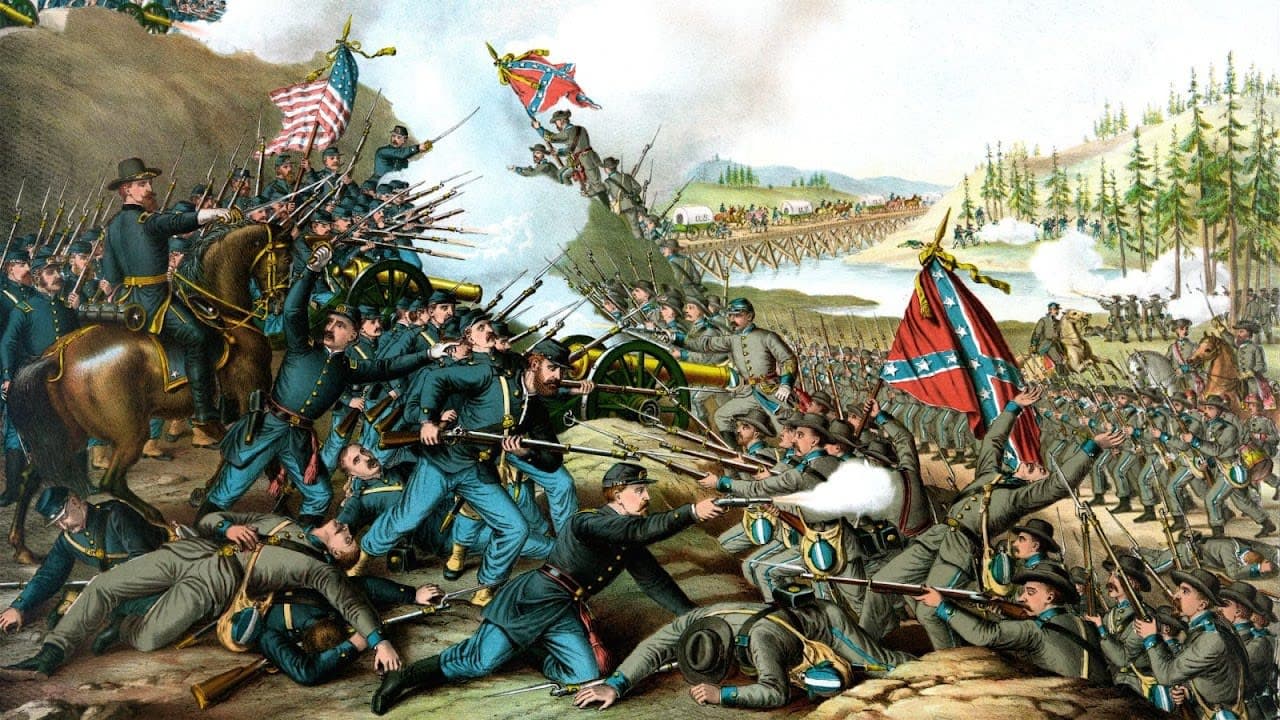
By the time the war began, the Northern states had become the stronghold of industrial progress. Life was bustling in machine-building and metalworking enterprises, while light industry demanded ever more labor. The demographic landscape of the North was shaped by powerful streams of immigrants from Europe, who found in the factories not only hard labor, but also hope for a new life. This ensured the region steady economic growth and a relatively high standard of living.


The South followed a different path. Thanks to the Louisiana Purchase of 1803 and the results of the Mexican-American War (1846–1848), the United States had acquired vast western territories. Fertile land and a favorable climate turned this region into an agrarian empire specializing in tobacco, rice, and, of course, cotton. Yet the Industrial Revolution largely passed the South by: European immigrants preferred free labor in the North, and plantation owners faced an acute shortage of workers. The solution, with catastrophic consequences, was the mass importation of Black slaves from Africa, a process that had begun as early as the seventeenth century. By the time the crisis began, slavery had become the backbone of the Southern states — a quarter of the region’s white population owned slaves, considering it the natural order of things.
For a long time, the North and the South coexisted in a forced harmony: Northern industrialists needed Southern raw materials, especially cotton, while planters needed Northern machinery. But the peace was illusory.
The conflict was maturing along four key lines, each of which by itself was sufficient cause for hostility:
Economic protectionism: The North demanded high import tariffs in order to protect its goods from European competition. The South, by contrast, sought duty-free trade with the entire world so that it could profitably sell cotton and cheaply buy equipment.
The question of sovereignty: Southerners, echoing the ideas of Robert Rhett, believed that the state was the highest form of authority to which a citizen owed loyalty. For them, the Union was merely a voluntary association of states. The North, on the other hand, sought centralization and the supremacy of federal law.
The land question in the West: The passage of the Homestead Act, which promised free land to settlers, was blocked by Southerners. They feared that western lands would be occupied by free farmers, depriving planters of the opportunity to expand their estates.
The most painful issue was slavery: Every admission of a new state sparked fierce disputes — would it be free or slaveholding?
The appearance of the Republican Party in 1854, committed to opposing the expansion of slavery, was a signal to action for the South. When the Republican Abraham Lincoln won the presidential election on November 6, 1860, Southern elites understood that their political dominance in Congress had come to an end.
South Carolina was the first to take the radical step, issuing an ordinance of secession from the Union on December 20, 1860. This triggered a chain reaction: during January 1861, Mississippi, Florida, Alabama, Georgia, and Louisiana joined it. Legally, Southerners relied on the fact that the Constitution contained no explicit prohibition against secession, although it contained no explicit permission either.


On February 4, 1861, the Provisional Confederate Congress convened and proclaimed the creation of the Confederate States of America. On February 18, Jefferson Davis became president of the new state, and on March 11 the Confederate Constitution was adopted. Texas soon joined the Confederacy, and after the historic battle for Fort Sumter and Lincoln’s call for mobilization, Virginia, Arkansas, Tennessee, and North Carolina also joined the rebellion. The capital was moved to Richmond.

The South now possessed 40 percent of U.S. territory and a population of 9.1 million people, including 3.6 million African Americans. Remarkably, Indian Territory also joined the Confederacy — the Five Tribes (Cherokee, Choctaw, Creek, Chickasaw, and Seminole) chose to support the slaveholders, partly because they themselves practiced slavery.
The North, which retained the name Union, possessed enormous advantages. Its population was 23 million, and it contained almost all of the country’s industry, 70 percent of its railroads, and 81 percent of its bank deposits. Taking advantage of the fact that Southerners had left Congress, the Republicans swiftly passed major laws that had previously been blocked: the Morrill Tariff, the Homestead Act, and the National Banking Act.
Yet the fate of the war was in many ways decided in the “border states,” where society was divided to the utmost:
Kentucky and Missouri: Chaos reigned there. Kentucky tried to declare an absurd neutrality, while Missouri effectively descended into its own internal civil war, preventing the state from taking a clear position.
Virginia: The western counties of the state categorically refused to secede from the Union. This led to a unique precedent — in June 1863, a new state, West Virginia, was separated from Virginia and admitted into the United States.
Maryland: Perhaps the most critical area. This state surrounded Washington, and its defection to the South would have meant the loss of the capital. Riots broke out in Baltimore, telegraph lines were cut, and on April 19, 1861, a mob attacked federal troops. Only the decisive actions of General Butler, who occupied Baltimore on May 13, and the deployment of troops succeeded in keeping Maryland in the Union.


Even within the North itself, unity was fragile. The election of 1864 showed that supporters of continuing the war had only a slight advantage: 2.2 million votes versus 1.8 million for those who wanted to recognize the South and end the bloodshed. The margin was only about 10 percent, underscoring the degree of tension in which the nation lived during those years.
At this stage, the country was completely divided, and ahead lay four long years of the bloodiest war in the history of the American continent.
Hostilities officially began in the predawn hours of April 12, 1861, when Confederate guns opened fire on Fort Sumter in Charleston Harbor. After a thirty-four-hour bombardment, the federal garrison was forced to surrender. This event instantly changed the political landscape: President Abraham Lincoln declared the Southern states to be in rebellion, proclaimed a naval blockade of the coastline, and issued a call for 75,000 volunteers. This decisive step forced the wavering states to choose — Virginia, North Carolina, and Tennessee finally went over to the South.
The initial enthusiasm of the volunteers who flooded recruitment centers quickly faded under the weight of military routine. Both sides had to resort to conscription: the South introduced it in April 1861, and the North in July. The Union army was significantly strengthened by immigrants: 177,000 Germans and 144,000 Irish fought under its banners. The first blood was spilled in the skirmish at Fairfax Court House on June 1, but the true test came in the Manassas campaign.
On July 21, 1861, the First Battle of Bull Run took place. Poorly trained federal forces attacked the Southerners, but the latter’s resilience and the timely arrival of reinforcements turned the Northern advance into a panicked flight back toward Washington. The defeat caused shock. To prevent the remaining slaveholding states from going over to the South, Congress adopted the Crittenden–Johnson Resolution, declaring that the war’s aim was the preservation of the Union, not the abolition of slavery. By autumn, George McClellan had assumed command of all Union armies; despite his brilliant training of the troops, he proved an extremely cautious and indecisive leader, as confirmed by the defeat at Ball’s Bluff in October. At the same time, a diplomatic crisis erupted at sea: the seizure of the British ship Trent carrying Southern envoys nearly dragged the United States into war with Great Britain.


One of the Union’s earliest strategic successes was the campaign in western Virginia. After Virginia officially seceded from the Union on May 23, federal troops under McClellan entered the western counties, where the local population sympathized with Washington. Consecutive victories at Philippi (June 3) and Rich Mountain (July 11) secured Northern control of the region. Even a counterstrike by the future-famous General Lee at Cheat Mountain in September failed to change the situation, and by December the western part of Virginia had been lost to the Confederacy.
The naval blockade became a slow strangulation for the South. The Confederacy, whose economy depended on cotton exports, lost 95 percent of its income — exports collapsed from 10 million bales to a mere 500,000. Attempts to run the blockade with fast ships brought profit to smugglers, but did not provide the army with all it needed. A major success for the federal navy was the capture of Port Royal Sound in November 1861, giving the Union a base on enemy territory. The South tried to respond with technical innovations: construction of ironclads began in the docks of captured Norfolk, while mines and ramming vessels were actively used on waterways.


On the Western Theater of war, 1862 began under the sign of Union initiative. General Ulysses Grant, through a series of energetic operations in February and April, pushed the Southerners out of Kentucky. The brutal Battle of Shiloh became a turning point, after which Tennessee was cleared of Confederate forces. At the same time, a cinematic episode occurred — the “Great Locomotive Chase” (April 12), when Northern saboteurs stole the locomotive General.
The capture of New Orleans on April 25, 1862, by David Farragut’s squadron was of enormous strategic importance. The loss of the largest port and shipbuilding center was a catastrophe for the South. The North gained a foothold in the lower Mississippi, which later allowed it to cut the Confederacy in two, depriving it of its most important transportation artery.


On the Eastern Front, events developed far less clearly. McClellan began the large-scale Peninsula Campaign, hoping to seize Richmond with the powerful blow of a 100,000-man army. However, the Southerners delayed him at Yorktown, and at the Battle of Seven Pines, after General Johnston was wounded, Robert Lee took command of Southern forces.
At the same time, in the Shenandoah Valley, General Thomas “Stonewall” Jackson conducted one of the most brilliant campaigns in the history of maneuver warfare. With only 5,000 soldiers, he confused and defeated three federal armies, preventing them from joining McClellan’s main force. After that, Jackson joined Lee in order to deliver a decisive strike.
During the Seven Days Battles (late June to early July), Lee attacked McClellan. Despite tactical Southern failures at Malvern Hill, McClellan fell into discouragement and ordered a retreat, missing the chance to take the Confederate capital. The initiative passed to the Confederates. In the Northern Virginia Campaign of August 1862, Lee and Jackson defeated General Pope’s Army of Virginia in the Second Battle of Bull Run, forcing federal forces once again to take shelter behind the fortifications of Washington.


On the wave of success, Lee invaded Maryland. By chance, the federals intercepted his battle plan (“Special Order 191”), which led to the Battle of Antietam on September 17, 1862. That day became the bloodiest single day in American history: total casualties amounted to nearly 23,000 men. The battle ended inconclusively, but Lee was forced to retreat. McClellan’s unwillingness to pursue the enemy led to his final dismissal; Ambrose Burnside became the new commander.
At the same time, the Confederate Kentucky Campaign was unfolding. General Braxton Bragg invaded Kentucky, won victories at Richmond and Perryville, but failed to gain broad popular support and was forced to retreat into Tennessee. This, together with Lee’s withdrawal from Maryland, prevented European diplomatic intervention on behalf of the Confederacy. The year ended in tragedy for the North: on December 13, 1862, at the Battle of Fredericksburg, Burnside hurled his troops against Lee’s impregnable positions, losing twice as many men as the enemy.


The year 1862 forever changed the face of naval warfare. On March 8–9, at Hampton Roads, the ironclads Virginia (formerly the Merrimack) and the federal Monitor clashed. The duel ended in a draw, but it vividly demonstrated that the era of the wooden fleet was over. The Confederacy, having lost its docks in Norfolk and New Orleans, could no longer build large warships and turned to commerce raiding, ordering fast steamers from Europe to hunt Northern merchant vessels.
The end of 1862 was marked by an event that transformed the American state. On December 30, 1862, President Abraham Lincoln signed the fateful Emancipation Proclamation, which came into force on January 1, 1863. From that point onward, all slaves in states in rebellion were declared free. This step was reinforced by the Homestead Act adopted earlier, in May 1862, which effectively closed the West to slavery by offering each family 160 acres of free land.


For the rest of the world, and above all for Europe, the character of the war changed irrevocably. If Britain and France, suffering from cotton shortages and unemployment in the textile industry, had earlier seriously considered recognizing the Confederacy, support for the South now meant support for slavery — something politically unthinkable. Russia, itself having abolished serfdom in 1861, adopted a firmly benevolent position toward the North. Lincoln won the most important battle of all — the battle for world public opinion.
The beginning of 1863 promised the Northerners no easy victories. The new commander, Joseph Hooker, leading a 130,000-man army, tried to outwit General Lee but suffered a crushing defeat at the Battle of Chancellorsville (May 1863) at the hands of forces half his size. Yet the price of victory for the South was irreparable: the Confederates lost their legendary strategist, Thomas “Stonewall” Jackson, who was mortally wounded during the battle.

Encouraged by success, Robert Lee undertook a bold invasion of Pennsylvania, hoping to force the North to sue for peace. The decisive clash came on July 1–3, 1863, near the town of Gettysburg. There Lee’s 80,000-man army met the Army of the Potomac under George Meade. It was the bloodiest battle in the history of the continent. On the first day the Southerners pushed the Northerners back, but the resilience of federal troops on the second and third days, including the famous but suicidal Pickett’s Charge, broke the backbone of the Confederate army. Having lost 27,000 men, Lee was forced to retreat. The North lost 23,000, and although Meade did not dare to pursue, the initiative left the South forever.
While the smoke cleared over Pennsylvania, a second disaster for the South occurred in the West. On July 4, 1863, after a long siege, General Ulysses Grant forced the fortress of Vicksburg to surrender. Four days later Port Hudson fell. The Confederacy was physically cut in two: the Union established complete control over the Mississippi River, separating the western rebel states from the main Confederate forces.
The second half of the year passed in bitter fighting for Tennessee. General Rosecrans pushed the Southerners out of Chattanooga, but fell into a trap at the Battle of Chickamauga (September 1863), where Braxton Bragg inflicted a heavy defeat on the North. Yet the siege of Chattanooga ended in a Union triumph: in November, the arriving Ulysses Grant relieved the city and crushed Bragg’s army, opening the road into the heart of the South — Georgia.


At sea, the industrial superiority of the North became overwhelming. In June 1863, in Wassaw Sound, federal monitors captured the pride of the South — the ironclad CSS Atlanta — in only fifteen minutes. Although the assault on Charleston from the sea failed, Northerners captured Fort Wagner, finally sealing off that key port. The South replied with the first successful torpedo attack in history: the launch CSS David damaged a Union ironclad with a spar torpedo. Nevertheless, the blockade became absolute, and the South had to rely only on rare cruiser raids by ships such as the Alabama and the Florida.
In 1864, Ulysses Grant, now commander of all Union forces, developed a plan of simultaneous blows on every front.
In May 1864, Grant began his offensive in Virginia. There followed a series of nightmarish battles: the Battle of the Wilderness, the fighting at Spotsylvania, and the slaughter at Cold Harbor. Grant suffered horrific losses — 18,000 men in each of the first two battles alone — but unlike his predecessors, he did not retreat. He methodically pressed Lee back toward Richmond, which eventually led to the exhausting ten-month siege of Petersburg.
At the same time, in the West, William Tecumseh Sherman’s army began its invasion of Georgia. Maneuvering against Johnston’s forces, Sherman fought his way to Atlanta and entered the city on September 2, 1864. After that, Sherman undertook his legendary and merciless “March to the Sea.” Cutting himself off from supply bases, his 60,000-man army crossed all of Georgia, destroying the South’s infrastructure and resources, and captured Savannah on December 22.
While Sherman marched toward the ocean, Southern forces under Hood tried to strike into his rear, but were almost completely destroyed at the Battle of Nashville in December 1864. The Confederate Army of Tennessee effectively ceased to exist.
The military victories of the autumn of 1864 directly influenced the fate of the White House. Despite a strong opposition dreaming of peace at any price, Abraham Lincoln was reelected to a second term. The people of the United States voted for war to the bitter end and for the complete destruction of slavery. The Confederacy’s reserves were exhausted, people were starving, and the railroads were ruined. The end of the rebellion became only a matter of time.
By the summer of 1864, General Ulysses Grant’s strategy had taken the form of relentless pressure. After the bloody slaughter at Cold Harbor, where the Southerners managed to stop a frontal Union assault, Grant realized that direct attacks on Richmond’s fortifications were costing the Union army too dearly. Showing a flexibility rare for him, he abandoned the tactic of “no maneuvering” and secretly transferred his 118,000-man army to Petersburg — the key railroad hub through which the Confederate capital was supplied.


The siege of Petersburg, which began on June 9, 1864, became the final stage of the war. This was not a siege in the classical sense — it was a series of exhausting battles lasting nearly ten months. Trench lines stretched for dozens of miles, and the fighting was reduced to positional warfare. Grant methodically, step by step, cut the roads leading into the city. During this period, the world saw foreshadowings of future tragedies: the mass use of “colored troops,” Black soldiers who displayed extraordinary courage but suffered colossal losses. One of the most tragic episodes was the Battle of the Crater (July 30, 1864), when after the explosion of a powerful mine beneath Confederate fortifications, federal troops, including African American regiments, became trapped inside a giant crater and were shot down by Confederates. The strategic deadlock facing General Lee became obvious: he was trapped, deprived of freedom of movement, while Grant could afford to replace any losses.

While infantry dug itself into the ground around Petersburg, a genuine technical revolution was unfolding at sea. On February 17, 1864, an event occurred that permanently changed naval science: the Confederate submarine H. L. Hunley successfully attacked and sank the Union screw sloop Housatonic. This was the first successful submarine attack in history, although the triumph was overshadowed by the loss of the boat and its entire crew along with their target.
At sea, the Confederacy, squeezed by the blockade, desperately tried to lash out. The ironclad CSS Albemarle controlled the bay of the same name for several months, but was boldly sunk by a Union torpedo boat in October. The decisive moment, however, was the Battle of Mobile Bay (August 2–23, 1864). Admiral David Farragut, scorning mines — in the famous cry, “Damn the torpedoes! Full speed ahead!” — broke past the forts and destroyed the Southern squadron, capturing the powerful ironclad Tennessee. With the fall of Mobile, the South lost its last port on the Gulf of Mexico. Confederate commerce raiding was also nearing its end: the legendary Alabama was sunk off the coast of France in June, while the Florida was captured in Brazil, nearly causing a diplomatic scandal with the Empire of Brazil.
While Grant tightened the ring around Petersburg, General William Tecumseh Sherman was putting the doctrine of total war into practice. Leaving behind a burned Atlanta on November 15, 1864, his army began the famous “March to the Sea.” Sherman made a radical decision: to abandon supply lines and feed the army off enemy resources. His troops advanced across Georgia on a broad front, destroying railroads, warehouses, and plantations, depriving the South of any hope of continuing the struggle. On December 21, 1864, Savannah fell.
At the beginning of 1865, Sherman turned north into South Carolina. On February 18, 1865, Charleston — a symbol of Southern resistance — fell. South Carolina paid a terrible price for its radicalism: the state’s infrastructure was virtually wiped from the face of the earth. Meanwhile, on the coast, the federal navy dealt the final blow to Lee’s supply lines — in January, after a massive amphibious landing, Fort Fisher was taken, closing the port of Wilmington, the Confederacy’s last channel of communication with Europe.
By the spring of 1865, the condition of Lee’s army had become catastrophic: 54,000 hungry, poorly armed Southerners faced Grant’s 115,000 well-equipped troops. After defeat at Five Forks on April 1, Lee was forced to abandon Petersburg. The next day, Jefferson Davis’s government evacuated burning Richmond.


The end came on April 9, 1865. At Appomattox, the encircled General Lee signed the act of surrender of the Army of Northern Virginia. Grant showed magnanimity, allowing officers to keep their sidearms and soldiers to keep their horses so that they could return to spring plowing. Although scattered fighting continued, for example the pointless Battle of Palmito Ranch in May, and the Native American forces of General Stand Watie surrendered only in June, the war was over.
The Confederacy ceased to exist. Yet victory was overshadowed by a national tragedy: on April 14, 1865, in Ford’s Theatre, the Southern fanatic John Wilkes Booth mortally wounded Abraham Lincoln. The president died the following morning, never seeing the fruits of his triumph.


This war was the first in history in which technology dictated the rules of the game. The battlefield saw the debut of Gatling guns, rifled artillery such as the Parrott and Brooke guns, and breech-loading rifles such as the Spencer and Henry. However, tactics did not keep pace with progress: generals still drove soldiers forward in dense formations under the fire of rifled muskets, producing monstrous casualties.
The results of the war were immense and bitter:
About 360,000 Northerners and 258,000 Southerners died. This was the bloodiest war in U.S. history — the losses exceeded the total number of Americans killed in the Second World War.
The war cost the treasury 3.5 billion dollars, but created the conditions for an unprecedented industrial surge.
The South lay in ruins, and the Reconstruction period that followed, lasting until 1877, only partially resolved the social problems. Freed slaves gained legal freedom, but not economic independence, which soon led to decades of racial segregation. Nevertheless, the United States emerged from this fire as a single, undivided nation, ready to become a world power.



