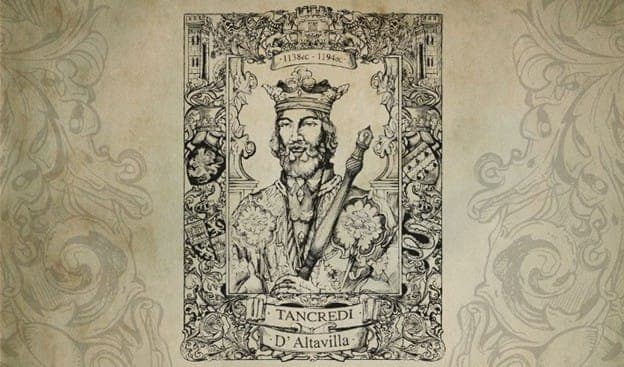

The exact year of his birth is lost in the mists of time — somewhere between 1135 and 1145. Tancred was born from an illegitimate relationship: his father was Roger III, Duke of Apulia and eldest son of the great Roger II, while his mother was Emma, daughter of Count Achard of Lecce.

Later, romantic chroniclers would invent a legend claiming that Roger of Apulia had been cruelly separated from his beloved by order of his royal father, imprisoned, and eventually died of grief. It was merely a beautiful myth. In reality, Tancred's father remained a loyal representative of Roger II on the mainland until his premature death. Although the duke married the French noblewoman Isabella of Champagne, he openly acknowledged his illegitimate son. Tancred's illegitimate birth did not prevent him from inheriting the County of Lecce from his maternal grandfather and securing an honorable position at the Sicilian court.
During the turbulent reign of William I the Bad, Tancred probably sympathized with the rebellious barons, for which he was imprisoned in the royal palace in Palermo in 1156. His moment of glory — and darkness — came on March 9, 1161. A bribed guard opened the prison doors. Tancred and another illegitimate member of the Hauteville dynasty, Simon of Taranto, took command of the rebellion. They opened the palace gates to the conspirators led by Matthew Bonnellus, slaughtered the guards, and took King William the Bad himself hostage.
However, the coup failed. On March 11, the people of Palermo besieged the palace, forcing Tancred to flee to the southern part of the island. After capturing Piazza and Butera, he continued resisting the king's punitive army for several months. Finally, in December 1161, he surrendered Butera in exchange for his life and permission to go into exile in Byzantium.

Tancred returned to his homeland during the reign of William II the Good. By then, he had matured into a brilliant military commander and admiral. It was Tancred who led the Sicilian fleet against Alexandria in 1174 and commanded the naval squadron during the disastrous campaign against Byzantium in 1185.
Although the king's ambitious plans repeatedly collapsed because of diplomatic miscalculations, Tancred consistently managed to preserve his fleet and bring his men home with honor. In 1176, he also successfully defeated the forces of Emperor Frederick Barbarossa in the north. The illegitimate nobleman had demonstrated that he knew how to fight.

On November 18, 1189, the death of the childless William II the Good triggered a catastrophe. His aunt, Constance of Sicily, remained the only legitimate heir. However, her marriage in 1186 to the German prince Henry of Hohenstaufen, son of Barbarossa, meant that Sicily would pass into the hands of its oldest and most existential enemy — the Holy Roman Empire.
Despite the oaths of allegiance sworn to Constance by the barons during William's lifetime, Sicily rose against German domination. The only high-ranking official who openly supported the Germans was Walter of the Mill, Archbishop of Palermo.
The national faction was led by Vice-Chancellor Matthew of Ajello. Yet even among the patriots, there was no unity. Two claimants emerged: Tancred of Lecce, illegitimate but a grandson of Roger II himself, and the powerful Count Roger of Andria, whose direct relationship to the Hauteville dynasty remained uncertain.

The streets of Palermo were stained with blood as supporters of the rival claimants clashed. The outcome of the struggle was determined by Matthew of Ajello's brilliant political instincts. He chose to support Tancred and managed to secure the approval of Pope Clement III.
On January 18, 1190, Tancred was crowned in Palermo Cathedral. In an ironic twist of fate, the crown was placed on his head by the very same pro-German Archbishop Walter of the Mill, who had been forced to accept political reality.
Matthew of Ajello received the position of chancellor, while his sons were granted the titles of count and Archbishop of Salerno.
But Tancred's crown was already burning with danger.
From the very first day of his reign in 1190, Tancred found himself surrounded by threats. In January, amid the power vacuum, violent riots erupted in Palermo. Christians massacred Muslims, who had traditionally been among the strongest supporters of the crown.
These events provoked the first full-scale uprising of the Muslim community in the history of Norman Sicily. The king spent his entire first year suppressing the rebellion.
Meanwhile, another crisis erupted on the mainland. In March 1190, the rejected claimant Roger of Andria and his barons launched an uprising in Apulia and Campania. Blinded by their hatred of Tancred, they committed an act of betrayal: they appealed for assistance to Henry of Hohenstaufen, whose claim to the Sicilian throne they themselves had previously opposed.
In May 1190, the imperial German army under the command of Henry of Kalden invaded the kingdom.
Tancred, trapped on the island by the Muslim rebellions, entrusted the fate of his country to his brother-in-law, Count Richard of Acerra. It was an excellent decision.
The count rapidly assembled an army of mercenaries, prevented the Germans from joining forces with the rebels, and began systematically driving them back.
In September 1190, the imperial forces withdrew from Italy in humiliation. Deprived of support, Roger of Andria was defeated, captured, and executed.
By the end of the year, Tancred had miraculously restored the unity of his kingdom.
But the greatest struggle still lay ahead.

In the autumn of 1190, Sicily faced another unexpected threat.
On September 14 and 23, two crusader kings arrived in Messina: Philip II Augustus of France and Richard the Lionheart of England.
They had decided to spend the winter on the island, taking advantage of a longstanding invitation from the late William II.
Relations between Tancred and the English king deteriorated almost immediately.
Richard was furious: Tancred had imprisoned his sister, Joan of England, the widowed queen of Sicily, refused to pay her widow's inheritance, and appropriated the revenues from her County of Monte Sant'Angelo.
Moreover, Richard demanded the ships and gold that the late William had allegedly promised him for the crusade.
Tancred made concessions, releasing Joan and paying compensation, but Richard considered this insufficient.

On September 30, Richard seized the Calabrian town of Bagnara and stationed a garrison there to protect his sister. He then forcibly occupied a Greek monastery in Messina.
When the outraged townspeople surrounded the English forces on October 3, Richard broke off peace negotiations, stormed Messina with great brutality, plundered the city, and constructed an ominous wooden fortress overlooking it.
He gave the fortress the insulting name "Mategriffon," meaning "Bridle for the Greeks."
Tancred watched this nightmare unfold from Catania.
He demonstrated the sophisticated cunning of a true fox.
The French king Philip, angered by Richard's arbitrary actions, secretly offered Tancred a military alliance against the English.
However, Tancred understood something crucial: Richard was a powerful enemy of the Hohenstaufens in Germany and therefore an ideal ally for Sicily.
Tancred established the appearance of an alliance with France while secretly negotiating with Richard behind Philip's back.
Under the Treaty of Messina, signed on November 11, 1190, Tancred generously compensated Richard with gold while retaining control of Joan's county. He even arranged the betrothal of his daughter to Richard's young nephew, Arthur of Brittany.
In return, the English king promised to defend Sicily against any enemies while he remained on its territory and to destroy the hated Mategriffon fortress.

Then Tancred delivered a brilliant diplomatic blow.
In March 1191, he handed Richard the very secret letters in which Philip of France had proposed destroying the English forces.
The two monarchs quarreled bitterly.
Taking advantage of their mutual hostility, Tancred politely but firmly persuaded both kings to depart for the Holy Land as quickly as possible.
In the spring of 1191, the crusaders sailed away.
Without firing a single shot, Tancred had rid Sicily of two of Europe's most powerful armies and transformed Richard into his geopolitical ally.
The respite was short-lived.
On April 15, 1191, Henry VI and Constance were solemnly crowned in Rome by the new Pope Celestine III, who had been unable to resist imperial power.
On April 29, the emperor launched an invasion of the Kingdom of Sicily with the full might of the German military machine.
The betrayal of the barons spread like an epidemic. The northern territories of the kingdom fell without a fight.
The monastery of Monte Cassino and the cities of Capua, Aversa, and Teano opened their gates to the invaders.
The inhabitants of Salerno, eager to win the emperor's favor, even invited Empress Constance to spend the summer in their city.
The relentless German advance was finally halted at the walls of Naples.
The city was heroically defended by Richard of Acerra and Archbishop Nicholas of Ajello, while the seemingly invincible Sicilian fleet of Admiral Margaritus of Brindisi attacked the Germans from the sea.
The German army became trapped beneath the scorching southern sun. A devastating epidemic broke out in the imperial camp.
Unable to withstand the mounting physical and psychological losses, Henry VI ordered a retreat on August 24, 1191, and fled back to Germany.
As soon as the Germans disappeared beyond the mountains, the traitors of Salerno realized their mistake.
Attempting to earn Tancred's forgiveness, the townspeople seized Empress Constance, who had been staying in their city.
She was nearly torn apart by the crowd, but Tancred's nephew arrived in time to save her. Under heavy guard, she was transported to Messina.
It was a triumph.
The German emperor had fled, while his wife, the principal legitimate claimant to the throne, had fallen into the hands of an illegitimate king.
By the spring of 1192, Tancred had also regained control of Abruzzo by force.
For a moment, Sicily appeared to have been saved.
To secure his final victory, Tancred needed international legitimacy.

In June 1192, Tancred met with papal legates in Gravina.
The pope officially recognized Tancred as the legitimate King of Sicily.
However, the price was high.
Tancred was forced to surrender the rights of the "Sicilian Legation" — the unique privilege originally obtained by Roger I, which had allowed the kings of Sicily to exercise extensive control over the local Church.
From that moment onward, Rome itself would appoint bishops on the island.
Nevertheless, later Sicilian kings would eventually restore this authority in practice.
The pope's second condition proved even more disastrous: Tancred had to surrender the captive Constance into papal custody.
Celestine III intended to use her as a bargaining chip in negotiations with Henry VI.
But on the road to Rome, the escort of cardinals encountered a detachment of German knights.
Constance rushed toward her countrymen, crying out for help.
Ignoring the protests of the clergymen, the Germans rescued their empress and took her back to Germany.
Tancred had lost his most valuable political hostage.
Seeking new allies, Tancred concluded a pact with Byzantine Emperor Isaac II Angelos, reinforced by the marriage of Tancred's son to the Byzantine princess Irene.
However, the Byzantine Empire was decaying from within and could provide neither soldiers nor gold.

Realizing that time was working against him, Tancred attempted to secure the future of his dynasty.
In 1193, he crowned his eldest son, Roger, as co-ruler.
However, on Christmas Eve, December 24, 1193, the young Roger suddenly died.
The tragedy devastated the king.
Following a brief illness, Tancred himself died in Palermo on February 20, 1194.
His death brought the kingdom to the brink of collapse.
The throne passed to the young William III, under the regency of Tancred's widow, Sibylla of Acerra.
Upon learning of his rival's death, Emperor Henry VI immediately resumed the war.
Encountering little serious resistance from the demoralized Sicilians, he advanced through the kingdom.
The regent capitulated, and on December 25, 1194, Henry VI placed the crown of Sicily upon his own head in Palermo.
The Norman era had ended.
Seventy years of Hohenstaufen rule had begun.
The victors' revenge was horrifying.
Tancred's family — his widow and daughters — was taken into captivity in Germany, while the fate of the young King William III disappeared into the darkness of history.
The Germans even opened Tancred's tomb and threw out his remains to be devoured by dogs.
The imperial propaganda machine systematically destroyed his reputation.
In his poem, the chronicler Peter of Eboli described him as a "wretched embryo" and a "repulsive monster," while illustrations portrayed him as a monkey wearing a crown.
For centuries, this caricature concealed the true character of the king.
Only many centuries later did history begin to give him the recognition he deserved.
Tancred was not a monster.
Having become king without any previous experience in governing a state, this provincial baron and rough warrior demonstrated an extraordinary talent for diplomacy.
Beginning his reign without allies, he managed to turn the crusader kings against one another, outmaneuver the Pope, and halt the most formidable military force in Europe — the German imperial army.
Under his rule, Muslims and Greeks lived peacefully on the island, continuing Sicily's tradition of religious tolerance.
Through sheer determination, he delayed the seemingly inevitable end of the kingdom for four full years.
With the death of Tancred of Lecce, the Kingdom of Sicily lost more than its last Norman king — it lost its independence.


