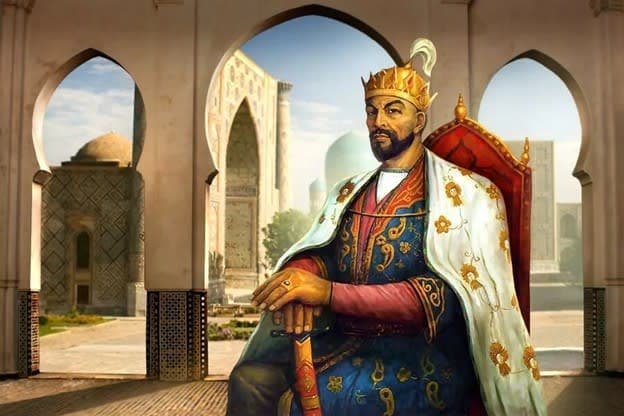
Timur (known in the West as Tamerlane), a name that means “iron” in Turkic, was born on April 9, 1336, in the village of Khoja-Ilgar near the city of Kesh (modern Shahrisabz, Uzbekistan). He came from the Turkicized Mongol clan of Barlas. He spent his childhood and youth in the mountains, where from an early age he trained in the art of war. Like Genghis Khan, he began his rise as the leader of a small band of loyal followers who became the core of his future power.
In 1347 the Chaghatay Ulus split into two states: Mā warāʾ an-nahr (Transoxiana) and Moghulistan.


In 1360 Transoxiana was conquered by the Moghul khan Tughlugh-Timur. During this period Timur was appointed by Tughlugh-Timur as governor of the Kesh district. Relations with the Moghuls quickly deteriorated, and he was forced to ally with a powerful emir, Husayn. In 1362, in a skirmish in Sistan, Timur suffered a severe leg wound and lost two fingers, which left him lame for life. After the Moghuls were expelled in 1364, Timur and Husayn returned to Transoxiana, but their friendship soon soured.
In 1370 Timur decisively defeated Emir Husayn at Balkh. Husayn was captured and executed. A quriltai (assembly of nobles) was held in Balkh, where Timur was chosen supreme emir of Turan—the name by which his state became known. Not being a Genghisid by blood, he did not take the khan’s title; instead, puppet khans from the line of Genghis Khan were placed on the throne. As a sign of his new status, he married Saray-Mulk Khanum, daughter of the Genghisid Kazan Khan and widow of Husayn, and received the honorific Guragān (“son-in-law of the khan”).

He made Samarkand his capital and began restoring the madrasas and mosques ruined during the Mongol invasions, inviting eminent scholars and jurists—such as Sa‘d al-Din Mas‘ud ibn ‘Umar al-Taftāzānī—to revive learning and Islamic jurisprudence. Timur was a devout Muslim, and his chief spiritual mentor was Shaykh Mir Sayyid Baraka, who blessed him for a great future and bestowed on him the symbols of authority—the drum and the banner.
In the first years of his rule Timur focused on strengthening his state, which faced constant threats from Moghulistan and other foes. From 1371 to 1390 he mounted seven campaigns into Moghulistan, finally crushing Amir Qamar al-Din and securing his eastern frontiers.

To the north his principal enemy was Tokhtamysh, khan of the Golden Horde. Before that, Timur had supported Tokhtamysh three times to help him seize power. Once enthroned, however, Tokhtamysh pursued a hostile policy toward Timur and raided Bukhara in 1387. In response Timur launched three campaigns, decisively defeating Tokhtamysh in 1395 at the Battle of the Terek River. After this victory Timur sacked and destroyed many cities of the Golden Horde, including its capitals Sarai-Batu and Sarai-Berke. This dealt the Horde a crippling blow from which it never recovered and indirectly aided the Russian principalities in their struggle against the Tatar-Mongol yoke. After routing Tokhtamysh, Timur also invaded the Ryazan lands and devastated Yelets, but unexpectedly turned back before reaching Moscow. His forces likewise plundered the trading cities of Azov and Kaffa in Crimea, delivering a severe blow to the northern branch of the Silk Road.

In 1398 Tamerlane launched a campaign into India. His army crushed the forces of the Delhi Sultanate and captured Delhi, which was then sacked. On Timur’s orders, 100,000 Indian prisoners of war were executed. He returned to Samarkand with immense booty.
In 1399 Timur began his “seven-year” campaign against the Ottoman Sultanate, provoked by Sultan Bayezid I, who had sheltered Timur’s enemies. In 1402, at the Battle of Ankara, Timur won a sweeping victory over Bayezid, capturing him alive. After this victory the Ottoman state temporarily ceased to function as a unified polity.


Back in Samarkand, Timur began preparing for his last and most ambitious campaign, against the Ming dynasty in China. He planned to restore the empire of Genghis Khan and seize the remaining portion of the Silk Road. In August 1404 he set out with a vast army, but the onset of a harsh winter forced him to halt at the city of Otrar. There he fell ill and died on February 18, 1405, before he could carry out his plan. His body was embalmed and taken to Samarkand, where he was buried in the Gur-e Amir mausoleum.
After his death the empire created by his conquests descended into internecine strife.



