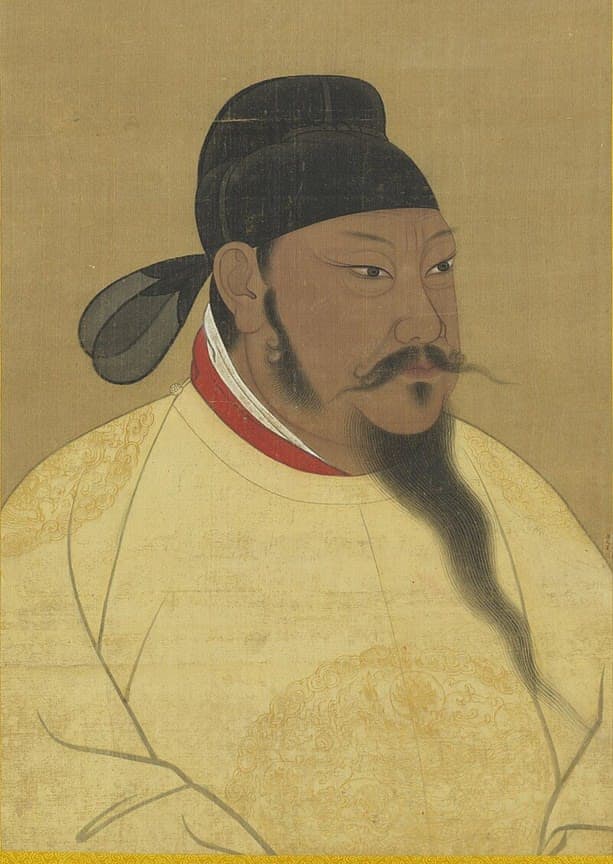

Li Shimin was born on January 23, 599, at the Wugong residence. On his father’s side he came from the ancient service lineage of the Li from Longxi County (northern Gansu): his grandfather, Li Bing, was a dignitary and general of the Tabgach (Tuoba) Northern Zhou dynasty; Li Shimin’s aunt, Dugu Jialuo, was the wife of Yang Jian, the future emperor and founder of the Sui dynasty. His mother was the daughter of the Sui aristocrat of Turkic origin Dou Yi, who came from the northwestern military elite. In 613, at the age of fourteen, Li Shimin was married to Zhangsun of the Luoyang clan, which traced its origins to Northern Wei.
In 616–617 his father, the governor of Taiyuan, Li Yuan, came under pressure: raids by the Eastern Turkic Khaganate and widespread rebellions; the enraged Emperor Yangdi demanded that Li Yuan appear at court to account for events. At that moment the eighteen-year-old Li Shimin proposed a radical solution—to raise a rebellion and replace Yangdi with a new underage emperor, with Li Yuan, Li Shimin’s father, serving as regent. In the headquarters of this uprising Li Shimin became the de facto chief strategist.
After the capture of Daxing in October 617, Li Yuan placed the twelve-year-old Yang You on the throne, while Yangdi, then in Jiangdu, was granted the title taishang huang (“Grand Supreme Ruler”). Li Yuan received the title Prince of Tang (Tang-wang) and the office of chengxiang (chancellor), concentrating effective control in his hands.
In 618 Li Yuan became emperor—later known as Gaozu—proclaiming his eldest son, Li Jiancheng, as heir, and granting Li Shimin the title Prince of Qin (Qin-wang). Li Shimin’s abilities quickly made him the principal contender: victories over rebels, deft work with the army and elites, and reform initiatives—all of this sharpened his rivalry with his brothers. A powerful court “party” formed around the heir, exploiting any pretext (including fabricated “seditious” remarks and, according to the chronicles, an attempted poisoning) to discredit Li Shimin. On July 2, 626, summoned to court, Li Shimin was ambushed by his brother but answered with a shot that killed Li Jiancheng; Li Yuanji was killed shortly afterward as well. Realizing that he had no sons left but Li Shimin, Gaozu declared him heir. Gaozu then abdicated, and on September 4, 626, Li Shimin ascended the throne as Taizong.
After the years of Sui rule and turmoil, the population of the realm, according to chroniclers, had shrunk by two-thirds. In response, Taizong had to implement a series of reforms to restore the empire.
He completed the reorganization of the central departments; mandatory state examinations (keju) again became the main avenue into the bureaucracy, opening a path for talented men of humble origin.
To strengthen his army, he reinforced frontier defenses and the cavalry, recruiting steppe Turks into its ranks.
Taizong also supported peasants, artisans, merchants, and the “new intellectuals,” who had previously been barred from the top. His policy aimed at practical measures and economic recovery, including the regularization of currency and markets.


Taizong’s reign was the first major attempt at a cultural-political synthesis of China and the Steppe. The emperor consciously integrated steppe elites into the administrative and military hierarchy while preserving their identity. His inner circle—Wei Zheng, Fang Xuanling, Wang Gui—and steppe companions chosen for personal loyalty (including the one-armed Uighur Kibi Heli and the Türkic prince Ashina Sheni). In Chang’an, yurts were set up “in the nomadic style,” and a Chinese-Türkic glossary appeared.
In 626–627 there was a sharp, prolonged cooling in Central Asia. This climatic disaster proved catastrophic for the nomadic economy of the Eastern Turkic Khaganate. Unable to feed themselves, the Turks under their khagan, Seli Qaghan, stepped up raids on the Tang Empire. Even intensified plundering could not save them from famine and economic collapse. Tensions rose within the khaganate. Out of desperation Seli Qaghan raised taxes, but the tribes—and even close allies such as Tuli Qaghan—began defecting to Tang.
By 630 the Eastern Turkic Khaganate was weakened to the limit, and under Seli Qaghan only about 10,000 soldiers remained. Li Shimin, whose northern lands also suffered from the cold, decided to seize the moment. The formal pretext for war was Seli Qaghan’s patronage of the rebel Liang Shidu in the Ordos region. Early in 630 the Tang army invaded the khaganate and dealt a crushing defeat to Seli Qaghan’s exhausted forces.

Li Shimin did more than win—he absorbed the khaganate. He appointed Tuli Qaghan his military governor (dudu) and extended Tang laws to the Turkic lands. That same year Turkic leaders came to the imperial court and proclaimed Li Shimin their “Heavenly Qaghan,” conferring on him symbolic authority over the steppe. He bore this title until July 639, when he transferred it to Ashina Simo.
After stabilizing the northern frontier, Taizong turned his gaze west and northwest, pursuing an aggressive foreign policy. Soon Tang forces—comprising many Turks—seized Gaochang, allowing China to establish control over the entire eastern stretch of the Silk Road. Pushing further west, Taizong’s army subdued more than seventy cities in Central Asia, from Kashgar to Bukhara. Thus the Tang Empire asserted control over a significant part of what are now Kyrgyzstan and Uzbekistan. Taizong’s campaigns extended China’s sway farther west than ever before.

Taizong’s only serious failure was the war against the Korean state of Goguryeo. In 645 his armies lost the initiative, failing to take the fortress of Anseong, which heroically held out for sixty days. The siege dragged on, and the Chinese army suffered heavy losses, losing 80% of its supply transport during the retreat. Although Taizong did not subdue Goguryeo, his operations weakened the state, paving the way for its fall in 668.
Taizong’s era was not only a time of conquest but also of cultural openness. A striking example is the journey of the Buddhist monk Xuanzang through Bactria, Dzungaria, and India from 629 to 645. After sixteen years he returned to Chang’an with 700 Buddhist relics. His Records of the Western Regions (Xiyou ji) became an invaluable source on the Western Regions.
In 648, sensing old age approaching, Taizong decided to leave political guidance for his heir. He composed the Di fan, a practical manual on governing the state. The work consisted of twelve chapters in four juan, covering topics such as “The Essence of a Ruler,” “Rewarding and Punishing,” and “Encouraging Agriculture.” Handing the Di fan to the future Emperor Gaozong (Li Zhi), he said: “Here is written how to perfect oneself and govern the state.”
Li Shimin died on July 10, 649. His tomb in Chang’an, adorned with exquisite high reliefs, is considered one of the masterpieces of Tang architecture. Although his son Gaozong did not possess his father’s talents, he was able to continue his successful policies, thanks largely to the solid foundation laid by Taizong.


