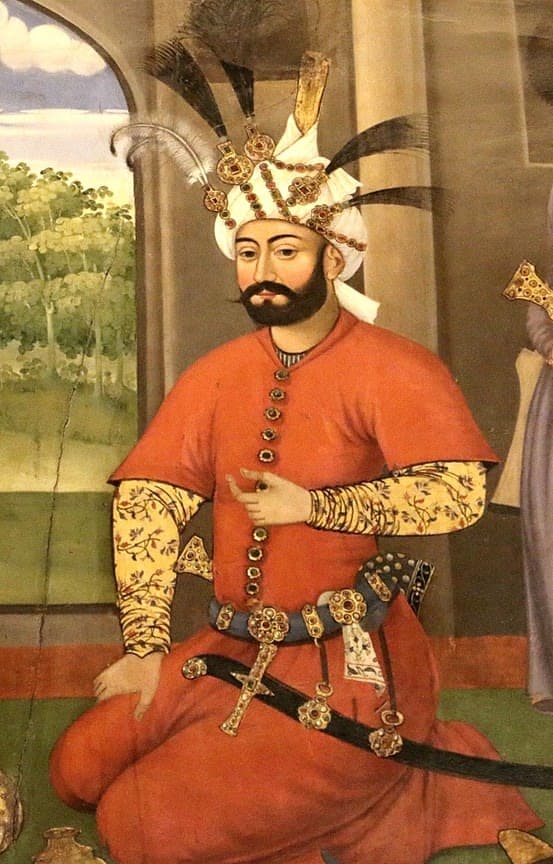

Tahmasp I, born on March 3, 1514, in Isfahan, became one of the longest-reigning monarchs of the Safavid Empire, holding the throne for 52 years. At the age of three he was appointed by his father, Shah Ismail I, as governor of Khorasan. Ismail loved his son dearly and, before his death, decreed that Tahmasp should inherit the throne, appointing Div Sultan Rumlu as his guardian for seven years. Ismail’s death in 1524, however, sparked a civil war among the Qizilbash emirs, greatly weakening the state and opening the way for invasions by the Ottoman Empire and the Uzbeks.

In 1524, at age ten, Tahmasp became shahanshah. Div Sultan Rumlu, as his atabeg, took control of state affairs. This aroused resentment among other tribes—especially the Ustajlu—who felt Div Sultan behaved with excessive arrogance. Tensions erupted into civil war in 1526. The Ustajlu were defeated and their leader Köpek Sultan killed. The surviving members of the ruling triumvirate—Div Sultan and Chukha Sultan Tekeli—then turned on each other. On July 5, 1527, Tahmasp, already seeking greater independence, gave the signal and Div Sultan was killed. Chukha Sultan became the new de facto ruler, but his dominance was short-lived. After he showed cowardice in battle against the Uzbeks in 1529, his rival Husayn Khan Shamlu rose to be the most powerful emir—only to be executed in 1534. That execution marked the end of the “Qizilbash interregnum” and the turning point at which Tahmasp, after a decade under the emirs’ sway, finally began to exercise sovereign authority.

Under Tahmasp I the Safavid forces began to field artillerymen and musketeers; in 1539 the new office of topchibashi—commander-in-chief of artillery—was created. In 1538 the shah crushed a revolt in Shirvan and brought the State of the Shirvanshahs to an end. In 1540 Anatolian Qizilbash who had been expelled from the Ottoman Empire arrived at his court; he settled them in Khorasan, Shirvan, and Iraq. At this time only a small portion of the realm was under direct court administration; most lands had been granted to Qizilbash emirs. Conditions for peasants and artisans worsened, leading to a series of uprisings—the most stubborn being in Gilan, which, with mixed fortunes, continued until 1572.
Tahmasp’s reign was marked by continual wars with the Ottoman Empire, which—taking advantage of Safavid weakness from internal strife—invaded three times. The first invasion in 1534 was spurred by the defector Ulama of the Tekeli tribe. The Safavids employed scorched-earth tactics that deprived the Ottoman army of supplies and forced it to withdraw. A second invasion in 1535 also ended in an Ottoman failure. The third and largest, in 1548, was launched by Sultan Suleiman I with the participation of the traitor Alqas Mirza, Tahmasp’s brother, who had fled to the Ottomans. His promises proved empty, and the Ottoman army again retreated. In 1555 the Peace of Amasya was concluded; it remained unbroken until the shah’s death.

Tahmasp also fought the Uzbeks under Ubaydullah Khan, who mounted five major invasions of Khorasan. At the Battle of Jam in 1528, Tahmasp won despite the Uzbeks’ numerical superiority. Raids on the eastern frontier continued until Ubaydullah’s death in 1540.
Relations with the Mughal Empire were friendly. Tahmasp recognized Babur’s accession and maintained diplomatic ties with his court. In 1543, when the Mughal padishah Humayun was deposed, he fled to Tahmasp for aid. The shah agreed to help on condition that Humayun accept Shi‘ism, which he did. In 1555, thanks to a Qizilbash expeditionary corps, Humayun was able to regain power in India.

Shah Tahmasp I died in 1576 at Qazvin. By the time of his death, the Ustajlu tribe held fifteen key posts in the state. Carpet weaving and the Persian school of painting flourished at his court. Despite internal turmoil and external threats, his long reign ensured the survival and stability of the Safavid Empire for many years.


