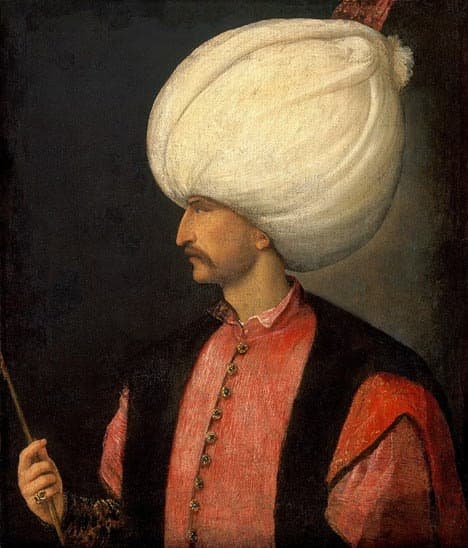

Suleiman was born in Trabzon to Sultan Selim I and his concubine—later wife—Hafsa Sultan. By one account, his mother was a daughter of the Crimean khan Mengli I Giray. From an early age he held state posts, first as beylerbey in Caffa and then as governor of Manisa. When his father Selim I died in 1520, the 26-year-old Suleiman became sultan.

European monarchs, including England’s Cardinal Wolsey, initially greeted his accession with optimism, hoping for a more peaceful reign. Their hopes were disappointed. Suleiman immediately showed his resolve, beginning by ordering the release of Egyptian prisoners taken by his father.
His reign saw unprecedented expansion on land and sea. The pretext for war with Hungary was the killing of a Turkish envoy by King Louis II.
In 1521, after a two-month siege, the Ottomans took Belgrade on August 29.


In 1522 Suleiman landed with a vast army on Rhodes and besieged the Knights Hospitaller. The siege began on June 26; after six months, on December 20, the garrison capitulated. The knights had fought bravely and Ottoman losses were heavy; under the terms, the knights were allowed to depart unharmed and later settled on Malta.
In 1526 Suleiman launched a new campaign against the Kingdom of Hungary. At Mohács, a 100,000-strong Ottoman army routed the Hungarian forces, and King Louis II fell in battle. Hungary was devastated and tens of thousands of its inhabitants were carried off into slavery.


In 1529 Suleiman with an army of about 120,000 besieged Vienna, but fierce resistance, disease, shortages, and oncoming cold forced him to withdraw. Even so, by the peace of 1547 Austria recognized Ottoman rule over central and eastern Hungary and agreed to pay an annual tribute of 30,000 ducats.

Suleiman also waged long eastern wars against the Safavid state under Shah Tahmasp I. In 1534 the Ottomans captured the Safavid capital Tabriz and then took Baghdad, annexing Iraq and adjoining lands—thereby strengthening Ottoman control over the Persian Gulf. In 1555, by the Peace of Amasya, the Safavids recognized all Ottoman gains, including part of the South Caucasus and Iraq.

Suleiman strengthened the fleet, appointing the famed corsair Hayreddin Barbarossa as kapudan pasha (grand admiral). In 1538 at Preveza the Ottoman navy defeated a combined European fleet under Andrea Doria, securing Ottoman dominance of the Mediterranean for decades. In 1534 Barbarossa seized Tunis, and in 1543 his fleet aided the French in taking Nice.
Suleiman was not only a conqueror but a great reformer. He earned the epithet Kanuni (“the Lawgiver”) for organizing and codifying Ottoman law into a single corpus. He also instituted important military and fiscal reforms and lavishly supported art, architecture, and learning. Masterpieces of his era include the Süleymaniye Mosque in Istanbul.


His life was marked by personal dramas. He had several concubines, but his great love—and only legal wife was Hürrem Sultan, known in Europe as Roxelana, a Ukrainian slave taken by Crimean Tatars. She bore him several sons, including Selim and Bayezid, and a daughter, Mihrimah.

Roxelana used her influence to advance her sons, provoking a bitter struggle for the throne. Her chief rival was Mahidevran Sultan, mother of Suleiman’s eldest son, Şehzade Mustafa. In 1553 Mustafa was executed on his father’s orders on charges of conspiracy.
After Hürrem’s death in 1558, a succession struggle broke out between her sons Selim and Bayezid. In 1559 Bayezid was defeated, fled to Persia, but was handed over and executed in 1561 along with his five sons.
Suleiman died on September 6, 1566, during his final campaign, while his army was besieging the fortress of Szigetvár in Hungary.


His body was brought to Istanbul and buried in a mausoleum beside that of Hürrem Sultan. Suleiman I left to his son Selim II a mighty empire whose frontiers stretched from Hungary to the Persian Gulf and from Algiers to the borders of Iran.


