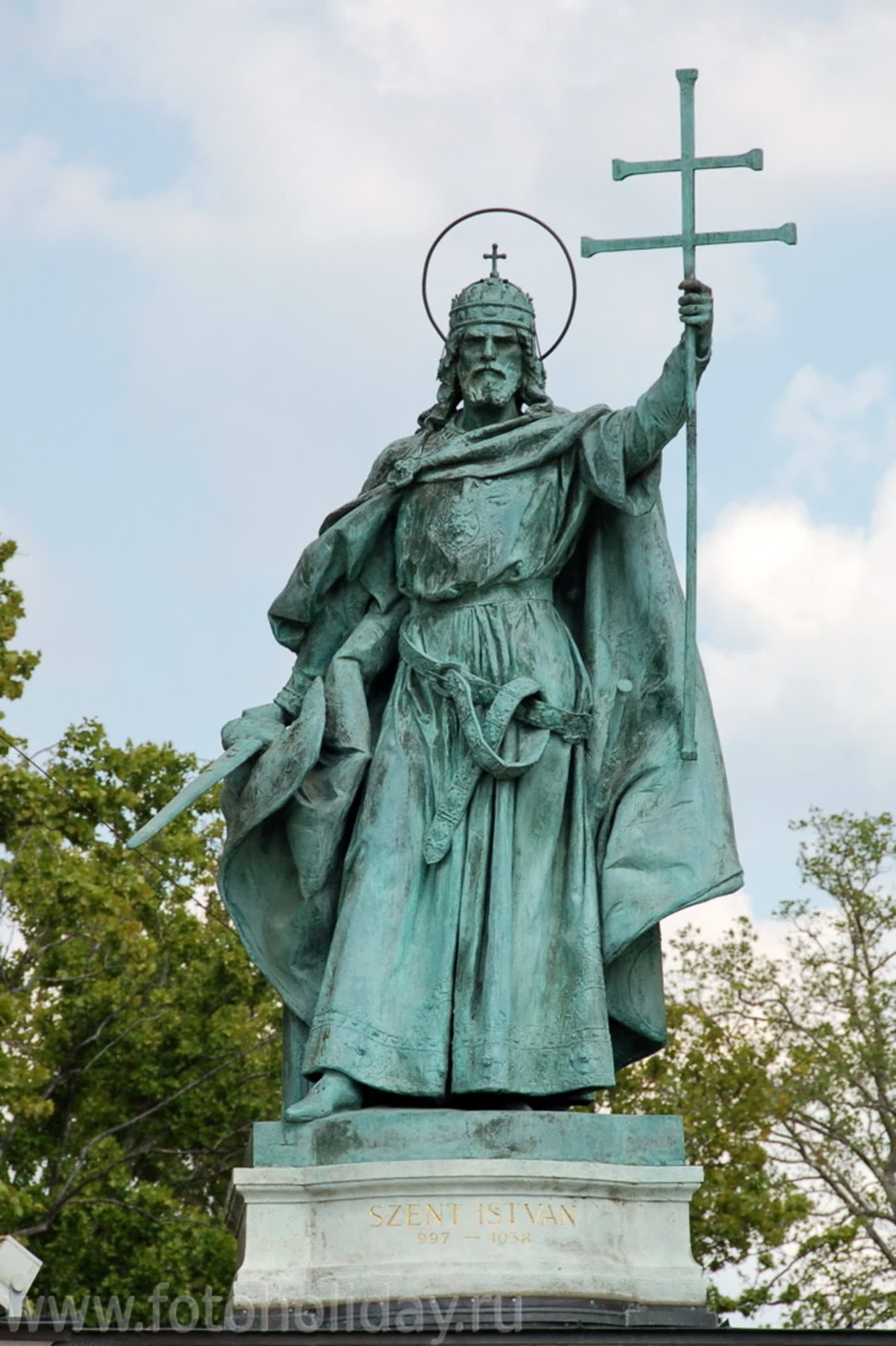

At the end of the tenth century, the Hungarian tribes stood at a historic crossroads. The era of plundering raids was coming to an end, and survival in Europe required an entirely different path. It was during this decisive period that the only son of Grand Prince Géza of the Hungarians and his wife, Princess Sarolt, was born.
His ancestry was marked by contradictions. His mother belonged to the powerful and noble dynasty of the Gyulas and had been baptized according to the Eastern Byzantine rite. She was also the sister of Judith, the wife of the Polish ruler Bolesław I.

The boy was given the Turkic name Vajk, meaning "hero" or "leader." The exact time and place of his birth remain shrouded in the mists of history. The fourteenth-century Hungarian Illuminated Chronicle claims that he was born in 969. However, modern historians generally believe that Vajk was born somewhat later, between 970 and 980, in either Esztergom or Székesfehérvár. The year 975, or slightly later, is often considered the most likely date.
Vajk's destiny changed forever when he received the sacrament of baptism and adopted the Christian name Stephen (István). Although both of his parents had already been formally baptized, Stephen was destined to become the first truly devout Christian in the ancient Árpád dynasty.
His spiritual mentor, the outstanding missionary Adalbert of Prague, who was later canonized by the Church, played an enormous role in shaping his worldview.
In 996, another crucial political and dynastic step was taken: Stephen married Gisela, a devout Christian and the daughter of the powerful Bavarian duke Henry II. This alliance permanently connected Hungary's destiny with the Western Christian world.

In 997, Grand Prince Géza died. Stephen intended to continue his father's work of establishing an early feudal state in Hungary. However, an ancient tribal tradition stood in his way.
Stephen's cousin Koppány, who ruled Somogy, laid claim to supreme authority, relying on his pagan warriors and the ancient custom of succession by seniority within the ruling family.
A brutal civil war erupted. Stephen was not alone in this struggle: several loyal noble families supported him, while the decisive factor proved to be the heavy cavalry — heavily armored Bavarian knights sent by his father-in-law.
The conflict reached its climax in 998, in a major battle near Veszprém. Koppány's pagan army was completely crushed, and the rebel leader himself fell in battle, killed by the Bavarian knight Vecelin.

The punishment inflicted upon the defeated was deliberately public and horrifying. To strike terror into the hearts of potential rebels, Stephen ordered Koppány's body to be quartered. The bloodied remains were nailed to the fortress walls of four major castles: Veszprém, Győr, Fehérvár, and Gyulafehérvár.
Yet this brutal lesson did not completely eliminate the problem. Hungarian historiography even developed the term "Koppány syndrome," referring to recurring attempts by senior members of the Árpád dynasty to overthrow their reigning nephews.
Having secured victory, Stephen began legitimizing his authority on the international stage. His historic triumph came on Christmas Day, December 25, 1000, although other sources place the event on January 1, 1001.
Astrik, the legate of Pope Sylvester II, solemnly placed upon Stephen's head a crown sent by the pontiff. From that moment onward, Stephen possessed not only secular authority but also spiritual power.
The famous Holy Crown of Saint Stephen became the nation's most sacred relic for centuries. It should be noted, however, that only its upper half is considered an authentic component dating from 1000–1001, while the lower part consists of a crown presented much later by the Byzantine emperor Michael VII Doukas to King Géza I.
Rome granted Stephen unprecedented powers. He received the title of Apostolic King and was granted authority over ten dioceses, the right to govern the Church autonomously, the freedom to spread Christianity, and the exclusive right to establish or abolish bishoprics both within Hungary and in conquered territories.
The monarch was also recognized as the supreme owner of all Church lands within the kingdom.
Stephen immediately established the Archbishopric of Esztergom, headed by Bishop Domokos, along with six dioceses and three Benedictine monasteries.
This brilliant diplomatic maneuver made the Hungarian Catholic Church completely independent of the archbishops of the Holy Roman Empire, while the kingdom itself preserved genuine sovereignty from papal interference — a privilege that neighboring Bohemia and Poland had been unable to obtain.
Stephen carried out the Christianization of his country with an iron fist. Relying on Latin and Greek priests, and especially Benedictine monks, he converted his people to the new faith without hesitation in employing coercive methods.
By royal decree, every ten villages were required to construct and maintain at least one Christian church.
After completing the construction of Pannonhalma Abbey, the country's first abbey, dedicated to Saint Martin and originally founded by his father, Stephen launched an extensive building program. Monasteries appeared at Pécsvárad in 1015, Zobor in 1019, Bakonybél in 1020, and many other locations.


Stephen I carried out his domestic reforms under the influence of the centralized administrative model of the Carolingian Empire.
He permanently abolished the archaic tribal divisions, reorganizing the territory into new administrative districts known as royal counties, or comitatus (Hungarian: vármegyék, traditionally also called zhupas). Each county was placed under the authority of an ispán, a royal governor.
Initially, the number of counties ranged from 32 to 45, eventually reaching a fixed total of 72.
A royal court council was established with advisory functions. The second most powerful official in the state, after the monarch himself, became the palatine, whose office combined the responsibilities of chief justice and a position resembling that of a prime minister.
Stephen's financial and economic reforms were equally radical.
He abolished the institution of slavery traditionally practiced among the early Hungarians, while reserving for himself the exclusive right to personally emancipate members of the feudal dependent classes.
To ensure a stable flow of revenue into the royal treasury, a fixed tax known as the tithe was introduced. Only the clergy, princes, ispáns, and senior military commanders were exempt from paying it.
Hungary also began minting its own currency. Silver denarii bearing the Latin inscriptions "STEPHANUS REX" ("King Stephen") and "REGIA CIVITAS" ("Royal City") soon circulated widely throughout Europe.

The foundation of the new legal order consisted of two codifications of laws, the first containing 35 articles and the second containing 20.
A progressive system of local administration, organized around secure fortresses, transformed Hungary into one of the safest transit routes in Europe.
Pilgrims and wealthy merchants traveling from Western Europe to Constantinople and the Holy Land now preferred the overland route through Hungary to the dangerous journey by sea.
Abbot Odilo of Cluny admired this achievement, while the Burgundian monk Rodulfus Glaber enthusiastically wrote:
"At that time, all those who traveled from Italy and Gaul to the Holy Sepulchre sought to abandon their former, customary route across the seas and instead pass through the land of King Stephen. He made the road safe for everyone, welcoming all whom he encountered and showering them with countless gifts."
It was along this safe route that the pilgrim Gerard (Gellért), a future saint, arrived in Hungary in 1015.
He remained at the royal court, becoming the spiritual mentor of the heir to the throne, Emeric (Imre). Later, he was appointed bishop of the newly established county of Csanád.
This territory was named after the distinguished military commander Csanád, probably a nephew of the king, who had played a key role in defeating the rebels and became the first ispán of these lands.

Stephen would not tolerate the independence of local rulers.
In 1003, he crushed his own uncle, the powerful Gyula the Younger, ruler of Transylvania. Gyula was captured but later managed to escape to the court of the Polish king Bolesław I the Brave.
Later, in 1008, or possibly around 1028, Ajtony, the ruler of Banat, was also defeated.
Interestingly, both Gyula and Ajtony were Christians, but they followed the Eastern Byzantine rite.
Their conflict with Stephen was driven not only by the struggle for political power but also by their resistance to the imposition of Latin-rite Catholic dioceses, particularly the establishment of the Archdiocese of Alba Iulia in Transylvania.

In 1008, the king's iron will brought the independent Kavar, or Kabar, tribes — the so-called "Black Hungarians" or "Dark Hungarians" — under his authority.
Stephen concluded the conflict with a diplomatic maneuver. In 1009, he arranged the marriage of his unnamed sister to a Kavar chieftain, believed to have been either Samuel Aba, the future king of Hungary, or his father.
By 1028, Stephen had united the entire Carpathian region, bringing the semi-independent chieftains under centralized royal authority.
Having established his supremacy throughout the Carpathian Basin, Stephen constructed a complex system of international alliances, securing his borders through treaties with Bolesław I the Brave of Poland and Grand Prince Yaroslav the Wise of Kiev.

Relations with Poland initially hovered on the brink of war.
The Hungarians supported the Bavarian duke Henry II, an enemy of Bolesław, and helped Henry's brother Bruno reconcile with the emperor.
The situation was further complicated by the Polish occupation of territories along the Morava River, in present-day Slovakia.
In 1017, Stephen was even forced to repel an invasion by the Pechenegs, who were acting in alliance with Bolesław and the Kievan prince Sviatopolk the Accursed.
However, immediately after the signing of the Peace of Bautzen in 1018 between Poland and the Holy Roman Empire, yesterday's enemies became allies. Five hundred elite Hungarian horsemen were already marching in Bolesław's army during his campaign against Kiev.
Dynastic ties with Rus' were also strengthened. Stephen's relative, Ladislaus the Bald, married Premislava, daughter of Prince Vladimir of Kiev.

In the south, Stephen acted as a loyal ally of Byzantium.
In 1015, Hungarian regiments fought shoulder to shoulder with the army of Emperor Basil II the Bulgar Slayer during the assault on the Bulgarian capital of Ohrid.
Another diplomatic success was the marriage of Stephen's younger sister to the Venetian doge Otto Orseolo around 1009.
The most formidable challenge to Hungary's sovereignty came from its confrontation with the Holy Roman Empire.
In June 1030, taking advantage of the dissatisfaction among Hungarian pagans, Emperor Conrad II led an army of German knights into Hungary, devastating the western bank of the Rába River.
Stephen responded with a brilliant scorched-earth strategy. By depriving the enemy of supplies and gradually exhausting its forces, troops loyal to the king managed to surround the Germans near Vienna itself.
Conrad II fled in disgrace, "without victory and without an army."
In 1031, the emperor was forced to sue for peace, surrendering extensive territories between the Leitha and Fischa rivers to the Hungarians.

Despite his extraordinary political triumphs, Stephen's personal life was filled with sorrow.
His marriage to Gisela of Bavaria produced three children, but all of them died before their father.
The most devastating blow was the tragic and unexpected death of the kingdom's greatest hope — his intelligent and brilliantly educated son Emeric (Imre), who was fatally wounded by a wild boar during a hunting expedition.

The absence of a direct heir triggered a severe dynastic crisis.
Having outlived all his children, Stephen officially designated his nephew, Peter Orseolo, as his successor.
This decision angered the king's cousin, Vazul, ruler of the Principality of Nitra, who organized an assassination attempt against Stephen.
The conspiracy failed.
The punishment was brutal: on the orders of Queen Gisela, Vazul was blinded with molten lead.
Later chroniclers frequently attributed this cruelty exclusively to the queen, attempting to preserve the virtuous image of Stephen himself. Nevertheless, these measures failed to prevent the bloody civil wars that would follow.
Stephen I the Great died on August 15, 1038.
His body was laid to rest in the magnificent Basilica of the Virgin Mary in the city of Székesfehérvár.

In 1083, on the initiative of Pope Gregory VII, Stephen was canonized by the Catholic Church together with his tragically deceased son Emeric and Bishop Gerard (Gellért), receiving recognition as a royal confessor.
That same year, the new Hungarian monarch, Saint Ladislaus I, solemnly transferred the remains of the founder of the Hungarian state into a magnificent silver sarcophagus beside the altar of the Basilica of Székesfehérvár.
The king's mummified right hand, known as the Szent Jobb ("Holy Right Hand"), became one of the nation's most sacred relics and the object of a national religious cult.
The date of the translation of his relics, August 20, is still celebrated as Hungary's principal national holiday: Saint Stephen's Day.
In 2000, another historic event took place. Patriarch Bartholomew of Constantinople officially recognized Stephen's canonization within the Orthodox Church, symbolically uniting East and West around his legacy.


