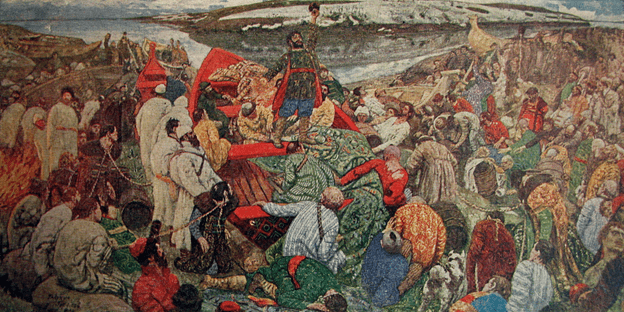

Stepan Razin’s uprising was not merely a riot, but a large-scale anti-government movement born of deep social and economic problems in seventeenth-century Russia.
The enserfment of the peasantry. The Sobornoye Ulozhenie (Council Code) of 1649 finally bound peasants to the land and established an unlimited search for runaways. This deprived peasants of their last hope for freedom.
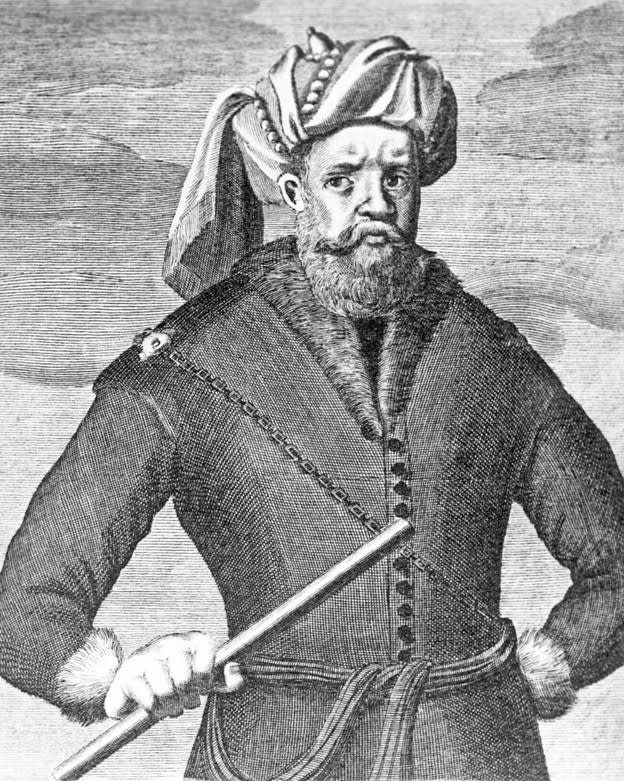
Excessive feudal oppression. Taxes and obligations for peasants and townsmen steadily grew. The situation was worsened by the protracted Russo-Polish War, an epidemic of plague, and widespread famine, all of which weakened the country’s economy.
Restrictions on Cossack freedom. The Muscovite government sought to strengthen central authority and curb the independence of the Don Cossacks.
A buildup of the poor on the Don. Many serfs fled to the Don, where the principle “No one is extradited from the Don” prevailed. These fugitives, who owned no property, formed the poorest stratum of the Cossacks the so-called golyt’ba (“have-nots”). In this milieu, calls for revolt and raiding expeditions for loot found a ready response.
The first stage of the uprising was the so-called “Campaign for Zipuns” (i.e., for plunder) of 1667–1669. Razin’s detachment blocked the Volga Russia’s most important transport artery and then seized Russian and Persian merchant ships. Laden with rich booty, he ranged along the Caspian coast and then returned to the Don, to the Kagalnitsky settlement. Runaway peasants and the poor began to flock to him, and Razin soon assembled a huge army.

It is difficult to speak of a coherent political program among the rebels; they had no clear plan. Their chief aim was to “beat the boyars, nobles, and chancery officials.” Razin himself declared that he was not acting against Tsar Alexei Mikhailovich, but against treasonous boyars who exerted a malign influence over him.
Rumors circulated among the people that the boyars had poisoned the tsar’s sons, and that the rightful heir, Tsarevich Alexei Alexeyevich, had miraculously survived and fled to the Volga. At a Cossack council Razin proclaimed himself the avenger of the tsarevich and the defender of the sovereign against the “wicked boyars.” He also promised to grant “the common folk” freedom from the power of the landlords.
In the spring of 1670, the second and main stage of the uprising began. Razin’s men seized Tsaritsyn, where townspeople, dissatisfied with the local voevoda (military governor), rose in revolt. The rebels cleverly convinced the tsar’s Streltsy that the voevoda was deceiving them, and the troops opened the gates. The voevoda, Timofei Turgenev, was captured and drowned in the Volga.
Razin then crushed a thousand-man Streltsy detachment under Ivan Lopatin, which had been sent to relieve Tsaritsyn. The rebels set an ambush, and the exhausted Streltsy surrendered. Most of their commanders were drowned.
A few dozen Cossacks, disguised as merchants, took Kamyshin by stratagem. They killed the guards, let the main forces into the town, and then executed the voevoda and local nobles.


The next target was Astrakhan. The Streltsy in the city were disgruntled over delayed pay, and when the government dispatched a fleet against Razin, they bound their commanders and went over to the rebels. Astrakhan soon fell, and Razin’s men set up their own government headed by Vasily Us. In May 1671, after an uprising by the townspeople, the rebels executed Metropolitan Iosif, who had refused to recognize Razin and had called for order.
After the capture of Astrakhan, the uprising spread rapidly through the Middle Volga region. The Chuvash, Mari, Tatars, and Mordvins joined Razin. He declared anyone who joined him a “free man.” His forces grew further when a Pretender “False Alexei,” claiming to be the miraculously saved tsarevich appeared in camp.
In September 1670 the rebels besieged the Simbirsk kremlin. The siege dragged on, and Razin’s troops were defeated by tsarist forces sent from Moscow under Princes Yuri Dolgorukov and Dmitry Baryatinsky.
In the battle near Simbirsk on 1 October 1670, Stepan Razin was badly wounded. Together with his brother Frol, he returned to the Don to raise a new army. But the settled, well-to-do Cossacks, fearing the tsar’s vengeance, turned against him. On 14 April 1671 they attacked Razin’s headquarters in the Kagalnitsky settlement, captured him, and handed him over to the tsarist authorities.
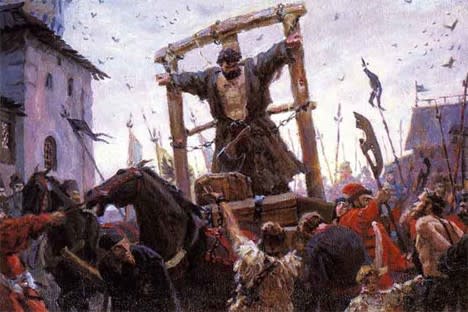
On 6 June 1671 Stepan Razin was quartered on Bolotnaya Square in Moscow. The Pretender “False Alexei” was executed soon thereafter. Unrest continued for several more months, but without its leader the uprising was doomed. The rebels’ last stronghold, Astrakhan, surrendered on 27 November 1671.
After the suppression of the uprising, a wave of brutal executions swept the country. Contemporaries described them as a “terrible spectacle,” with gallows and bodies impaled on stakes.
Despite its complete rout and the savagery of the reprisals, Stepan Razin’s uprising revealed the deep fissures within Russian society and its acute need for reform. Although Razin’s men failed to achieve their principal aim the destruction of serfdom their movement was one of the largest in Russian history and demonstrated the force of popular anger.


