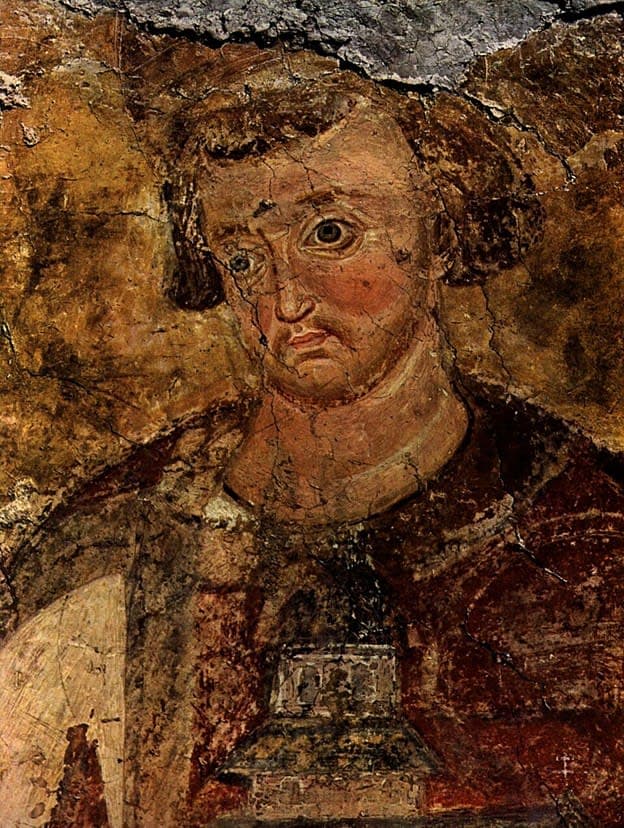

Stefan Vladislav, born around 1198, was the second son of King Stefan the First-Crowned and the Byzantine princess Eudokia. Like his elder brother Radoslav, he carried the blood of both Serbian rulers and Byzantine emperors. For a long time, Vladislav remained in the shadow of the heir to the throne, governing his appanages alongside his younger brother Uroš while their father strengthened the kingdom.

In 1227, King Stefan the First-Crowned became seriously ill and died after taking monastic vows.
It seemed that power in the country had been firmly secured by the dynasty: the eldest son, Radoslav, was crowned at Žiča Monastery, receiving the crown from his uncle, the great Archbishop Sava.
The younger brothers, Vladislav and Uroš, continued to govern their respective territories.
Interestingly, another of their brothers, Predislav, soon entered the clergy under the name Sava and became Bishop of Zahumlje. He would later serve as Archbishop of Serbia from 1263 to 1270.
Thus, the Nemanjić dynasty concentrated both secular and spiritual authority in its hands.

Initially, Radoslav was considered a good ruler, as noted by the monk Theodosius, the biographer of Saint Sava.
However, the elder brother quickly fell under the overwhelming influence of his wife and her father, the powerful ruler of Epirus, Theodore Komnenos Doukas.
Radoslav increasingly turned away from Serbian traditions, preferring Byzantine customs, which caused growing resentment among the Serbian nobility, known as the vlastela.

As long as Epirus remained powerful, Radoslav's authority appeared unshakable.
However, in 1230, at the Battle of Klokotnitsa, the army of Epirus was destroyed by the Bulgarian Tsar Ivan Asen II, while Theodore Komnenos himself was taken prisoner.
Having lost his powerful foreign protector, Radoslav's position rapidly collapsed.
The Serbian nobility was no longer willing to tolerate the "Greek" king.

In 1233, influential noble families launched an open rebellion.
According to Theodosius, the vlastela turned away from Radoslav and sided with the young and ambitious Vladislav.
In the autumn of that same year, the deposed Radoslav fled the country.
Attempting to regain his throne, he promised the governor of Ragusa (Dubrovnik) commercial privileges in exchange for military assistance.
Upon learning of this, Vladislav threatened Ragusa with war, forcing his brother to seek allies in Bosnia, where he appealed to Ban Matej Ninoslav, and later in Dyrrhachium, where he sought the support of Manuel Komnenos.
However, Radoslav's efforts failed everywhere.
At this critical moment, the uncle of the feuding brothers, Archbishop Sava, once again intervened in the fate of the country.
Although his sympathies lay with Radoslav on the grounds of legitimate succession, Sava, as a pragmatic statesman, understood that a civil war would destroy Serbia.
To legitimize Vladislav's authority and bring peace to the country, Sava not only took steps to arrange his coronation but also personally organized a political marriage.
Vladislav married a daughter of the powerful Bulgarian Tsar Ivan Asen II.
Soon afterward, Archbishop Sava resigned from his ecclesiastical office.
Meanwhile, Radoslav, realizing that his situation was hopeless, contacted his uncle, renounced his claims to the throne, and took monastic vows under the name Jovan.

According to historian Željko Fajfrić, the exact terms of the reconciliation remain unknown.
However, Radoslav never again rebelled against his brother, and Vladislav may even have entrusted him with the administration of a small part of the country.
Having consolidated his position on the throne, Vladislav faced a serious internal crisis.
In 1236, Saint Sava died in Bulgaria while returning from a pilgrimage.
He was buried with honors in Tarnovo.
Rumors immediately began spreading throughout Serbia, accusing the king of responsibility for his uncle's death and condemning the fact that the great saint had been laid to rest in a foreign land.
Vladislav repeatedly asked the Bulgarian tsar to return the saint's relics, but his requests were refused.
Eventually, the king was forced to travel personally to Tarnovo for difficult negotiations with Ivan Asen II.
His diplomacy proved successful: the relics of Saint Sava were brought back to Serbia and solemnly buried in the magnificent Mileševa Monastery, which Vladislav had constructed in 1234.

Having resolved the spiritual crisis, the king turned his attention to foreign policy.
Whereas under Radoslav Serbia had effectively become a political dependency of Epirus, Vladislav reoriented the kingdom toward Bulgaria, whose ruler Ivan Asen II was the undisputed hegemon of the Balkans at that time.
Some historians even believe that Vladislav formally acknowledged Bulgarian suzerainty.
In addition, Vladislav actively defended the economic and territorial interests of his kingdom.
In 1235, he signed an extremely important trade agreement with Dubrovnik, guaranteeing that the city-republic would not become a refuge for enemies of the Serbian crown.
Soon, Serbia was forced to confront Hungarian aggression.
Between 1235 and 1241, Hungarian crusaders waged war in Bosnia, while in 1237 Duke Coloman attacked Zahumlje, a coastal region partly belonging to Serbia.
Vladislav demonstrated his abilities as a determined military commander.
He personally led his army as far as the Cetina River and successfully defended his territories.
By 1240, his troops were stationed beneath the walls of Dubrovnik, demonstrating the military strength of the kingdom.
Despite his military successes, Vladislav's position depended heavily on Bulgarian support.
When Ivan Asen II died, the Serbian nobility, exhausted by Bulgarian influence, immediately began to challenge the king's authority.
As Željko Fajfrić observes, Vladislav might have overcome the opposition had it not been for a catastrophe of international proportions — the Mongol invasion.
After sweeping through Rus', Poland, Bohemia, and Hungary with fire and sword, the forces of Batu Khan returned toward the steppes through the Balkans.
The Mongols devastated Bulgaria and Serbia.
Although Serbia avoided massive loss of life, as much of the population managed to hide in dense forests where Batu's cavalry did not venture, the towns of Cattaro, Drivast, and Svač were razed to the ground.
The country lay in ruins.

This chaos proved fatal for Vladislav.
In the spring of 1243, the dissatisfied vlastela supported the king's younger half-brother, Uroš.
Vladislav was forced to abdicate the throne.
Željko Fajfrić suggests that his resistance was quickly crushed and that Vladislav may even have spent some time in captivity.
His wife, Queen Beloslava, attempted to resist.
She fled to Ragusa, from where she tried to organize an uprising against Uroš.
However, by the summer of 1243, Uroš had already issued a decree under which the citizens of Ragusa swore allegiance to the new king and promised to prevent any hostile actions by Beloslava.
Unlike many medieval dynastic conflicts, this struggle ended peacefully.
Uroš demonstrated remarkable generosity toward his elder brother: he granted Vladislav control over the region of Zeta and even allowed him to retain his royal title.
After 1243, Vladislav I virtually disappeared from the pages of Serbian chronicles.
The few surviving references suggest that the brothers maintained friendly relations.
Vladislav permanently abandoned his political ambitions and never again attempted to reclaim the throne by force.
His children also played no significant role in the subsequent history of Serbia.
Stefan Vladislav I died sometime between 1264 and 1281.
The king found his final resting place in the same monastery where Saint Sava, whose relics he had brought back to Serbia, had been laid to rest — Mileševa Monastery, which Vladislav himself had founded.
He left behind the memory of a ruler who had struggled to preserve Serbia's stability and survival during one of the most turbulent periods in its history.


