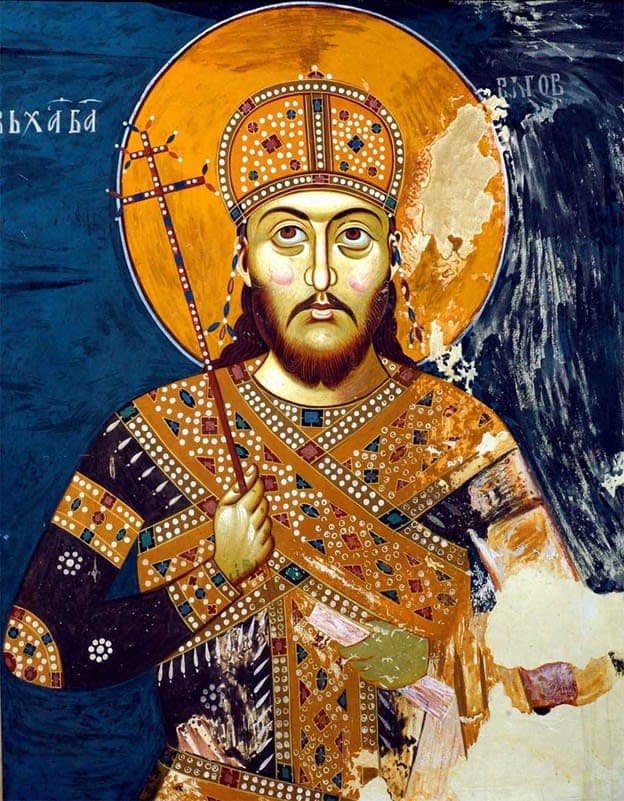

Stefan was born in 1308 to Stefan Uroš, son of King Milutin, and Theodora, daughter of the Bulgarian Tsar Smilets. In the year of his birth, his father rebelled against his grandfather, suffered a crushing defeat, was blinded, and was sent into exile.
The young Stefan spent the first twelve years of his life, until 1320, in Constantinople, absorbing the atmosphere of Byzantine grandeur, which would forever shape his worldview.

His fortunes changed dramatically on October 29, 1321.
Following the death of his grandfather Milutin, his father, Stefan Uroš III, who had miraculously "regained his sight," crushed his rivals and ascended the Serbian throne.
The young Stefan received the title of "Young King" and became the officially designated heir to the throne.
Stefan Dušan soon demonstrated that he had been born for warfare.
His military talent first shone brightly in 1329, when Serbian detachments under his command completely defeated the forces of the Bosnian Ban Stephen Kotromanić, who enjoyed the support of King Charles Robert of Hungary.
However, true glory came to him in 1330 at the historic Battle of Velbazhd.
Serbia faced the Bulgarian Tsar Michael Shishman in a deadly confrontation.
It was the rapid assault of Western mercenaries and heavy cavalry, personally led by Dušan, that decided the outcome of the battle.
The Bulgarian army was destroyed, Michael Shishman himself was killed, and the Serbs placed Dušan's young nephew, Ivan Stephen, on the Bulgarian throne. The boy's mother, Anna Neda, Dušan's sister, became his regent.

The taste of power and the support of the nobility of Zeta, who were eager for new conquests, gradually alienated Stefan from his peace-loving father.
In 1331, the simmering conflict escalated into open warfare.
As early as January, armed clashes began between the armies of father and son near the city of Shkodër in Zeta.
In April, thanks to the diplomacy of Dubrovnik, a fragile truce was concluded, but the nobles continued urging the heir to the throne to launch a decisive attack.
In late August 1331, Dušan's troops surrounded the royal palace at Nerodimlje.
Stefan Uroš III attempted to escape but was soon captured.
On September 8, 1331, Stefan Dušan was solemnly crowned King of Serbia.
Two months later, on November 11, his deposed father died in the grim dungeons of Zvečan Castle under highly mysterious circumstances, casting an eternal shadow of patricide over his son's triumph.
The internal dynastic struggle came at a high price for the kingdom.
The Bosnian Ban Stephen Kotromanić seized territories in the Neretva River valley, a dangerous rebellion led by the military commander Bogoje erupted in Zeta, and a coup d'état took place in Bulgaria.
Dušan's nephew, Ivan Stephen, lost his throne, and Ivan Alexander became the new Bulgarian tsar.

Having secured his position on the throne, Stefan demonstrated his talent as a pragmatic diplomat.
In late July 1332, he married Helena, the sister of the new Bulgarian Tsar Ivan Alexander, thereby securing his eastern frontiers.
The border with Bosnia was also stabilized through a truce, although Hum and the Neretva valley remained under Kotromanić's control.
Dušan concluded an extremely advantageous agreement with Dubrovnik.
Serbia ceded the Pelješac Peninsula and the town of Ston to the republic in exchange for a one-time payment of 8,000 perpers and an annual tribute of 500 perpers.
Having secured his rear, the king turned his attention southward, toward the fabulously wealthy territories of the declining Byzantine Empire.
In 1333, Stefan Dušan declared war on Emperor Andronikos III and immediately captured Strumica.
In the autumn of that same year, he formed a daring alliance with the fugitive Byzantine nobleman Syrgiannes Palaiologos.
The Serbs advanced victoriously through Macedonia and laid siege to Thessalonica, but the assassin's dagger that ended Syrgiannes's life disrupted all their plans.

On August 26, 1334, a peace treaty was signed.
Byzantium recognized Serbian control over Strumica, Ohrid, and Prilep and even provided Dušan with auxiliary troops for the impending war against Hungary.
Relations between the two monarchs improved.
In 1336, they met personally on Serbian territory, where, according to eyewitnesses, the powerful Dušan behaved toward Andronikos with deliberate "prudence and modesty."
This support proved particularly valuable, as Serbia was forced to repel aggression from King Charles Robert of Hungary between 1334 and 1337.
The Hungarians invaded from the north, launching attacks across the Sava and Danube rivers toward Mačva, Belgrade, and Golubac, while the Bosnians operated farther south.
The war ended in Dušan's favor.
The Hungarians withdrew, and several nobles from Hum and Nevesinje recognized Serbian authority.

On June 15, 1341, the death of Byzantine Emperor Andronikos III plunged the Empire into chaos.
A fierce struggle for the regency of the young John V erupted between his mother, Anna of Savoy, and the ambitious military commander John Kantakouzenos, who proclaimed himself emperor in October.

Dušan immediately seized the opportunity.
Between June and October, Serbian forces swept aside Byzantine defenses and reached the outskirts of Mount Athos.
Although in 1340 the powerful Serbian feudal lord Hrelja had betrayed the king, defected to Byzantium, and established an independent principality centered on Strumica, the initiative remained in Serbian hands.
In mid-1342, Kantakouzenos, who was rapidly losing supporters, concluded a military alliance with Dušan.
Serbian troops swept through Albania and Macedonia like an unstoppable force, securing Kantakouzenos's authority in Thessaly.
However, the allies soon went their separate ways.
In 1343, Dušan broke his agreement with Kantakouzenos and began negotiating directly with Constantinople.
A major diplomatic triumph was the engagement of Stefan's five-year-old son, Uroš, to the sister of Emperor John V.
This alliance helped legitimize the Serbian conquests.
In 1344, the Serbs confronted a new threat — the Turkish mercenaries of Umur Bey, who had been summoned by Kantakouzenos.
In the second half of May, a Serbian detachment commanded by Voivode Preljub suffered defeat at the Battle of Stephaniana.
However, this was merely a temporary setback.
By the autumn of 1345, Serres, the entire Chalkidiki Peninsula, and the Holy Mountain of Athos had fallen under Dušan's authority.
The rapid expansion of the kingdom's borders demanded a new political status.
The evolution of the king's titles was particularly revealing.
In 1343, he became a "partaker of the Greeks."
In October 1345, he adopted the title "King and Autocrat of Serbia and Romania."
By the end of that year, he had proclaimed himself the "God-equal Emperor of the Serbs and Greeks."
The pinnacle of his power came on Easter Sunday, April 16, 1346.
In Skopje, in the presence of the Bulgarian Patriarch Simeon, the newly appointed Serbian Patriarch Joanikije II solemnly placed upon Stefan Dušan the crown of "Emperor of the Serbs and Greeks," also styled "Basileus of Serbia and Romania."
Venice and Dubrovnik recognized his new title, but proud Constantinople refused to acknowledge it.
Dušan himself, respecting established traditions, agreed that during prayers on Mount Athos, his name would be commemorated only after that of the Byzantine emperor.


In early 1347, John VI Kantakouzenos captured Constantinople.
In response, Dušan's armies resumed their offensive, and by the end of 1348, the Serbian Empire had absorbed Epirus, Thessaly, and Acarnania.
Only Thrace remained under Byzantine control.
To deliver a decisive blow against Constantinople, Dušan lacked one essential instrument — a fleet.
In 1350, he proposed a daring anti-Byzantine alliance to Venice, but the calculating republic politely refused, unwilling to see a Serbian hegemon emerge in the Balkans.
Meanwhile, the situation in the north deteriorated.
The Bosnian ban resumed his raids.
In October 1350, Dušan launched a devastating offensive against Bosnia, capturing several fortresses and advancing as far as the Adriatic coast, reaching Šibenik and Trogir.
However, news that Kantakouzenos and his Turkish allies were attacking Thessaly forced the emperor to interrupt his Croatian campaign.
Dušan rapidly returned south and successfully defended Macedonia, but his conquests in Bosnia were lost.

In 1352, Dušan supported the young Emperor John V against Kantakouzenos and the Turks.
At the Battle of Didymoteicho, the Serbian contingent suffered a devastating defeat at the hands of the Ottomans.
Recognizing the magnitude of the Turkish threat, as the Turks had already established themselves in Gallipoli, Stefan even appealed to the Pope in 1354 with a proposal to organize a crusade.
He envisioned himself as the "Captain of the Christians," but this grand idea went unanswered.
In 1354, Serbia was attacked by King Louis I of Hungary.
The enemy advanced toward the strategically important mines of Rudnik, but nature itself intervened.
A deadly epidemic broke out in the Hungarian camp, claiming the life of the king's brother and forcing the army to retreat.
Soon afterward, Kantakouzenos was overthrown in Constantinople, and Dušan's relations with Byzantium remained peaceful until his final days.

The empire's vast territories, inhabited by numerous peoples, required a new system of administration.
Dušan divided the empire into two parts.
The northern Serbian territories lived "according to Serbian customs" under the administration of his son, King Uroš.
The southern region of "Romania," inhabited predominantly by Greeks, was governed directly by Dušan "according to the Roman way of life."
The inscription on his coins read:
Rex Rasie, Imperator Romanie — "King of Raška, Emperor of Romania."
The royal court adopted Byzantine ceremonial traditions, while powerful nobles received prestigious titles such as despot and sebastokrator.
Beginning in 1347, Dušan launched a process of administrative unification, introducing the institution of imperial governors known as kephalai.
At the same time, he preserved the estates and privileges of loyal members of the local Greek nobility.
The greatest legal monument of his era was Dušan's Code, proclaimed at an assembly in Skopje on May 21, 1349, and supplemented in 1354.
This remarkable legal compilation combined Serbian customary law, including jury trials and the collective responsibility of the župa, with Byzantine legal principles, such as the requirement for written judicial decisions.
The Code became the foundation of an extensive legal reform that also incorporated translated versions of the Law of Justinian and the Syntagma of Matthew Blastares.
Significantly, the Code placed the law above the authority of the monarch himself.
Under Dušan, the Serbian Church acquired unprecedented power.
The elevation of Archbishop Joanikije II to the rank of patriarch provoked outrage in Constantinople.
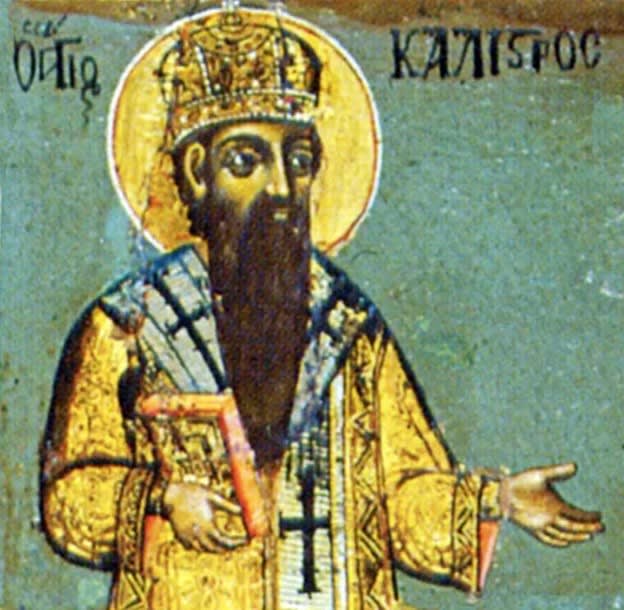
In 1350, Ecumenical Patriarch Callistus I pronounced an anathema against Dušan, Joanikije, and the entire Serbian Church, which was not lifted until 1375.
Nevertheless, the emperor generously endowed the monasteries of Mount Athos, especially the Serbian monastery of Hilandar.
In the conquered territories, he replaced Greek bishops with Slavic ecclesiastical authorities.
The crowning achievement of his religious architecture was his magnificent foundation, the Monastery of the Holy Archangels near Prizren, consecrated in 1347.
The life of the triumphant emperor ended astonishingly early and unexpectedly.
On December 20, 1355, before reaching the age of fifty, Stefan Dušan suddenly died while traveling through his Macedonian possessions.
He was buried in the Monastery of the Holy Archangels.
After the monastery was destroyed by the Ottomans in 1615, his remains were miraculously rediscovered by archaeologists in 1927 and transferred to St. Mark's Church in Belgrade.


The state he had created proved to be a colossus with feet of clay.
As early as 1356, the Empire began to fall apart.
Dušan's half-brother, Simeon Siniša, launched a rebellion in Epirus.
Albania and Thessaly broke away, while Macedonia became independent. In 1365, Vukašin Mrnjavčević proclaimed himself king.
In the very heart of Serbia, ambitious feudal lords divided political power among themselves: Prince Vojislav Vojinović, Nikola Altomanović, and Prince Lazar Hrebeljanović.
Meanwhile, the Balšić brothers established their authority in Zeta.
The vast empire, in the words of Kantakouzenos, shattered "into a thousand pieces."
In popular memory, Stefan Dušan remained an invincible ruler who, as the epic songs proclaimed:
"He restrained the defiant commanders and brought them under our imperial authority."
However, the Church never forgave the first Serbian emperor for the circumstances surrounding his father's death.
Unlike many other members of the Nemanjić dynasty, the creator of the greatest Serbian Empire was never canonized as a saint.


