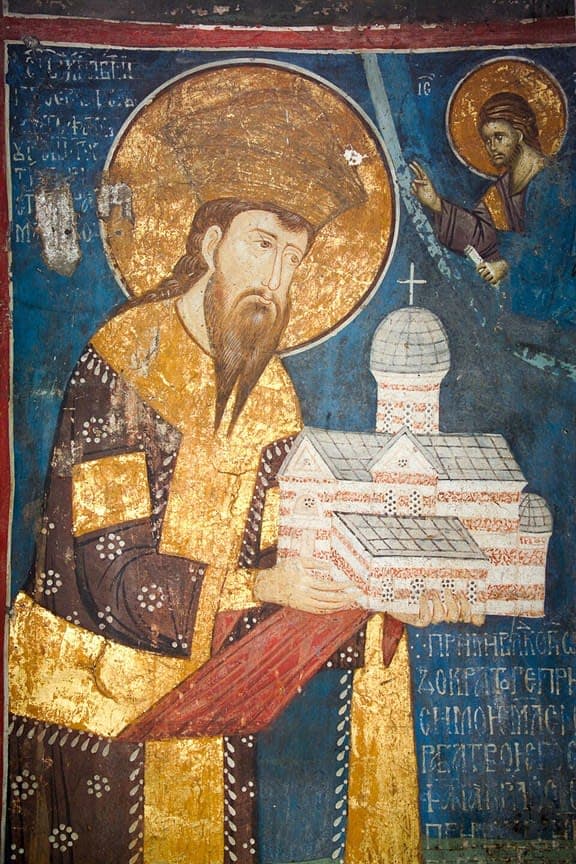

The exact date of Stefan Uroš III's birth has been lost in the mists of medieval history. Chroniclers and historians continue to debate not only the year of his birth but also the identity of his mother.
Some researchers believe that he was born around 1275 from the marriage of King Stefan Uroš II Milutin to the daughter of an influential Serbian feudal lord. Others maintain that his mother was Anna Terter, in which case his birth must have occurred sometime after 1284.

In any case, the young heir's childhood unfolded during harsh and turbulent times.
In 1292, King Milutin became embroiled in a fierce conflict with Shishman, the ruler of the Bulgarian city of Vidin.
Serbia achieved a decisive victory: the kingdom's position was strengthened, and Shishman himself was forced to submit, becoming a Serbian vassal.
However, the triumph proved short-lived.
The overlord of the defeated Shishman, the formidable Nogai, furiously began assembling an enormous army. The core of his horde consisted of swift Tatar and Cuman cavalry, ready to descend upon the Serbian lands.
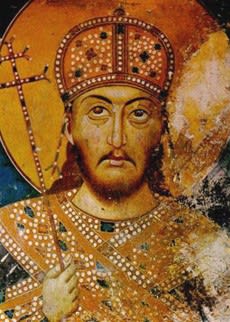
Learning of the approaching storm, King Milutin acted with remarkable speed.
He dispatched an embassy to the khan's headquarters, and the envoys reached Nogai at the very moment when his army was preparing to march.
The details of those tense negotiations have been lost to history, but the ambassadors accomplished something extraordinary: they convinced the khan that Serbia harbored no ambitions toward the territories Nogai considered his own or within his sphere of influence.
The khan canceled the invasion, but the price of peace was high.
As a guarantee of loyalty, he demanded hostages.
Thus, in 1292 or 1293, the young Uroš, together with the children of Serbia's most powerful feudal lords, was sent to Nogai's headquarters.
For seven long years, he lived far from his homeland in the unfamiliar and dangerous world of the nomads, constantly risking his life.
He regained his freedom only after Nogai's death in 1299, when he managed to make a daring escape and return to Serbia.
Soon after the now-mature Uroš returned home, his father decided to strengthen his dynastic position by arranging his marriage to Theodora, daughter of the Bulgarian Tsar Smilets.
Regarding Stefan as his legitimate heir to the throne, Milutin entrusted him with the administration of Zeta, the historical region of Duklja.
This territory enjoyed a special status because, according to ancient tradition, future monarchs governed it before ascending the throne.
There, amid the rugged landscapes of Zeta, Uroš became the father of two sons, Dušan and Dušica, and a daughter named Jelena.

However, peace within the royal family did not last long.
In 1314, Uroš rebelled against his own father.
For years, the Serbian vlastela, the nobility dissatisfied with Milutin's foreign policy, had been gathering around the young governor.
The true motives behind this desperate decision remain shrouded in mystery.
Serbian chroniclers claimed that Uroš had been incited to rebellion by his ambitious supporters.
According to another, more personal interpretation, he lived in constant fear of losing his inheritance. By dissolving his marriage to Uroš's mother, Anna Terter, Milutin had effectively rendered Uroš illegitimate and deprived him of his rights to the throne.
Even the traditional title of Governor of Zeta offered him no guarantee of security.
Both sides began assembling their armies.
Milutin, who commanded enormous resources, mobilized a powerful force and mercilessly invaded Zeta.
Meanwhile, Uroš's forces were visibly diminishing. Some of the feudal lords who had sworn allegiance to him cowardly deserted to the king's side, taking their detachments with them.
The armies of father and son confronted each other near the Bojana River.
However, bloodshed was avoided.
King Milutin offered his son negotiations.
Realizing that the battle had effectively been lost before it had even begun, Uroš appeared before his father and begged for forgiveness.
But mercy was foreign to Milutin.
As soon as the negotiations ended, the king ordered his son to be placed in chains and transported to Skopje.
The sentence was horrifying: blinding, followed by exile to Constantinople together with his wife and both sons.
Yet something extraordinary happened — Uroš did not lose his eyesight.
Whether the executioner had been bribed with gold and merely pretended to carry out the punishment without touching the prince's eyes with the red-hot iron, or whether divine providence had intervened, remains a mystery.
In Constantinople, the disgraced family found refuge at the court of Emperor Andronikos II, who treated them with kindness.
However, sorrow continued to pursue Uroš. Some time after their arrival, his younger son Dušica died from a serious illness.

Only around 1320 did the broken but undefeated Uroš once again begin pleading with his father for forgiveness and permission to return to Serbia.
This time, the highest-ranking officials of the Serbian Orthodox Church intervened on his behalf.
Toward the end of that year, or in early 1321, Milutin finally relented.
Uroš returned to his homeland and received the modest district of Budimlja to govern.
However, his eldest son, the future great commander Dušan, remained at Milutin's court as a hostage.
On October 29, 1321, King Milutin unexpectedly died at his magnificent residence in Nerodimlje.
His death became the signal for a brutal fratricidal struggle.
The deceased king's second son, Stefan Constantine, the former governor of Zahumlje, immediately declared his claim to the crown.
Milutin had entrusted Zeta to Constantine following Uroš's exile, and it was probably Constantine whom the king had regarded as his successor during the final years of his life.

But Uroš possessed an advantage of his own.
As soon as news of his father's death reached him, he removed the bandage covering his eyes and publicly announced that a miracle had occurred — through the grace of Saint Nicholas, his sight had been restored.
The news spread throughout the country like wildfire, attracting crowds of enthusiastic supporters to his cause.
Serbia was divided into two opposing camps, with the army and nobility splitting their loyalties between the brothers.
The Serbian Orthodox Church played the decisive role.
Archbishop Nikodim hastened to crown Uroš under the title "Stefan Uroš III, the Pious King of the Serbian and Maritime Lands."
Hoping to avoid the shedding of brotherly blood, the newly crowned monarch offered Constantine the opportunity to recognize his authority in exchange for becoming the second most powerful man in the kingdom.
But Constantine remained uncompromising.
Convinced that a blind man was incapable of ruling, and relying on a powerful army of foreign mercenaries, he challenged his brother.
In the great battle that followed, Constantine's army was completely destroyed.
His supporters defected to the victor, while Constantine himself was captured.
Uroš showed no mercy.
By his order, Constantine was brutally executed, nailed to a wooden board with iron nails.
Dark rumors soon spread among the population, claiming that the ruthless king had ordered his brother's head to be severed and later drank wine from his skull during royal feasts.
Yet the struggle was far from over.
Stefan Vladislav II, son of Uroš's uncle King Dragutin, escaped from the prison into which Milutin had once thrown him.
Reaching his former territories, Vladislav proclaimed himself the rightful King of Serbia and even began minting his own coins.
He received the support of nobles who had served his father, the Hungarian king, and the Bosnian Ban Stephen Kotromanić.
This exhausting war continued until the spring of 1324.
The principal and bloodiest battles took place near Rudnik and Ostrovica.
Vladislav suffered a crushing defeat, fled to Hungary, and soon died ingloriously in exile.

In October 1322, Stefan Uroš suffered a personal tragedy when his wife Theodora died.
Seeking new political alliances, he planned to marry a daughter of Philip of Taranto, hoping to establish family ties with the powerful Angevin dynasty.
However, these plans were never realized because his enemy Vladislav was related to the House of Anjou through his mother.
Having failed to secure an alliance in the west, the king turned his attention eastward.
In 1324, he married Maria Palaiologina, daughter of John Palaiologos, a nephew of the Byzantine Emperor Andronikos II.
Her father, the ambitious John, cherished an extraordinary dream: to establish his own independent state between Serbia and Byzantium, with Thessalonica as its capital.
The marriage of his daughter to the Serbian king was intended to become the principal instrument for realizing this ambition.
John nearly persuaded Uroš to launch a full-scale war against the Empire.
However, Emperor Andronikos II, alarmed by the prospect of an alliance between these two ambitious rulers, offered his nephew the title of Caesar in exchange for submission.
Shortly afterward, John died, taking his grand ambitions to the grave.
Meanwhile, a conflict was intensifying along Serbia's western borders with Dubrovnik.
Although Uroš had confirmed all the commercial privileges of this wealthy city after his coronation, merchants from Dubrovnik had secretly financed his enemy Stefan Vladislav, and one of them had even commanded the defense of Ostrovica.
The situation escalated around 1325, when the Serbian feudal lords known as the Branivojević family, who governed the town of Ston, began launching unauthorized raids against Dubrovnik in an attempt to gain independence from the Serbian Crown.
The Bosnian Ban Stephen Kotromanić came to the merchants' defense. He defeated the Branivojević family and annexed Ston and part of Zahumlje to his territories.
This forced Uroš to intervene.
In the second half of 1327, the royal army besieged Dubrovnik, mercilessly burning and plundering its suburbs.
In response, Dubrovnik's powerful fleet launched an extensive campaign of piracy at sea, sinking Serbian merchant ships near Kotor.
Mutual exhaustion eventually led to a peace agreement in 1328, under which Dubrovnik undertook to return the territories seized from the Branivojević family.
During these same years, Byzantium was being shaken by a devastating civil war.
The young Andronikos III rebelled against his grandfather, Andronikos II.
Having secured the support of the Bulgarian Tsar Michael Shishman, Andronikos III captured Macedonia and Albania in 1328 and soon made a triumphant entry into Constantinople.
The supporters of the old emperor desperately clung to the frontier towns of Melnik, Prosek, and Strumica, awaiting Serbian assistance.

Stefan Uroš III led his regiments to the Byzantine border, but after assessing the balance of power and listening to the cautious advice of his commanders, he decided against entering a battle that appeared doomed from the outset.
An unexpected move was made by Michael Shishman.
Breaking his alliance with the young emperor, he sided with Andronikos II and advanced toward the capital with an army of three thousand soldiers.
Only the brilliant diplomacy of Andronikos III's envoys prevented the Bulgarians from launching an assault.
The old emperor finally acknowledged his defeat and entered a monastery two years later.
The Serbs, meanwhile, acted pragmatically during this turmoil.
Their only territorial gain was the town of Prosek, whose garrison voluntarily opened its gates to the army of Uroš.
For Andronikos III, this provided an excellent pretext for declaring war.
By 1328, the Byzantine emperor had resolved all his disputes with Bulgaria and established a powerful alliance with Michael Shishman.
The Bulgarian tsar not only regarded Serbia as a dangerous competitor in the struggle for Macedonia but also thirsted for revenge.
In 1324, he had divorced Anna Neda, Uroš's own sister, inflicting a deeply humiliating insult upon the Serbian king.
During 1328–1329, Serbian detachments tested the Byzantine defenses in Macedonia, even laying siege to Ohrid.
However, upon seeing the imperial banners, the Serbs withdrew without offering battle.
In the summer of 1330, Byzantium and Bulgaria launched a coordinated offensive.
The Byzantines devastated the Macedonian frontier, while the Bulgarian army, led by Shishman himself, began plundering the Struma River valley.
Uroš demonstrated his abilities as a strategist by correctly identifying the greatest danger.
Understanding that the union of the two enemy armies would mean the destruction of Serbia, he rapidly marched his troops to intercept the Bulgarians.
The two armies, each numbering approximately 15,000 soldiers, confronted one another near Velbazhd, modern-day Kyustendil.
Uroš needed time for his reinforcements to arrive, so he sent envoys to Shishman with a false proposal for peace.
The arrogant Bulgarian tsar interpreted this as a sign of weakness.
He allowed his detachments to scatter across the surrounding countryside in search of plunder, losing his vigilance.
Early in the morning of July 28, 1330, having received his reinforcements, Stefan Uroš gave the order to attack.
The Serbian assault struck like lightning.
Heavy cavalry and mercenaries, led by the king's eldest son, Stefan Uroš Dušan, broke through the center of the Bulgarian formations.
Shishman's army was annihilated.
According to legend, it was the young Dušan himself who captured the Bulgarian tsar.
Michael Shishman suffered a mortal wound and died several days later, although other chroniclers claimed that he was killed while fleeing or was executed.


Stefan Uroš demonstrated remarkable mercy toward the defeated.
He allowed the Bulgarian feudal lords to bury their ruler with honors in the church of the village of Staro Nagoričane, near Kumanovo.
When the Serbian army advanced toward the Bulgarian capital of Tarnovo, it was met by an embassy of Bulgarian nobles who pleaded for peace and even proposed uniting the two kingdoms.
Uroš rejected the idea of annexation.
He demanded only that his nephew Ivan Stephen, son of the deceased tsar and Anna Neda, be placed on the Bulgarian throne.
Bulgaria retained its existing borders, while Uroš promised not to interfere in its internal affairs.
This noble act became the king's fatal mistake.
The Serbian vlastela, deprived of the opportunity to plunder the Bulgarian territories, became furious.
Their dissatisfaction was led by none other than the victor of Velbazhd himself — the king's son, Stefan Uroš Dušan.
Seeking to suppress the growing rebellion, the king dispatched an army under Dušan's command to reconquer Byzantine cities.
Following a brilliant campaign, Uroš officially granted Zeta to Dušan, proclaiming him his heir.
But the machinery of betrayal had already been set in motion.
As soon as Dušan arrived in Zeta, an aggressive faction of young nobles gathered around him, eager for war and power.
They skillfully exploited the prince's fears, whispering that the king intended to transfer the crown to his younger son by Maria Palaiologina — Simeon Siniša.

In the autumn of 1330, open warfare erupted between father and son.
The royal army invaded Zeta, devastating its territories, but Dušan skillfully avoided a decisive confrontation.
Realizing that the pursuit was futile, Uroš proposed negotiations, restoring the status quo.
But this was merely an illusion of peace.
Fearing royal revenge and pressured by threats from his own feudal lords, who promised to abandon him if he hesitated, Stefan Dušan decided to take a treacherous step.
On August 21, 1331, at the head of a small detachment of elite warriors, Dušan launched a surprise attack against the royal palace in Nerodimlje.
Stefan Uroš fled to the fortress of Petrič but was soon forced to surrender.
The deposed monarch, together with his wife Maria Palaiologina, his son Simeon Siniša, and his daughter Theodora, was placed in chains and thrown into the grim dungeons of Zvečan Fortress.
On September 8, 1331, the coronation of the new ruler, Stefan Dušan, took place at the palace in Svrčin.
The life of Stefan Uroš III came to an end on November 11, 1331, in a cold prison cell at Zvečan.
The mystery surrounding his death has never been resolved.
Some whispered that he had died of natural causes, others claimed that he had been executed on Dušan's orders, while still others swore that the son had strangled his father with his own hands.
His body found its final resting place in Visoki Dečani Monastery, a magnificent religious foundation constructed by the king himself, from which he received his popular epithet, "Dečanski."
In 1339, the Serbian Orthodox Church canonized him as a saint.
A sinister legend arose following his death.
It was said that in his final moments, looking into the eyes of his murderers, King Uroš pronounced a terrible curse that would fall upon the descendants of his treacherous son and upon the entire Serbian state.
Although Stefan Dušan himself escaped its consequences, fate eventually caught up with his son, Uroš V, during whose reign the Serbian Empire collapsed.
The Serbs would later recall this ancient curse of the blinded and strangled king with sorrow when Prince Lazar fell upon the blood-soaked fields of Kosovo and Serbia descended into centuries of Ottoman domination.


