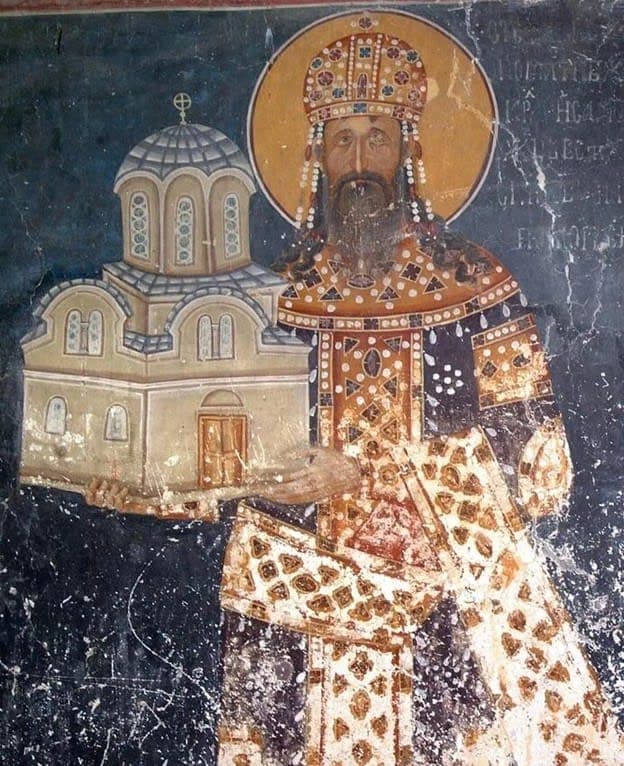

The exact date of Stefan Milutin's birth remains shrouded in the mists of medieval history. It is generally believed that he was born in 1253 as the second son of the powerful Serbian king Stefan Uroš I and his ambitious wife, Helen of Anjou.
The royal family was large. In addition to his elder brother Dragutin, Milutin had a brother named Stefan, who died in 1264, a sister named Brnča, a nun who also passed away in 1264, and another sister whose name has not been preserved in historical chronicles.

The chronicles reveal little about the prince's childhood and early youth.
Milutin first emerged onto the stage of major political events in 1267. At that time, his father, Stefan Uroš I, decided to free Serbia from its suffocating dependence on Hungary and seek a new, powerful ally in the south — the recently restored Byzantine Empire.
Constantinople responded favorably. Emperor Michael VIII Palaiologos desperately needed a strategic foothold in the Balkans.
Intense negotiations began over a marriage between the emperor's daughter, Princess Anna Palaiologina, and the young Milutin.

In 1268, a magnificent Byzantine delegation arrived at the Serbian royal court.
Since the Greeks categorically refused to marry the emperor's daughter to anyone other than the heir to the throne, Uroš resorted to a daring diplomatic deception.
As historian Željko Fajfrić observes, the king assured the envoys that his eldest son Dragutin was gravely ill and physically incapable of governing the kingdom, meaning that the crown would pass to Milutin.
Princess Anna, accompanied by an entourage of nobles, arrived in the Macedonian city of Beroea.
From there, an advance delegation led by the future Patriarch of Constantinople, John XI Bekkos, traveled to prepare the Serbian royal residence.
What they encountered shocked the refined Byzantines.
The royal palace appeared almost ridiculously modest to them, but the final insult came when they saw the king's daughter-in-law, Dragutin's wife Catherine, sitting in the hall and spinning yarn with her own hands.
For members of an imperial family, such an occupation was unthinkable.

An enormous scandal erupted.
John Bekkos and King Uroš engaged in a furious argument. The Serbian ruler accused the Byzantines of a corrupt obsession with luxury, while the Greeks contemptuously described Serbia as a backward land of barbarians.
Bekkos hurried back to Beroea, pleading with the princess to cancel the wedding.
However, the proud Anna refused to surrender and continued her journey as far as Ohrid.
Meanwhile, Bekkos made another attempt to negotiate with Uroš, but his delegation was completely robbed by local bandits along the way.
Ultimately, it was not the poverty of the Serbian court that destroyed the alliance, but the exposure of the king's deception.
According to the chronicler George Pachymeres, John Bekkos personally encountered Prince Dragutin at court and discovered that he was in perfectly good health.
Realizing that Uroš had deceived the emperor regarding the succession to the throne, the envoys terminated the agreement.
Princess Anna and Bekkos returned to Constantinople in disgrace.
Stefan Uroš I ruled with an iron hand, categorically refusing to grant separate territories to his sons.
His eldest son Dragutin, who remained trapped at his father's court, had demanded genuine political authority for years.
Relying on the support of his father-in-law, King Stephen V of Hungary, Dragutin attempted to obtain control over a portion of the kingdom.
Historian Sima Ćirković believes that this had been one of the conditions for Uroš's release from Hungarian captivity back in 1268.
However, Uroš remained uncompromising.
Another categorical refusal followed in 1275, immediately after the Serbian war against Dubrovnik.

In 1276, Dragutin's patience finally ran out.
Supported by a dissatisfied faction of the nobility, he fled to Hungary to obtain an army.
Historians continue to debate the underlying causes of the rebellion. Mihailo Dinić sees it as an ordinary desire for power, while the Greek scholar L. Mavromatis argues that the uprising was provoked by Milutin's official designation as heir to the throne.
With Hungarian and Cuman regiments, Dragutin invaded Serbia.
At the fateful Battle of Gacko, the aging king's army was crushed.
Archbishop Danilo II described the event in The Life of Saint Stefan Dragutin with epic grandeur:
"And because there was a great battle between them in the land called Gacko, the son defeated his father and seized his throne by force..."

The deposed father took monastic vows at Sopoćani Monastery, where he died in 1277.
Having become king, Dragutin was forced under pressure from the nobility to divide the country.
He granted his mother Helen extensive possessions: Zeta, Travunia, and the coastal territories, including Konavle and Cavtat.
Milutin's role in these dramatic events remains a mystery.
It is known only that by this time he was married to the daughter of a local nobleman and was living peacefully at his mother's court in Shkodër.
Željko Fajfrić suggests that Milutin nevertheless received some territory to govern.
However, as historian John Fine correctly observed, decentralization triggered a dangerous process: regional rulers began acquiring alarming levels of autonomy.
Dragutin's reign brought no peace to Serbia.
The vlastela, the Serbian nobility, openly complained about the excessive Hungarian influence at court, the king's passivity during the civil war in Bulgaria, and the humiliating defeats inflicted by Byzantium.
Moreover, the population could not forgive Dragutin for the sin of waging war against his own father.
The turning point came unexpectedly.
In 1282, Dragutin fell from his horse.
His leg injury was so severe that gangrene developed, placing the monarch's life in immediate danger.
According to the official account given by Danilo II, the crippled king convened an assembly at Deževo, where he voluntarily abdicated in favor of Milutin because of his deteriorating health.
However, modern researchers regard the Assembly of Deževo as a quiet coup d'état.
The haste of the abdication raises suspicions: Dragutin did not even attempt to establish a regency council.
Most scholars agree that the injury merely provided a convenient pretext.
The powerful aristocracy, dissatisfied with military defeats, effectively forced the king to step down, believing that the young Milutin would be easier to control.
One theory even suggests that Milutin was not present at the assembly and that all the decisions were dictated by the nobility.
The outcome of Deževo redrew the political map of the Balkans.
Milutin received the crown and central Serbia, while Dragutin retained the northern territories of Srem, together with Uskoplje and Dabar in the Lim River valley.
The question of succession remains controversial. Some Byzantine sources claim that Dragutin's son Vladislav was declared Milutin's heir, but L. Mavromatis considers this an error.
Distrustful of his brother, Dragutin established himself near the Hungarian border, taking a portion of the nobility loyal to him.
In practice, the kingdom was on the verge of splitting into two independent states.
Milutin inherited the crown at a critical moment.
On one hand, the nobility demanded war and plunder. On the other, Serbia was bound by a military alliance with Charles of Anjou against Byzantium.
Fulfilling his obligations, the young king launched his army southward in 1282.
The Serbs easily overwhelmed Byzantine defensive positions and captured several towns in Macedonia.
This triumph immediately elevated Milutin's standing among the warlike Serbian nobility.

The Byzantines anxiously anticipated a march on Constantinople, but Milutin, having secured his conquests and expelled the Greek nobility, returned home.
That same year, he made a dramatic political maneuver: he divorced his first wife and married a daughter of John I Doukas, the ruler of Thessaly and Byzantium's principal enemy at the time.

Meanwhile, a storm was gathering in Constantinople.
Emperor Michael VIII had assembled an enormous army consisting of Tatar, Turkish, Norman, Bulgarian, and Russian mercenaries.
However, on December 11, 1282, shortly after beginning his campaign, the emperor suddenly died near Rhaedestus.
His successor, Andronikos II Palaiologos, changed the plan and sent Tatar cavalry against Serbia.
Dividing into separate detachments, the steppe warriors advanced as far as Prizren and Lipljan.
However, while attempting to cross the Drin River, a large Tatar detachment was utterly defeated by Serbian forces.
The surviving mercenaries fled in terror.

Taking advantage of his enemy's weakness, Milutin summoned his brother Dragutin for assistance.
In the autumn of 1283, their combined army swept through Macedonia like an unstoppable force, advancing all the way to the Aegean Sea.
It was a campaign of unprecedented scale.
In 1284, Poreč, Kičevo, and Debar fell.
The new frontier followed the line Strumica–Prosek–Prilep–Ohrid–Krujë.
Milutin entrusted its defense to Kotanitzes, a talented Byzantine military commander who had defected to the Serbian side.
Against the backdrop of military victories, the king's personal life became a diplomatic kaleidoscope.
In 1283, he dissolved his short-lived marriage to the Thessalian princess, who had given birth to his son Constantine, and married the thirty-year-old Hungarian princess Elizabeth.
The scandal was enormous.
Elizabeth was a nun in Buda and the sister of Dragutin's wife.
Having persuaded the Orthodox Church authorities to overlook the violations of canon law, Milutin remained married to her until the birth of their daughter Zorica.
But in 1284, he divorced yet again.
Elizabeth returned to her monastery, while the king married Anna Terter, daughter of the Bulgarian Tsar George I.

Soon, war came from the east.
The notorious raider brothers Drman and Kudelin had established themselves in the fortress of Ždrelo on the Mlava River, terrorizing Dragutin's northern territories.
In 1285, they destroyed a Hungarian punitive army.
When Dragutin's own troops were defeated and the Tatars hired by the raiders devastated his lands, the ruler of Srem desperately appealed to Milutin for help.
In 1290, the brothers' united Serbian army razed the raiders' stronghold to the ground, and Braničevo passed into Dragutin's possession.
But this triumph awakened formidable enemies.
In response to the capture of Braničevo, Shishman, ruler of the Despotate of Vidin, unexpectedly invaded Serbia, probably acting on the direct orders of his overlord, Nogai.
His hordes advanced as far as Peć, but Milutin launched a devastating counterattack.
Shishman fled across the Danube by boat, while Vidin surrendered to the Serbs.
Demonstrating diplomatic wisdom, Milutin chose not to devastate the city.
He restored Shishman to his throne as a vassal, arranged the marriage of his daughter Ana to Shishman's son Michael, and married Shishman's daughter to the Serbian feudal lord Dragaš.
The eastern frontier was now securely protected.

However, Nogai, the effective ruler of the Golden Horde, was furious that Milutin had brought his vassals under Serbian control.
An enormous Tatar army had already set out on a punitive expedition against Serbia.
Milutin acted with remarkable speed: his envoys intercepted Nogai during his march.
Their assurances of submission succeeded, and Nogai halted his army, but demanded hostages.
In 1292 or 1293, Milutin's young son Stefan, accompanied by children from the highest-ranking noble families, was sent to Nogai's headquarters.
They would regain their freedom only after seven long years, when Nogai was killed during an internal conflict in 1299.

Having secured his frontiers, Milutin expelled the Byzantine garrison from Dyrrhachium in 1294 or 1296.
In 1297, Byzantium attempted to retaliate, but the army of the celebrated commander Michael Glabas was defeated by the Serbs.
Exhausted, Emperor Andronikos II requested peace.
Milutin, who wanted to permanently secure Serbia's conquests in Macedonia, agreed.
The price of this peace shocked Europe.
Andronikos initially offered his sister Eudokia to the Serbian king in marriage, but she categorically refused.
The emperor then sacrificed his own five-year-old daughter, Simonis.
The reaction in both countries was intense. The Orthodox clergy opposed the marriage, as did the king's mother, Helen of Anjou.
But the coldly pragmatic Milutin agreed to everything.
In 1299, he handed over his wife Anna Terter and his loyal Byzantine-born commander Kotanitzes to the Byzantines as hostages.
In exchange, Constantinople officially recognized all of Serbia's territorial borders.
This peace came at a heavy domestic political cost to the monarch.
Deprived of military plunder, the furious Serbian vlastela began defecting to the northern ruler, Stefan Dragutin.
Realizing that Milutin intended to transfer the throne to his own son Stefan rather than Dragutin's heir Vladislav, Dragutin raised the banners of rebellion.
Around 1301, a fratricidal war broke out, lasting ten exhausting years.
Dragutin counted on Hungarian assistance, but Hungary had become engulfed in a dynastic crisis.
Milutin, meanwhile, received support from Byzantium.
The decisive factor was money.
In 1302, Milutin captured the immensely valuable silver mines at Rudnik.
It was this silver that enabled him to hire entire armies of mercenaries, compensating for the betrayal of his own nobility.
The exhausting war of sieges finally ended sometime between 1312 and 1314 through the mediation of the Church.
Both sides returned to their prewar borders, and Rudnik was restored to Dragutin.
However, the question of succession remained unresolved — a political time bomb waiting to explode.
In 1314, a new wave of bloodshed swept through Serbia when Milutin's son, Stefan Dečanski, rebelled.
Surrounded by rebellious nobles, Stefan was serving as governor of Zeta.
The chroniclers disagree about the causes of the uprising. Some blame the prince's entourage, while others point to Stefan's fear of losing his rights to the throne after his father had rejected his mother, Anna Terter.

Both sides assembled their armies along the Bojana River.
Seeing that his forces were superior, Milutin resorted to treachery: he offered his son negotiations.
Trusting his father, Stefan appeared before him and submitted.
The outcome was horrifying.
Milutin ordered his son to be seized, taken to Skopje, and blinded.
The mutilated prince was then exiled to Constantinople together with his wife and two sons.
A miracle, or perhaps the bribery of the executioner, preserved Stefan's eyesight, but for many years he would wear a bandage over his eyes, concealing this secret.
Having suppressed the rebellion, Milutin met Dragutin at the royal residence of Paunpolje.
The aging brothers finally reconciled.
On March 12, 1316, Stefan Dragutin died.
Without wasting a moment, Milutin violated all their agreements, imprisoned his nephew Vladislav, and seized almost all his brother's territories.
Only Mačva and Belgrade remained free, but in 1319 they too were absorbed by Hungary.

Milutin's greed provoked another war.
In 1317, Serbian forces besieged Dubrovnik and brutally devastated its surrounding territories, retreating only when threatened by intervention from the Venetian fleet.
At the same time, King Charles Robert of Hungary, supported by Pope John XXII, launched a crusade against Serbia.
In the spring of 1318, the forces of the Croatian Ban Mladen II Šubić attacked the Serbs, but by 1319 they had been defeated.
Šubić signed a humiliating peace agreement, surrendering his brother, Prince Grgur, as a hostage.
The offensive launched by Albanian feudal lords also failed.
Only Charles Robert achieved success, reconquering Mačva and Belgrade, after which the front finally stabilized.

The final years of the great king were overshadowed by bitterness and illness.
In 1317, the young Queen Simonis traveled to Constantinople for her mother's funeral and attempted to escape from her hated husband.
She secretly took monastic vows at a monastery in Serres.
However, her own brother, Constantine Palaiologos, tore off her monastic garments and forcibly returned her to the aging Serbian ruler.
Only in 1320, yielding to the pleas of the Orthodox clergy, did Milutin allow his exiled son Stefan to return to his homeland.
One year later, while staying at his residence in Nerodimlje, the iron-willed monarch, whose determination had reshaped the political map of the Balkans for half a century, suffered a severe stroke.
Paralyzed and deprived of the ability to speak, the king visibly deteriorated.
News of the ruler's helpless condition spread throughout the country, provoking chaos and widespread banditry.
Having failed to appoint an official successor, Stefan Uroš II Milutin died on October 29, 1321.
He was buried in Banjska Monastery, which he himself had founded.
The fate of his remains proved almost as turbulent as his life.
His relics were later transferred to Trepča, and in 1460 they found their final resting place in the Cathedral of Saint Nedelya in Sofia.
Just over two years later, the Serbian Orthodox Church canonized the formidable monarch, remembering his generous donations, the monasteries he had constructed, and his suppression of heresy.
Thus, his name was permanently inscribed in the religious and historical memory of Serbia.


