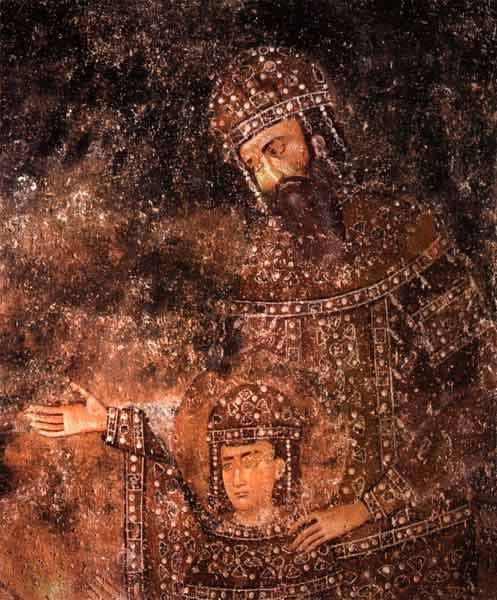

Stefan Uroš I, the youngest son of the Serbian king Stefan the First-Crowned, born to his second (or third) wife, Anna Dandolo, came into the world during an era of severe trials for his country.
During his father's reign, Serbia had proudly maintained its status as a sovereign state. However, Uroš's elder brothers lacked the political determination necessary to preserve this position. His eldest brother, Stefan Radoslav, had fallen into humiliating dependence on the ruler of Epirus, Theodore Komnenos Doukas, while his successor, Stefan Vladislav, had become an obedient puppet of the Bulgarian Tsar Ivan Asen II.

The death of Vladislav's protector, the Bulgarian tsar, immediately gave the Serbian opposition an opportunity to act. The dissatisfied nobility openly rebelled against the king.
Vladislav might have succeeded in suppressing the uprising had Europe not been struck by a catastrophe of unprecedented proportions — the Mongol invasion.
Between 1206 and 1227, the Mongols swept through Asia with fire and sword. By the end of 1242, their armies had conquered most of the Russian principalities and reduced the lands of Poland, Bohemia, and Hungary to ruins, including territories that form part of modern-day Croatia and Bosnia and Herzegovina.
Returning to the Caspian steppes, the hordes of Batu Khan passed through the Balkans, devastating Bulgaria and Serbia.

Serbia lay in ruins.
The ancient cities of Kotor, Drivast, and Svač had been burned to the ground.
However, the population managed to avoid mass extermination. Large numbers of people fled into dense forests, where the heavily armed Mongol cavalry did not dare to venture.
Against this background of destruction and growing resentment toward Bulgarian influence, the Serbian nobility placed its hopes in the young and ambitious Stefan Uroš.
In the spring of 1243, Vladislav, unable to withstand the pressure, abdicated the throne.
The transfer of power was not bloodless. Uroš quickly crushed his brother's resistance and, according to historians, held him in captivity for some time.
However, Vladislav still had a powerful ally — his wife, Queen Beloslava.
Refusing to accept the coup, she fled to the fortified city of Dubrovnik, from where she began plotting against the new king.
This confrontation is documented in a historical decree issued by Uroš in the summer of 1243, in which the citizens of Dubrovnik swore allegiance to the new monarch and guaranteed that Beloslava would cease her subversive activities.

Fortunately for Uroš, the dynastic crisis was resolved wisely and quickly.
The brothers concluded a peace agreement.
Uroš demonstrated generosity by granting Vladislav control over Zeta and even allowing him to retain his royal title.
Historians continue to debate the true causes of this fraternal conflict, but it is evident that Vladislav's loss of power was a direct consequence of a geopolitical catastrophe — the death of his Bulgarian father-in-law and the devastating Mongol invasion.
No sooner had Stefan Uroš ascended the throne than he began pursuing an aggressive and carefully calculated foreign policy.
His wife, Queen Helen of Anjou, a relative of the Sicilian king Charles and a woman of remarkable political insight, played an enormously important role in Serbia's diplomatic maneuvers.

The weakening of neighboring states allowed Uroš to embark on territorial expansion.
His principal objectives were the subjugation of western Zahumlje and the strengthening of Serbia's northern frontiers with Hungary.
In 1252, a major crisis erupted with the wealthy city-republic of Dubrovnik.
Numerous causes for war had accumulated: a dispute over who had the right to collect taxes from Catholics living along the coast — the Archbishop of Dubrovnik or the Serbian Bishop of Bar — competition for commercial privileges, border skirmishes, and old grievances connected with Dubrovnik's protection of Beloslava.
The dispute eventually reached the papal court, where Uroš and his brother Vladislav presented a united front in support of Bar.
Contemporary chronicles portray Uroš as a ruthless pragmatist who deliberately provoked the conflict, seeking either to bring Dubrovnik under his control or to drive the Venetians out of Serbia.
At the head of a large, heavily armed army, the king approached the walls of Dubrovnik and set all its suburbs ablaze.
Detachments of the city's defenders marched into the open countryside, but no major battle took place.
The citizens of Dubrovnik feared destruction, while Uroš, an experienced military commander, understood that the city's formidable walls could not easily be taken by assault.
Dubrovnik responded with a diplomatic offensive.
In 1253, the republic concluded a military alliance with the Bulgarian Tsar Michael Asen I and the Župan of Zahumlje, Radoslav.
The city paid generous tribute to the King of Hungary in exchange for his protection and promised to surrender to the Bulgarians every Serbian fortress that the allies managed to capture.
Soon afterward, a Bulgarian army, composed primarily of fierce Cuman mercenaries, invaded Serbia.
The invaders plundered the countryside as far as the Lim River and burned Bijelo Polje, but they failed to consolidate their gains and eventually retreated.

In the autumn of 1254, Uroš demonstrated extraordinary diplomatic skill by dismantling the hostile coalition.
He concluded a separate peace agreement with the Bulgarians, restoring the status quo.
That same year, a peace treaty was also signed with Dubrovnik.
Both sides compensated each other for their losses, but Serbia emerged victorious.
In exchange for the right to conduct trade within the kingdom, the republic agreed to pay Uroš the enormous sum of 2,000 gold coins annually.
Moreover, Dubrovnik permanently renounced its right to collect taxes from Serbian Catholics, transferring this authority to the Bishop of Bar.
The fate of the internal traitors was decided harshly.
Župan Radoslav disappeared from the pages of history, while Uroš simply annexed his territories to the Crown.
The dynasty that had ruled Zahumlje was reduced to the status of minor feudal lords in Popovo Polje.
George, the ruler of Zeta, who had also supported the rebellion, was likewise deprived of power.
The king appointed his loyal governors in their places.
Meanwhile, the Empire of Nicaea was rapidly gaining strength in the south.
Its ruler, John III Doukas Vatatzes, had seized Thrace, Macedonia, and Thessalonica from the Bulgarians in 1246, and by 1252 had occupied western Macedonia and Albania.
Observing these triumphs, Manfred, the Hohenstaufen King of Sicily, entered the political struggle by supporting the enemies of Nicaea.
During Vatatzes's lifetime, Stefan Uroš maintained friendly relations with him, welcoming the weakening of Bulgaria.

But in politics, there are no eternal friends.
When Vatatzes died around 1254, Uroš abruptly changed his political course.
Taking advantage of the chaos and the invasion of Epirote and Sicilian forces, the Serbian king launched a swift offensive in 1258, capturing the Greek cities of Skopje, Prilep, and Kičevo.
However, his triumph was short-lived.
In 1261, the new emperor, Michael VIII Palaiologos, restored the Byzantine Empire and regained control over part of Macedonia.
Realistically assessing the strength of the revived Byzantine state, Uroš withdrew his troops to Serbia without offering battle.

Along his northern borders, Uroš actively intervened in the conflict between the Hungarians and the Bohemians, supporting King Béla IV of Hungary as an ally.
This alliance was reinforced through marriage: Uroš's eldest son, Dragutin, married the Hungarian princess Catherine, daughter of Prince Stephen.
In 1264, Uroš even attended the magnificent wedding of the young Hungarian prince Béla.

However, peace with Hungary collapsed in 1268.
Seeking to exploit the internal conflict between King Béla and his son Stephen, Uroš invaded the Hungarian territory of Mačva.
The beginning of the campaign was successful, but the Serbian army was soon defeated by the arriving forces of Ban Béla Rostislavich.
Uroš himself suffered the humiliation of being taken prisoner.
His freedom had to be purchased through political concessions.
The Hungarians released the king only after securing firm guarantees that his son Dragutin, who was connected to the Hungarian royal court through marriage, would receive genuine political authority in Serbia.
From that moment onward, Dragutin began to be officially referred to in documents as the "Junior King."
Recognizing the growing threat from Hungary, Uroš attempted to establish closer relations with Byzantium around 1268.
Emperor Michael VIII, who desperately needed allies in the Balkans, agreed to a proposal to marry his daughter Anna Palaiologina to Uroš's younger son, Milutin.

In 1269, a magnificent Byzantine delegation arrived in Serbia.
Uroš was forced to resort to deception, informing the envoys that his eldest son Dragutin was gravely ill and that Milutin would therefore become the heir to the throne.
The envoys had refused to marry the princess to anyone other than the future monarch.
Princess Anna arrived in the Macedonian city of Beroea, from where an advance Byzantine delegation, led by the future Patriarch John XI Bekkos, departed to inspect the Serbian royal court.
The encounter between the two cultures proved disastrous.
The refined Byzantines were shocked by the austere simplicity of the Serbian royal residence.
But the final insult came when they saw Dragutin's wife, the Hungarian princess Catherine, sitting in the hall and personally spinning yarn — an occupation considered utterly unthinkable for a woman of royal blood at the imperial court in Constantinople.

A fierce argument erupted between Uroš and John Bekkos.
The king accused the Greeks of excessive refinement and corrupting luxury, while the Byzantines responded by describing Serbia as a savage country that had barely risen above barbarism.
Returning to Beroea, Bekkos pleaded with the princess to cancel the wedding, but the proud Anna continued her journey as far as Ohrid.
Meanwhile, Bekkos traveled to Uroš once again, but his delegation was robbed by local bandits along the way.
To make matters worse, Bekkos accidentally encountered the supposedly "gravely ill" Dragutin at the Serbian court and discovered that he was in perfectly good health.
The deception had been exposed.
According to the chronicler George Pachymeres, the agreement was immediately terminated, and the princess returned to Constantinople in disgrace.
The offended Uroš did not leave the insult unanswered.
When Charles of Anjou, who dreamed of restoring the Latin Empire, ascended the Sicilian throne in 1266, the Serbian king, influenced in part by his wife Helen, joined a powerful anti-Byzantine coalition in 1272 or 1273.
The alliance included the rulers of Sicily, Achaea, Epirus, Bulgaria, and Thessaly, whose ruler's daughter Helen became Milutin's wife.
However, the grand war never materialized. Byzantium launched a preemptive strike in Albania, disrupting the allies' plans.

Uroš did not remain inactive in the west either.
In 1275, he once again sent his army to assault the hated city of Dubrovnik.
For the first time in the city's history, its ruler, Petar Čepolo, refused to remain behind the defensive walls. Instead, he led his army into the open field and repelled the Serbian offensive.
The fleet of Dubrovnik attempted to retaliate by devastating the coastline, but it fell into a carefully prepared ambush organized by Uroš.
The fleet was defeated, approximately forty noble patricians were captured, and its commander, Benedict Gundulić, was brutally blinded on the king's orders.
Only the intervention of Venice brought an end to the bloodshed and led to peace.
Continuous warfare required enormous financial resources, and Uroš found a way to transform Serbia into an economically prosperous kingdom.
The principal driving force of this economic development was the migration of Saxon miners, known in Serbia as the Sasi, who had fled Transylvania between 1241 and 1250 to escape Mongol terror.
The king granted them extensive self-government through the so-called "Saxon privileges."
In exchange for paying taxes to the royal treasury, the Saxons established numerous mines, extracting gold, silver, lead, and tin.
To protect them, the king created special armed detachments.
New and prosperous towns rapidly developed around the mining centers, where the local Serbian population gradually became integrated into the expanding economy.
The boom in mining and metallurgy stimulated international trade and allowed Uroš to begin minting his own silver coinage, which became highly valued throughout Europe.
To encourage commercial activity, the king concluded agreements personally guaranteeing compensation to merchants for losses caused by bandits.

"And thus, thanks to the many mines that they opened for him, his wealth increased greatly, and he became very rich. His predecessors had been unable to achieve this, for they had lived simply and had not concerned themselves with accumulating wealth or attracting money."
Economic prosperity was accompanied by a cultural renaissance.
Uroš skillfully subordinated the Church to the interests of the state.
In 1263, he secured the appointment of his brother Sava as Archbishop of Serbia, followed by the appointment of John, an Athonite monk devoted to the king.
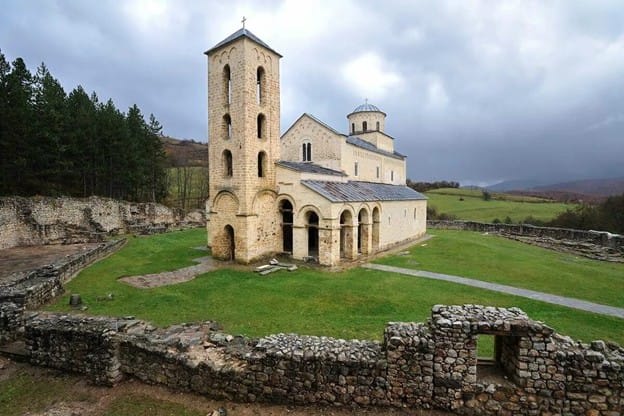
During the 1260s, the magnificent Sopoćani Monastery was constructed by royal command.
Its frescoes, depicting biblical scenes and members of the royal family, became an unsurpassed masterpiece of 13th-century Serbian painting.
At Hilandar Monastery on Mount Athos, Uroš constructed a Chapel of the Transfiguration.
He also commissioned the celebrated monk Domentijan to compose two major works — The Life of Saint Sava and The Life of Saint Simeon.
Seeking to preserve the unity of his kingdom, Stefan Uroš categorically refused to divide the country or grant separate appanages to his sons.
This decision would prove fatal.
His eldest son Dragutin, supported by his father-in-law, King Stephen V of Hungary, demanded a portion of the kingdom for years.
Following the difficult war against Dubrovnik in 1275, tensions reached their breaking point.
Uroš once again responded to his son's demands with a cold refusal.
In 1276, Dragutin launched a rebellion.
Rallying dissatisfied Serbian nobles around him, he fled to Hungary, where he received powerful military support from the king, including Hungarian mercenary detachments and fierce Cuman warriors.
With this army, the son invaded his father's territories.
The two armies met in a decisive battle near the town of Gacko.
The forces of the aging king were unable to withstand the assault and were completely defeated by his own heir.
A Serbian chronicler recorded this tragic moment with bitterness:
"And because there was a great battle between them in the land called Gacko, the son defeated his father and seized his throne by force. And when he began to rule upon his father's throne in the Serbian land, he called himself Stefan, the pious, Christ-loving, autocratic king of all the Serbian, Maritime, Danubian, and Srem lands."
The proud monarch, whose determination had restrained empires and dictated terms throughout the Balkans for decades, was finally broken.
Following his defeat at Gacko, Stefan Uroš I abdicated the throne.
He found his final refuge within the walls of Sopoćani Monastery, which he himself had founded, and took monastic vows.
There, far from political intrigues and the clash of swords, the great Serbian ruler died peacefully in 1277.
He left behind a wealthy and powerful kingdom, but one divided by the ambitions of his own heirs.


