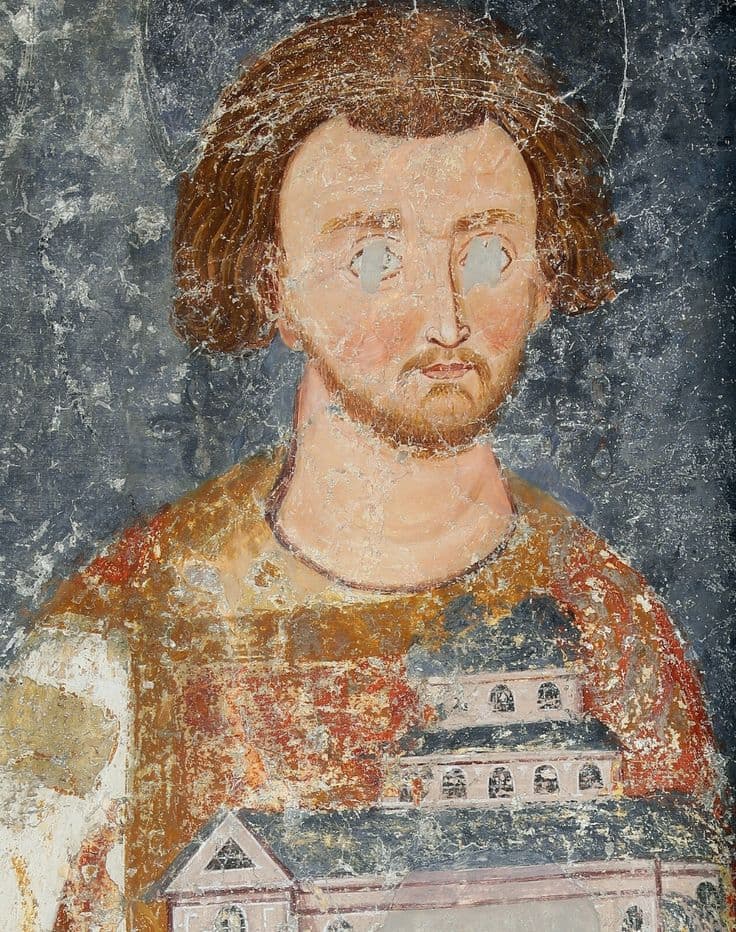

Stefan Radoslav was born in 1192 as the firstborn son of the great Serbian ruler Stefan Nemanjić (the future Stefan the First-Crowned) and the refined Byzantine princess Eudokia. From birth, the blood of the powerful Nemanjić dynasty and the proud Byzantine emperors flowed through his veins. However, the young heir's childhood coincided with a period of fierce political turmoil.

Nine years after Radoslav's birth, in 1201, his father, seeking political advantage and hoping to establish closer relations with the Pope, made a deliberate and scandalous break with Byzantium.
Radoslav's mother, Eudokia, was expelled and sent back to Constantinople. As a pretext for dissolving the marriage, she was publicly accused of adultery and even alleged to be suffering from scabies.
The imperial court in Constantinople, however, chose not to attach political significance to this insulting gesture and simply considered the marriage dissolved.
Despite growing up without his mother, the young Radoslav absorbed her cultural heritage, developing a profound lifelong attachment to Byzantine culture and traditions.
As the years passed, Serbia's geopolitical orientation changed once again.
Soon after his long-awaited coronation in 1217, Stefan the First-Crowned recognized the need to return to his previous political course — relying on the Orthodox powers of the Balkans.
A diplomatic bridge was established with the increasingly powerful Despotate of Epirus.
As part of this alliance, the ambitious ruler of Epirus, Theodore Komnenos Doukas, gave his daughter Anna in marriage to Stefan Radoslav, firmly drawing the heir to the Serbian throne into his sphere of influence.

In 1228, King Stefan the First-Crowned died.
According to the principle of primogeniture, the throne passed to Radoslav, whose solemn coronation took place in Serbia's spiritual center — the famous Žiča Monastery.
However, from the very first days of his reign, the new king demonstrated that his heart belonged not to Serbia.
Radoslav fell completely under the overwhelming influence of his domineering father-in-law, Theodore Komnenos Doukas, and his wife Anna.
The Byzantine upbringing he had inherited from his mother played a considerable role in this development.
As Serbian historian Željko Fajfrić perceptively observes, Radoslav took far greater pride in his connection to the ancient dynasty of Byzantine emperors than in his descent from the illustrious Serbian House of Nemanjić.
This cultural divide quickly began to irritate the proud Serbian nobility, known as the vlastela.
The king's Hellenophilia assumed forms that offended the national identity of his subjects.
On official state charters, Radoslav signed his name using his mother's family name, "Doukas," while newly minted Serbian coins bore inscriptions exclusively in Greek rather than Serbian.
The king's dependence on the wishes of his father-in-law and wife alienated the Serbian elite, but Radoslav himself remained oblivious to the growing danger.
Enjoying the powerful protection of the ruler of Epirus, he lived under the illusion of complete security.
Indeed, Radoslav's position appeared unshakable for as long as Theodore Komnenos Doukas maintained his military and political power.
But the history of the Balkans has rarely been merciful to rulers who rely solely on foreign military strength.
In 1230, a geopolitical catastrophe struck.
At the great Battle of Klokotnitsa, the army of Epirus was utterly defeated by the Bulgarian Tsar Ivan Asen II.
Radoslav's seemingly invincible father-in-law fell into Bulgarian captivity.

With the downfall of Theodore Komnenos Doukas, the Serbian king's position immediately and critically weakened.
Having lost his external support, Radoslav found himself alone against the dissatisfied Serbian nobility.
Resentment that had been growing for years finally erupted in 1233, when several influential noble families launched an open rebellion.
According to the medieval biographer Theodosius, the nobility definitively withdrew its support from Radoslav and sided with his younger brother — the young and ambitious Vladislav.
In the autumn of that same year, 1233, Radoslav was forced to flee his homeland in haste to save his life.
Thus began the bitter wanderings of the deposed monarch, who desperately sought to regain his crown.
He first turned his attention to the wealthy trading city of Ragusa (Dubrovnik).
Radoslav promised the city's governor generous commercial privileges in exchange for military and political support.
However, his brother Vladislav acted preemptively. He began openly threatening Ragusa, forcing the city to refuse assistance to the fugitive king.

Radoslav then appealed for help to the Bosnian Ban Matej Ninoslav, but this diplomatic mission also ended in failure.
His final hope was Dyrrhachium (modern-day Durrës), where Manuel Komnenos ruled.
Yet even there, the exiled Serbian king failed to obtain the support he had expected, finding himself completely isolated.
At this critical moment, when Serbia stood on the brink of a large-scale fratricidal war, Archbishop Sava intervened.
Sava was the younger brother of the late Stefan the First-Crowned and the uncle of both rival brothers.
As a defender of legitimate succession, Sava's personal sympathies most likely lay with Radoslav.
However, as a wise statesman, he understood that a full-scale war for the throne would bleed the country dry and ultimately destroy it.
For the sake of preserving Serbia, he made a pragmatic decision and took steps to legitimize Vladislav's authority by crowning him king.

To further strengthen the new king's position on the international stage, largely through Sava's personal diplomatic efforts, Vladislav married a daughter of the powerful Bulgarian Tsar Ivan Asen II — the very ruler who had crushed Radoslav's father-in-law.
Immediately afterward, Sava, considering his earthly duty fulfilled, resigned from the position of archbishop and transferred the office to his devoted disciple Arsenije.
Meanwhile, Radoslav, exhausted by his wanderings and having recognized the futility of further resistance, contacted Sava.
He expressed his desire to return to his homeland, officially declaring that he completely renounced all claims to the throne.
Seeking to protect his nephew from possible retaliation by Vladislav, Sava found what he considered the only reliable solution.
According to Theodosius, Sava tonsured the former king as a monk, giving him a new spiritual name — Jovan.
The exact terms of the peace agreement between the reigning Vladislav and the reconciled Radoslav have remained a mystery to history.
However, according to the well-founded assumption of historian Željko Fajfrić, Radoslav kept his word and never again engaged in intrigues against his brother.
It is even possible that Vladislav, showing mercy, entrusted the former king with the administration of a small part of the country.
The former ruler, who had once dreamed of Byzantine grandeur, spent the final year of his life in prayer and tranquility within the sacred walls of the Serbian Studenica Monastery.
There, he found his final resting place, remaining in history as a king who lost his crown because of his devotion to a foreign culture.


