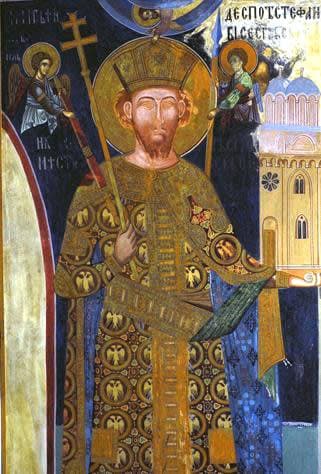
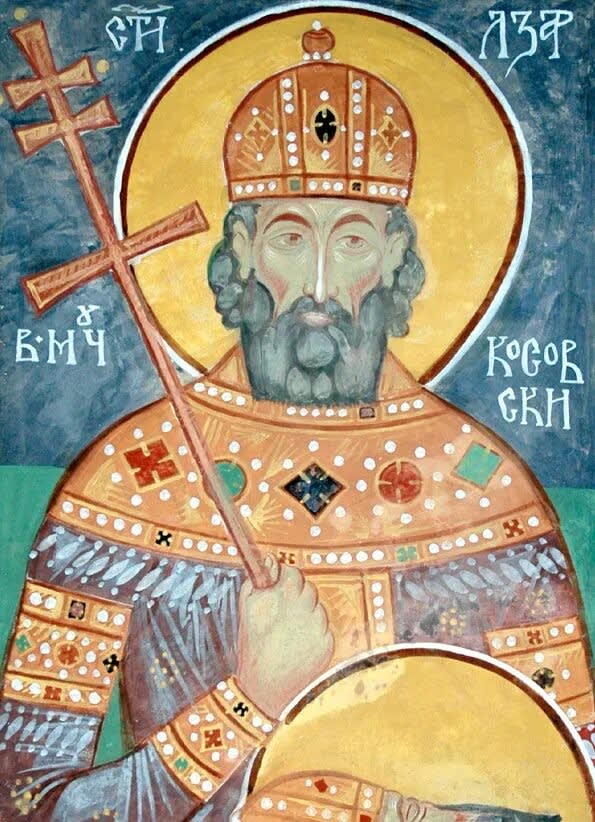
The story of Stefan Lazarević began in 1377 in Kruševac, the flourishing capital of Moravian Serbia. His father was Prince Lazar Hrebeljanović, the last independent ruler of Serbia, while his mother was Princess Milica, a descendant of the ancient but extinct imperial Nemanjić dynasty.
The princely family was large. In addition to Stefan, the eldest child, there were five daughters and a younger son, Vuk, born in 1380.
The heir's childhood came to an abrupt end.
In 1389, a battle erupted on Kosovo Field that would forever change the fate of the Balkans. Prince Lazar fell in combat, leaving an orphaned and devastated country in the care of his widow and young son.
The principal source that has preserved the atmosphere of that era and the details of Stefan's life is the monumental Life of Stefan Lazarević, meticulously composed around 1433 by Constantine the Philosopher.
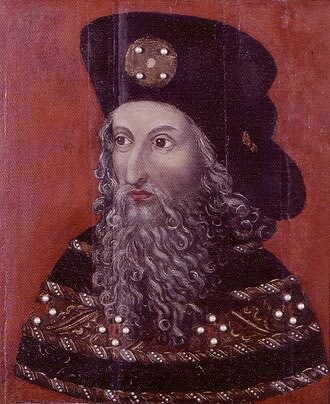
Following Lazar's death, Moravian Serbia found itself on the brink of destruction.
Its army had been devastated, and its borders were left defenseless against powerful neighboring states.
As early as the autumn of 1389, King Sigismund of Hungary took advantage of the tragedy, crossed the Sava River, and captured the Serbian strongholds of Borač and Čestin.

The regency was assumed by Stefan's wise and resilient mother, Milica.
Realizing that fighting a war on two fronts would mean the end of Serbia, an assembly of Serbian nobles, with the active support of Patriarch Spiridon, made an extremely difficult but ultimately necessary decision: to seek peace with the Ottoman Empire.
In the first half of 1390, a peace treaty was signed with Sultan Bayezid I.
The terms were harsh. Serbia recognized Ottoman suzerainty, agreed to pay tribute, and undertook to provide auxiliary troops for the Ottoman army.
This alliance was sealed by a personal sacrifice from the ruling family: Stefan's young sister Olivera was sent to Sultan Bayezid's harem as his wife.
Stefan himself was now required to appear annually at the sultan's court to reaffirm his loyalty.
This bitter compromise brought immediate results. Ottoman detachments helped the Serbs recapture the fortresses they had recently lost to the Hungarians.

When Stefan reached adulthood, Milica transferred the reins of government to him.
She then withdrew to Ljubostinja Monastery, which she had founded, where she took monastic vows and died peacefully in 1405.
Like Prince Lazar, she was later canonized as a saint.
For many years, Stefan Lazarević, who bore the modest title of prince, was forced to shed the blood of his own soldiers in the interests of the Ottoman Empire.
As a loyal vassal of Bayezid, he participated in the sultan's military campaigns.
In 1393, Serbian swords contributed to the downfall of the Second Bulgarian Empire.
In 1396, Stefan fought against European crusaders at the Battle of Nicopolis and subsequently took part in the extremely difficult Battle of Rovine.


The decisive turning point in both his destiny and that of Europe came with the great Battle of Ankara in 1402.
Bayezid's confrontation with the armies of Tamerlane ended in catastrophe for the Ottomans and temporarily halted their expansion into the Balkans.
Freed from the burden of his oath following the sultan's capture, Stefan traveled to Constantinople.
There, the Byzantine emperor, deeply impressed by the Serbian ruler's nobility and strength, granted him the highest title of the Byzantine aristocracy — Despot.
This rank, surpassed only by the imperial title and, according to some historians, even superior to that of king, symbolized Serbia's return to the center of European political affairs.

Upon returning to his homeland, Stefan encountered betrayal.
His nephew Đurađ Branković, who had placed his hopes in the young Ottoman claimant Süleyman, challenged his uncle's authority in a struggle for supremacy over Serbia.
In the decisive battle of 1402, Stefan achieved a brilliant victory, largely thanks to the assistance brought by his brother-in-law, Đurađ II Balšić, ruler of the Principality of Zeta.
Recognizing the fragility of his position, Stefan radically changed the direction of his foreign policy in 1403 by forming an alliance with his former enemy, King Sigismund of Hungary.
Having become a Hungarian vassal, the despot was generously rewarded.
Sigismund granted him extensive territories in Vojvodina, including the towns of Zemun, Mitrovica, and Apatin, as well as strategically important Danubian strongholds — the fortresses of Golubac and Belgrade.
Belgrade, entrusted to Stefan's personal administration, would soon flourish under his rule.
The despot was also granted the honor of becoming a knight of the prestigious Hungarian Order of the Dragon.
In September 1405, Stefan Lazarević concluded a dynastic marriage with Helena, daughter of Francesco II Gattilusio, the lord of Lesbos.
This marriage established family ties with the Byzantine imperial dynasty, as Helena was the sister of Irene, wife of John VII Palaiologos.
The marriage remained childless, which would later force Stefan to designate his nephew, the same Đurađ Branković, as his legitimate successor.

Despite external threats and internal conflicts, Stefan's reign became an era of unprecedented prosperity for Serbia.
Relations with the Branković family in the south remained tense, while Stefan's brother, Vuk Lazarević, constantly engaged in intrigues, attempting to seize portions of the despot's territories until his death in 1410.
Nevertheless, relying on enormous revenues generated by the rapid development of mining, Stefan succeeded in establishing strong centralized authority, an independent economy, and a capable army.
He ruthlessly suppressed separatism, confiscated the estates of rebellious feudal lords, and restricted the authority of aristocratic assemblies.
The despot encouraged domestic trade and craftsmanship while protecting local markets from the excessive influence of foreign merchants, particularly those from Dubrovnik.
Cities, especially Belgrade, received unprecedented privileges.
The inhabitants of Belgrade were completely exempted from customs duties.
In 1412, Stefan systematized the country's economy by issuing the famous Mining Code, which strictly regulated the mining industry.
In military affairs, Stefan proved himself a genuine innovator.
He introduced Western-style knightly tournaments to Serbia and became one of the first rulers in the Balkan Peninsula to employ firearms.
Following the death of Balša III, ruler of Zeta, in 1421, the territories passed by inheritance to Stefan, who had maintained excellent and friendly relations with him.
This triggered a prolonged war with the Republic of Venice over control of the coastal cities.
Eventually, the conflict ended with a peace treaty under which Stefan ceded Kotor, Ulcinj, Lezhë, Shkodër, and the Petrovići region to Venice.
Maintaining control over the remaining mountainous territories of Zeta proved difficult because of the defiance of local feudal lords, particularly the influential Crnojević family.
Contemporaries called Stefan the "Thunder-Renowned Emperor" and wrote that looking directly at him was as difficult as gazing into the dazzling sun.
During his reign, a new state symbol became firmly established in Serbia.
Alongside the ancient double-headed eagle, coins and a heraldic collection dating from 1425 began depicting a Byzantine-style white cross with four firesteels — the famous Serbian Cross.

Despite the harshness of the era, Serbia experienced a cultural renaissance.
The despot surrounded himself with leading representatives of the Slavic intelligentsia, offering refuge to prominent Bulgarian scholars, including Gregory Tsamblak and Constantine the Philosopher.
The latter became the keeper of the ruler's personal library.
Stefan himself was an outstanding literary figure.
Among his works was the deeply moving poetic epistle A Word on Love, permeated with the pain of separation.
According to different interpretations, the work was dedicated to his sister, his fiancée, or his rebellious brother Vuk.
He is also credited with composing the magnificent Funeral Lament for Prince Lazar and the famous epitaph carved into the Kosovo Column in 1400 or 1404.
The cultural brilliance of Stefan's court reached as far as Rus', contributing to the so-called Second South Slavic Influence.
Serbian texts, including The Life of Stefan Lazarević, were actively copied in Russian monasteries.
In his personal life, the despot was a deeply religious ascetic.
He did not tolerate secular entertainment, including music and dancing, and was indifferent to female beauty, leading an almost monastic existence.
Stefan devoted considerable energy and resources to charity, generously distributing alms and offering shelter to travelers.
Legends preserve a story about how the despot rewarded a captured thief with money, saying:
"Take this, thief, and steal no more."
The criminal replied with bold wisdom:
"I am not the thief — you are, for you steal the Kingdom of Heaven from yourself by exchanging it for an earthly kingdom."
Another legend tells how Stefan disguised himself as a commoner and personally distributed alms to the poor in order to hear the truth about himself.
This motif was later adapted in Russian literature in the life of Prince Ivan Kalita.
The crowning achievement of Stefan's spiritual legacy was the magnificent Manasija Monastery, which he founded and richly decorated.

During the second quarter of the 15th century, Serbia's situation once again became desperate.
Although the country formally remained a vassal of both Hungary and the rapidly recovering Ottoman Empire, it found itself surrounded by threats on every side.
The Hungarians failed to provide the protection they had promised the despot.
The state began to decline.
Stefan's own health also deteriorated. During his final years, he suffered from severe pain in his legs.
Death came suddenly to the Thunder-Renowned Despot.
On Saturday, August 1, 1427 (July 19 according to the old calendar), Stefan was returning from his summer residence at Belo Polje to Belgrade.
Stopping around midday near the modern city of Kragujevac, he ate lunch and, despite his illnesses, mounted his horse to go falcon hunting.
While still in the saddle, he was struck by a devastating heart attack.
The ruler was carried into a tent, where, sensing that his end was approaching, he uttered his final words, instructing those around him to protect his nephew Đurađ Branković, to whom he had bequeathed the throne.
Đurađ Zubrović, who accompanied the dying ruler, ordered a marble obelisk with a commemorative inscription to be erected at the site.
The monument still stands in the courtyard of a church near the settlement of Markovac.

The despot was secretly buried at Koporin Monastery in northern Šumadija, approximately 71 kilometers in a straight line from Belgrade.
Centuries of Ottoman rule destroyed numerous sacred sites. The monastery was repeatedly damaged, and the location of the great ruler's grave was eventually forgotten.
Only in 1974, during extensive restoration work beneath an ancient fresco depicting Stefan holding a model of a church, did archaeologists discover a concealed tomb.
Detailed anthropological and paleopathological examinations conducted between 1983 and 1989 by leading specialists in Belgrade, at St. Bartholomew's Hospital in London, and at the British Museum confirmed that the remains indeed belonged to Stefan Lazarević.
His path toward official recognition as a saint began shortly after his death.
Constantine the Philosopher claimed that Stefan had appeared to him from the afterlife, instructing him to write his biography.
In Serbian chronicles and genealogical records of the late 16th and 17th centuries, he was already described as "blessed and holy."
Ancient frescoes depicted him with a halo and identified him as the "Holy Emperor."
Veneration of Stefan spread widely not only throughout the Balkans but also in Rus' and even in the Catholic world.
A sculpture believed to represent him may have been placed among the statues of monarchs at the monastery on Ptujska Gora in Slovenia.
During the 20th century, Metropolitan Dimitrije of Belgrade repeatedly raised the question of formally canonizing the enlightened ruler, doing so in 1907, 1912, and 1924.
Finally, on August 1, 1927, the five-hundredth anniversary of the despot's death, Patriarch Dimitrije solemnly proclaimed Stefan a saint.
His relics, recovered from the forgotten tomb at Koporin, were carefully placed in a reliquary, forever affirming the spiritual triumph of a ruler who had sacrificed his earthly peace throughout his life for the salvation of his homeland.


