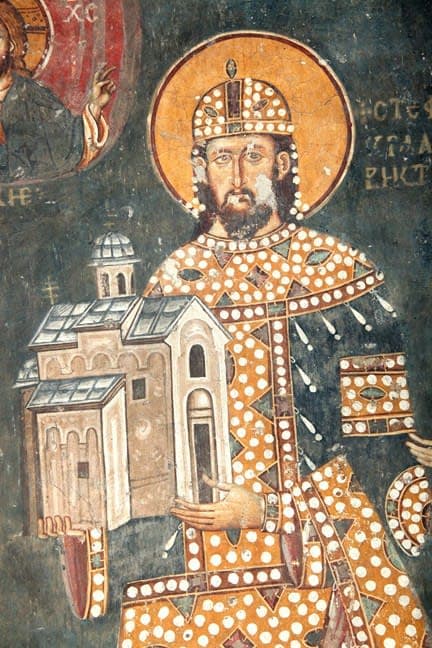

Stefan Dragutin, the eldest son of the powerful Serbian king Stefan Uroš I and his influential wife Helen of Anjou, was born sometime between 1250, when his parents married, and 1253, when his younger brother Milutin was born. From early childhood, he was drawn into the complex web of Balkan and Central European diplomacy.

Upon reaching adulthood, Dragutin became an important political instrument in his father's hands.
He probably married Catherine, daughter of King Stephen V of Hungary, in 1268. This marriage was dictated by harsh political necessity.
It was in 1268 that Stefan Uroš I, seeking to exploit the major internal conflict in Hungary between King Béla IV and his son Stephen, invaded the wealthy region of Mačva.
However, his initial success turned into a catastrophe. The Serbian army was defeated by the local ban, Béla Rostislavich, who had received reinforcements from the Hungarian king, and Stefan Uroš himself was taken prisoner.

The Serbian monarch's freedom was purchased at a high price.
The Hungarians released Uroš only after obtaining firm guarantees that Dragutin, as a son-in-law of the Hungarian royal court, would receive genuine authority in governing Serbia.
From that moment onward, Dragutin began to be referred to in official documents by the title "Junior King."
However, several historians, including Sima Ćirković, believe that the marriage to Catherine was a consequence rather than the cause of this political compromise, while Byzantine sources indirectly suggest that the wedding may have taken place before 1268.
Despite making concessions in foreign affairs, Stefan Uroš I continued pursuing a strict policy of centralization within his kingdom.
He categorically refused to divide the country or grant separate territories to his sons.
Dragutin, who remained at his father's court, felt increasingly trapped by the situation.
Relying on the support of his powerful father-in-law, Stephen V, he repeatedly demanded that a portion of the kingdom be placed under his direct authority.
Uroš once again rejected his demands in 1275, immediately after the conclusion of the war against Dubrovnik.
This proved to be the final straw.
In 1276, Dragutin launched an open rebellion.
Historians continue to debate his underlying motives. M. Dinić sees the rebellion as nothing more than a desire for power, while L. Mavromatis considers it a reaction to Uroš's attempt to designate his younger son, Milutin, as heir to the throne.
Rallying a loyal faction of the Serbian nobility, Dragutin fled to Hungary in search of military assistance.
He returned at the head of an army reinforced by Hungarian troops and fierce Cuman detachments and confronted his father near the town of Gacko.
Uroš's army suffered a crushing defeat.
Archbishop Danilo II recorded this dramatic moment in the following words:
"And because there was a great battle between them in the land called Gacko, the son defeated his father and seized his throne by force. And when he began to rule upon his father's throne in the Serbian land, he called himself Stefan, the pious, Christ-loving, autocratic king of all the Serbian, Maritime, Danubian, and Srem lands."
The defeated Uroš abdicated the throne and withdrew to Sopoćani Monastery, which he himself had founded, where he took monastic vows.
He died there one year later, in 1277.

Having seized the throne, Dragutin quickly realized that power came at a price.
Under pressure from the local aristocracy, he was forced to embrace the decentralization that his father had so desperately resisted.
He granted his mother, Helen of Anjou, control over extensive territories: Zeta, Travunia, and the coastal lands, including Konavle and Cavtat.
His younger brother Milutin, who had married a daughter of the Thessalian ruler John Doukas Angelos, settled at their mother's court in Shkodër.
Regional rulers rapidly began acquiring greater autonomy, threatening the very territorial integrity of Serbia.
In foreign policy, Dragutin acted with extreme caution.
He relied on his alliance with Hungary, reaffirmed Dubrovnik's commercial privileges, and established excellent relations with Venice.
Like his father, he remained loyal to the alliance with Charles of Anjou, who dreamed of restoring the Latin Empire that had fallen in 1261.
However, the Byzantine Emperor Michael VIII proved to be a skilled diplomat. Following the death of King Béla IV of Hungary, he succeeded in establishing closer relations with the Hungarian kingdom.
Deprived of support from the north, Dragutin undertook only one minor campaign against Byzantium during his six-year reign.
In 1281, Serbian forces temporarily occupied several border regions.

The Byzantine response was swift.
After defeating the forces of Charles of Anjou in Albania, the Greeks turned their attention toward Serbia.
Dragutin hastily withdrew his troops, but the Byzantines invaded Serbian territory, burning and devastating the lands as far as Lipljan.
The geopolitical catastrophe was further aggravated in 1282, when the famous Sicilian Vespers permanently destroyed Charles of Anjou's ambitions in the Balkans.
Serbia was left alone to confront an enraged Byzantine Empire.

Many historians believe that these foreign policy failures were the principal catalyst for Dragutin's downfall.
The official reason, however, was an accident.
In that same year, 1282, the king fell from his horse and suffered an extremely serious fracture of his leg.
The injury was so severe that it raised the possibility of gangrene and death.
According to The Life of Saint Stefan Dragutin, written by Danilo II, the injured king convened an assembly at Deževo, where he unexpectedly abdicated the central throne in favor of his brother Milutin.
However, this sudden decision raises numerous questions among historians.
Dragutin did not even attempt to establish a regency council.
Most researchers believe that the injury merely provided a convenient pretext.
The true cause of the Assembly of Deževo was a powerful rebellion by the Serbian vlastela, the nobility, who were dissatisfied with the defeats suffered against the Greeks.
The nobles believed that Milutin, as the new king, would be easier to manipulate.

Under the terms of the Deževo Agreement, Dragutin transferred central Serbia to his brother but retained extensive territories in the north.
According to L. Mavromatis, the country effectively split into the Kingdom of Serbia and the Kingdom of Srem, although the question of Dragutin's subordinate status remains the subject of intense historical debate.
Željko Fajfrić reasonably observes that Dragutin, distrustful of his brother, deliberately chose territories near the Hungarian border so that he could rely on assistance from his father-in-law in the event of war.
Dragutin's possessions included northwestern Serbia, with Rudnik and Arilje, as well as Uskoplje and Dabar in the Lim River valley.
A considerable portion of the nobility loyal to him also moved north.
Initially, the brothers demonstrated remarkable unity.
In 1283, Dragutin joined Milutin's large-scale expedition against Byzantium at the head of his own troops.
The Serbian army advanced triumphantly through Macedonia all the way to the shores of the Aegean Sea.
Since the Greeks offered almost no resistance, Milutin allowed his brother to return home with honor while he himself continued the conquests.
Upon returning, Dragutin turned his attention toward the northern frontiers.
In 1284, he received a generous grant from the Hungarian Crown: the regions of Mačva and Belgrade, together with the northern Bosnian territories of Usora and Soli.
Establishing his residences in Debrc and Belgrade, he went down in history as the first Serbian monarch to rule the city that would eventually become Serbia's capital.
It was during this period that contemporaries began respectfully referring to him as the "King of Srem."
His policies acquired a distinctly pro-Western orientation.
In Bosnia, Dragutin harshly suppressed heresy and strengthened political ties with Ban Stephen Kotroman by giving his daughter Elizabeth in marriage to him.
Another of his daughters, Urošica, became the wife of the powerful Croatian ban Paul Šubić.
Dragutin maintained active relations with Naples, Venice, and Rome. There is even a hypothesis that he secretly converted to Catholicism in 1291.

However, a new threat was emerging along the eastern borders of Mačva.
At the fortress of Ždrelo on the Mlava River, in the region of Braničevo, two notorious raider brothers, Drman and Kudelin, had established their stronghold.
They were of Bulgarian or Cuman origin and had been terrorizing the surrounding territories since the early 1280s.
In 1285, they completely defeated a Hungarian punitive expedition in a mountain gorge.
Dragutin attempted to destroy their stronghold in order to secure Mačva and annex Braničevo to his territories, but his own army also suffered a devastating defeat.
Emboldened by their success, Drman and Kudelin recruited Tatar and Cuman mercenaries, who brutally devastated Dragutin's lands.
The proud King of Srem was forced to request assistance from his brother Milutin.
By 1290, the united Serbian army had destroyed the raiders' stronghold, and Braničevo became part of the northern kingdom.
This provoked the anger of the Bulgarian ruler Shishman I, who considered the region his own territory.
In 1292, he advanced with his army as far as the Serbian city of Peć.
In response, the two brothers rapidly invaded Bulgaria and laid siege to Vidin.
Shishman fled in panic across the Danube to his protector, the powerful Tatar khan Nogai.
To avoid a punitive invasion by the Golden Horde, Milutin demonstrated political flexibility.
He returned the disputed lands to the Bulgarians and, as a guarantee of peace, sent his son Stefan, the future Stefan Dečanski, to Nogai as a hostage.

The fragile peace between the brothers collapsed in 1299.
Nogai was killed by Khan Toqta, and Prince Stefan took advantage of the chaos to escape from Tatar captivity and return to his father.
Milutin immediately entrusted his son with the administration of Zeta, the traditional appanage of heirs to the Serbian throne.
For Dragutin, this was a devastating blow.
He firmly believed that, according to the agreements reached at Deževo, his own son Vladislav was supposed to inherit the united Serbian throne.
Although the chronicles of Dubrovnik record Stefan's rule in Zeta only in 1308–1309, tensions had begun to rise much earlier.

The situation reached a breaking point when Milutin concluded peace with Byzantium in 1299.
The warlike Serbian nobility, eager to conquer Macedonian territories, began defecting to Dragutin's side in large numbers.
In 1301, the cold hostility between the brothers escalated into open warfare.
However, Dragutin entered the conflict at the worst possible moment.
He had counted on military assistance from Hungary, but in January 1301, the Árpád dynasty became extinct following the death of Andrew III, plunging the country into a bloody civil war between the supporters of Charles Robert of Anjou and the Bohemian claimant Wenceslaus III.
Dragutin was forced to divide his forces.
When Charles Robert gained the upper hand over the Bohemians around 1308–1309, Dragutin attempted to place his own son Vladislav on the Hungarian throne, but the effort ended in failure.
By 1309, the Angevin dynasty had firmly established itself in Buda, while Dragutin's allies found themselves in determined opposition.

The fratricidal war in Serbia raged for more than ten years.
Around 1300, Dragutin nearly launched a major general offensive but withdrew upon learning that Byzantine reinforcements had arrived to support Milutin.
The conflict consisted less of open battles than of an exhausting succession of sieges against seemingly impregnable fortresses.
The decisive factor proved to be economic power.
In 1302, Milutin seized the exceptionally wealthy silver mines at Rudnik.
It was this silver that enabled him to finance armies of mercenaries, compensating for the betrayal of his own nobility.
The exhaustion of both sides eventually forced them to enter negotiations through the mediation of the Serbian Orthodox Church.
The war, which ended sometime between 1312 and 1314 according to different estimates, resulted in the restoration of the prewar status quo.
Rudnik and the other lost territories were returned to Dragutin.
However, the question of Vladislav's succession remained unresolved, continuing to provoke debate among historians to this day.
The final years of the King of Srem were overshadowed by grief and profound religious mysticism.
On February 8, 1314, the queen mother, Helen of Anjou, died.
Dragutin, who loved his mother immensely, did not dare attend her funeral, seriously fearing that his brother Milutin would throw him into prison.
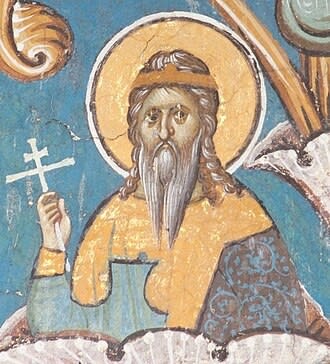
That same year, Serbia was shaken by another family tragedy.
Prince Stefan rebelled against his father, Milutin.
The ruthless monarch suppressed the uprising, ordered his own son to be blinded, and imprisoned him.
Only after this brutal elimination of a rival, and, according to some historians, after Vladislav had been secretly confirmed as the heir to the throne, did Dragutin finally dare to visit his mother's grave.
He then traveled to his brother's residence at Paunpolje near Uroševac.
The meeting between the two monarchs was surprisingly peaceful.
According to Željko Fajfrić, from that day onward, the hostility between the brothers disappeared forever.
During his final years, Dragutin embraced severe asceticism.
Preparing his soul for eternity, he ordered a coffin to be placed in his chambers and slept in it every night.
In 1314, he permanently relinquished the crown of Srem, transferring it to his son Vladislav, and took monastic vows under the name Theoktistos.

Despite his earlier diplomatic flirtations with Catholicism, the monk-king became one of the greatest defenders of Orthodoxy in the north.
He established new metropolitan sees in Mačva and Braničevo, encouraged missionary activity, and founded an impressive collection of magnificent monasteries: Rača, Tronoša, Tavna, Mala Remeta, and Bešenovo, as well as the elegant Church of Saint Achillius in Arilje.
Stefan Dragutin peacefully passed away on March 12, 1316.
His body was buried with honors at Đurđevi Stupovi Monastery near Novi Pazar.
However, Balkan politics had little room for sentimentality.
No sooner had his brother died than Milutin treacherously violated all their peace agreements and seized the territories belonging to his nephew Vladislav.
Only Mačva and Belgrade remained independent, but even their brief period of freedom did not last long.
By 1319, these northern strongholds had been swallowed up by the advancing Hungarian army.


