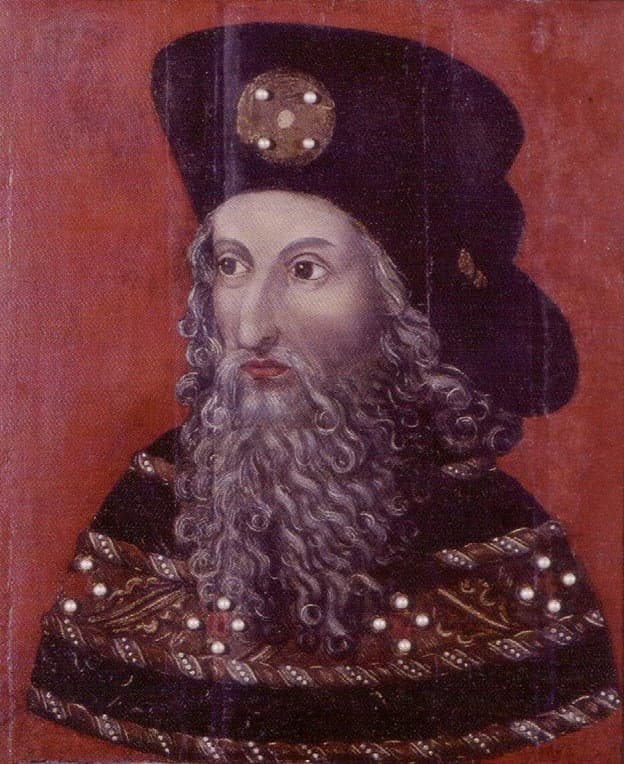
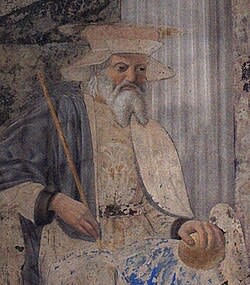
In 1368, in the very heart of Europe, in Prague or possibly Nuremberg, a boy was born into the family of Holy Roman Emperor Charles IV and his fourth wife, Elizabeth of Pomerania. He was destined to wear many crowns.
The blood of great dynasties ran through his veins. On his mother’s side, he was a great-grandson of Gediminas, Grand Duke of Lithuania, and a grandson of King Casimir III of Poland; on his father’s side, he belonged to the powerful House of Luxembourg. The child was named after his father’s favorite saint, Sigismund of Burgundy. In the lands of the Bohemian Crown, the red-haired and intelligent young prince was soon aptly nicknamed the “Red Fox” (liška ryšavá).
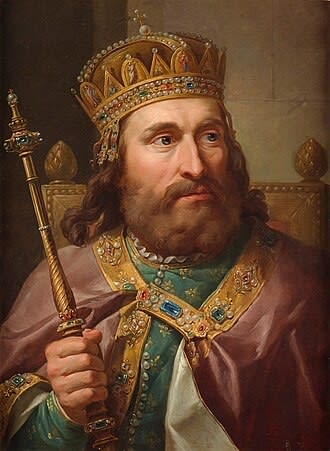
From his earliest childhood, Sigismund’s life was subordinated to high politics. His father, Charles IV, maintained extremely close relations with King Louis I of Hungary. This alliance resulted in a betrothal: in 1374, the six-year-old Sigismund was engaged to Louis’s infant daughter Mary. The marriage alliance was expected to expand the possessions of the Luxembourg dynasty enormously.
In 1378, Sigismund’s father, Charles IV, died. The young Sigismund, who inherited the title of Margrave of Brandenburg, was sent to the court of the Hungarian monarch. There he did not merely reside: he absorbed the new culture, became fluent in Hungarian, and developed a deep attachment to the country.
King Louis, who had no sons, declared the boy his heir to the Hungarian throne.
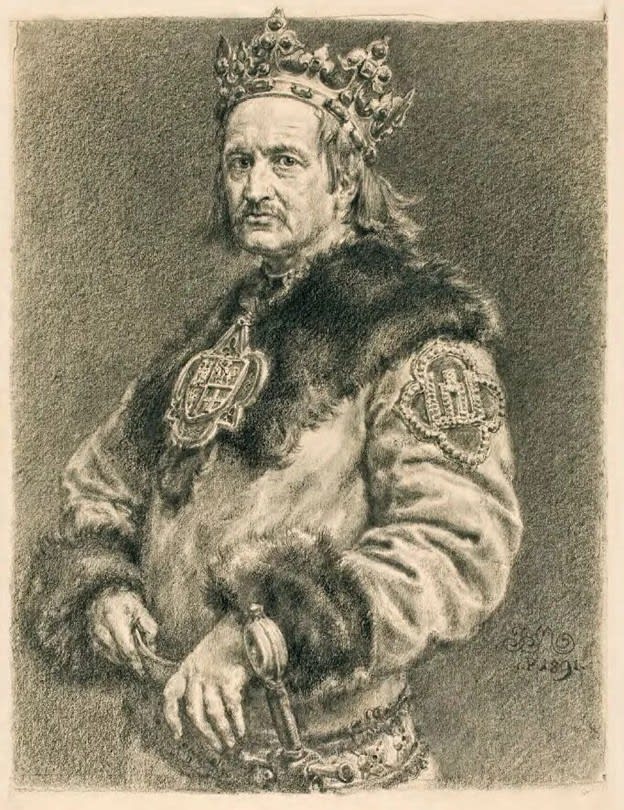
The ambitions of the Luxembourgs, however, extended even further. In 1381, the thirteen-year-old prince was sent to Kraków on the orders of his elder half-brother and guardian, Wenceslaus IV of Bohemia. Wenceslaus even granted him the Neumark in an attempt to create a secure territorial link between Brandenburg and Poland.
The plan was ambitious: Sigismund was to learn Polish and claim the Polish crown, since Mary had already been recognized as ruler of Hungary. The Polish nobility, however, resisted. Despite their internal disputes, the magnates of Lesser and Greater Poland agreed on one point: they did not want a German ruler or a union with Hungary.
Their choice ultimately fell upon Mary’s younger sister, Jadwiga, whose husband became the Lithuanian prince Jogaila. The Polish crown slipped from the hands of the “Red Fox.”
King Louis died in 1382, and Mary officially became Queen of Hungary. In 1385, at Zólyom, modern-day Zvolen, Sigismund and Mary were finally married. A year later, the Treaty of Győr of 1386 formally confirmed his status as future co-ruler.
Hungary, however, was seething with rebellion.
In 1387, a revolt broke out led by the powerful Horvat family — Paul, Bishop of Mačva, John, and Ladislaus. Following a daring attack, Mary and her mother, the regent Elizabeth of Bosnia, were taken prisoner. Before the queen’s eyes, her mother was brutally strangled.
Sigismund was forced to act immediately. After rallying the loyal nobility, he secured his wife’s release and, on March 31, 1387, was triumphantly crowned King of Hungary at Székesfehérvár.
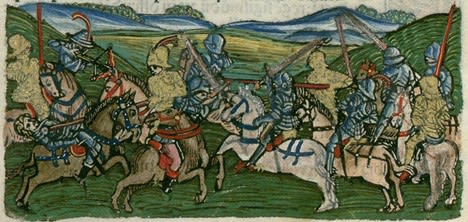

The crown, however, proved extraordinarily burdensome. The royal treasury was empty and the kingdom deeply fragmented. In 1388, Sigismund was even forced to mortgage his native Margraviate of Brandenburg to his cousin Jobst of Moravia in order to raise money for the struggle to retain the Hungarian throne, which remained unstable for nine long years.
The king’s authority depended heavily on the powerful Cilli-Garai coalition of barons, whose support cost the treasury enormous sums of money and vast royal estates. At times, a council of barons effectively governed in the name of the Holy Crown, forcing Sigismund to spend decades rebuilding the authority of the central monarchy.
His opponents, meanwhile, remained active. In the south, between the Sava and Drava rivers, the Horvats, supported by Mary’s uncle, King Tvrtko I of Bosnia, proclaimed Ladislaus of Naples, son of the murdered King Charles II, the legitimate monarch.
Only in 1395 did Sigismund’s loyal commander Nicholas II Garai finally crush the rebellion.
That same year, however, brought the king a personal tragedy. On May 17, 1395, Queen Mary fell while riding in the hills of Buda. In the late stages of pregnancy, she gave birth to a son, but both mother and child died shortly after the premature delivery.
Sigismund, whose claim to the throne had been based largely on his marriage to Mary, suddenly found himself at the center of a dynastic crisis.
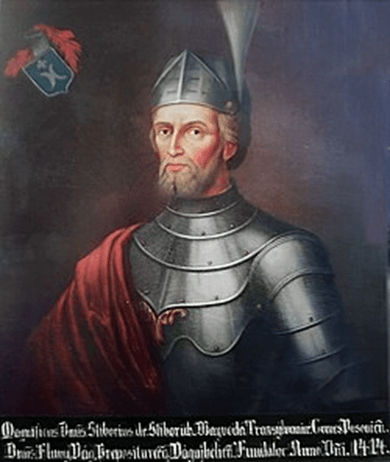
Nevertheless, with the support of loyal men such as his closest adviser, Stibor of Stiboricz, Sigismund retained power.
Even when Hungarian magnates placed the king under arrest several times, the troops of Garai and Stibor repeatedly restored his freedom and throne. Sigismund was forced to compromise, promising to distribute offices and lands only among Hungarian nobles, although he always made an exception for the Polish-born Stibor.
By the end of the fourteenth century, a far more dangerous threat appeared on the horizon — the Ottoman Empire, whose borders had already reached the Danube.
In 1396, Pope Boniface IX proclaimed a crusade. Sigismund placed himself at the head of the united Christian forces. Thousands of Hungarian nobles and volunteers from across Europe joined his army of approximately 15,000 men and a fleet of 70 galleys, including elite French contingents commanded by John the Fearless.
At first, the campaign proceeded successfully, and Vidin was captured.
But at the fortress of Nicopolis, the crusaders encountered Sultan Bayezid I, who had hastily lifted his siege of Constantinople and arrived with an army of about 10,000 men.
In the Battle of Nicopolis, fought between September 25 and 28, 1396, the Christian army suffered a devastating defeat. Sigismund narrowly escaped aboard a ship, returning to Hungary by a long maritime route through the territories of Zeta.
In gratitude for the refuge given to him, he granted the local ruler Đurađ II the islands of Hvar and Korčula, which returned to the king after Đurađ’s death in April 1403.

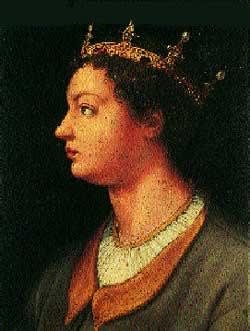
The disaster at Nicopolis once again destabilized Sigismund’s throne. His prestige damaged, he was arrested again by discontented nobles in Hungary in 1401.
At the same time, a crisis was developing in Germany and Bohemia. In 1400, his half-brother Wenceslaus IV was deposed from the German throne and replaced by Rupert of the Palatinate.
Sigismund was unable to help him, but in 1401 he supported an uprising in Bohemia, took the imprisoned Wenceslaus into his custody, and effectively governed Bohemia on his brother’s behalf for nineteen months before releasing him in 1403.
In Hungary, meanwhile, the rebels once again called upon Ladislaus of Naples.
In 1403, at Nagyvárad, he was proclaimed king after swearing an oath upon the relics of Saint Ladislaus. Ladislaus captured Zara, modern Zadar, but soon sold the Dalmatian cities to Venice for 100,000 ducats and withdrew to Italy.
Sigismund did not forget this and for many years waged an indirect war against Ladislaus in Italy, forming alliances with his enemies.

To strengthen royal authority, Sigismund issued the decree known as the Placetum Regium in 1404, prohibiting the publication of papal bulls in Hungary without the monarch’s approval.
At the same time, he transformed Buda Castle into one of the greatest Gothic palaces in Europe.
Around 1406, the king resolved his dynastic concerns by marrying Barbara of Cilli, daughter of Count Hermann II. Her grandmother, Catherine of Bosnia, was a close relative of Sigismund’s deceased mother-in-law.
On October 7, 1409, at Visegrád, their only surviving legitimate child was born — Elizabeth of Luxembourg.
Having secured his position at home, Sigismund turned his attention to rebellious Bosnia.
In 1408, he led an army of 50,000 “crusaders.” The campaign culminated in the Battle of Dobor, where approximately 200 Bosnian aristocrats were killed.
Although Bosnia soon slipped politically beyond Hungarian control, the military victory gave Sigismund the opportunity to establish the legendary Order of the Dragon that same year — an elite chivalric order intended to defend Christianity and unite his allies.
Its members included Stefan Lazarević, Garai, Hermann II of Cilli, Stibor, and Pipo of Ozora.
Sigismund also secured his southern borders through diplomacy. In 1403, he transferred Belgrade and Mačva to the Serbian Despot Stefan Lazarević, who remained his loyal vassal until his death in 1427. His successor, Đurađ Branković, subsequently returned Belgrade.
Having consolidated his position, Sigismund began his struggle for leadership in Europe.
In 1410, the German king Rupert died. On September 20, Sigismund was elected by three prince-electors, but on October 1, four others chose his cousin Jobst of Moravia.
Jobst’s death on January 18, 1411, removed the principal obstacle, and on July 21, 1411, Sigismund was finally elected King of the Romans. His solemn coronation at Aachen, however, did not take place until November 8, 1414.

As German monarch, Sigismund entered into a complex diplomatic struggle against Poland and Władysław II Jagiełło, forming an alliance with the Teutonic Order for 300,000 ducats.
An attack from the south was to be carried out by the Transylvanian duke Stibor of Stiboricz, a member of the Polish Ostoja clan and one of the wealthiest men in Europe, who controlled approximately one-third of Slovakia and thirty-one castles.
In July 1410, while the Battle of Grunwald was taking place, Stibor burned Nowy Sącz but later withdrew to Beckov.
The Teutonic defeat at Grunwald brought Poland enormous quantities of silver, which the resourceful diplomat Stibor later persuaded Jagiełło to lend to Sigismund himself.
The pinnacle of Sigismund’s diplomatic magnificence was the grand Conference of Buda in 1412.
It was far more than a chivalric tournament — it was effectively a summit of Europe.
Around 2,000 knights attended, together with three kings, including Jagiełło and the Bosnian monarch Tvrtko II or Stjepan Ostoja, as well as Vytautas, thirteen dukes, twenty-one counts, cardinals, seventeen ambassadors, and even Jalal ad-Din, son of a khan of the Golden Horde.
Delegations from seventeen countries arrived with approximately 40,000 horses.
The tournaments were won by Silesian knights, including those from Niemcza, and vassals such as the Bulgarian prince Fruzhin.
Sigismund demonstrated his position as a major arbiter of European politics.
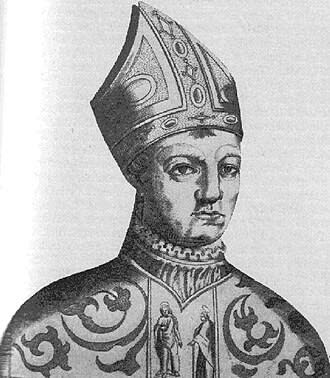
While simultaneously waging war against Venice between 1412 and 1423, Sigismund also undertook the task of ending the Great Western Schism within the Church.
He compelled Antipope John XXIII to convene the Council of Constance in 1414.
Sigismund became one of its central figures. He traveled throughout France, England, and Burgundy, attempting to persuade rival popes to abdicate.
By 1418, the schism had been resolved.
The council was also the setting for a famous linguistic anecdote. When a cardinal corrected the king’s Latin, Sigismund supposedly replied proudly:
“Ego sum rex Romanus et super grammaticam” — “I am King of the Romans and above grammar.”
Because of this phrase, the philosopher Thomas Carlyle later referred to him as “Super Grammaticam.”

The council, however, also gained a darker reputation.
In July 1415, Jan Hus was burned at the stake on charges of heresy. Sigismund had granted him a safe-conduct, but the ecclesiastical court, which was not subordinate to secular authority, sentenced the preacher to death.
The execution became a spark that would soon ignite much of Central Europe.

At the same council in 1415, Sigismund made a decision of enormous importance for the future of Germany: he transferred Brandenburg to Frederick I of Hohenzollern, Burgrave of Nuremberg, laying the foundations for the future greatness of the Hohenzollern dynasty.
On August 15, 1416, he signed the Treaty of Canterbury with King Henry V of England, redirecting his foreign policy against France and becoming a Knight of the Order of the Garter.

In 1419, Wenceslaus IV died, and Sigismund inherited the crown of Bohemia.
The Czechs, however, had not forgiven him for the death of Jan Hus.
After entrusting the administration to Wenceslaus’s widow, Sophia of Bavaria, Sigismund faced a fierce uprising.
The Hussites, led by the brilliant commander Jan Žižka, repeatedly defeated imperial forces: at Kutná Hora in December 1421 and at Německý Brod in January 1422.
Vytautas sent Sigismund Korybut to assist the rebels. On May 16, 1422, he arrived in Prague and assumed leadership among the Czechs.

Three crusades launched by Sigismund ultimately failed.
Only the military effectiveness of the Stibor family helped hold the Hungarian frontiers.
At the Imperial Diet of Nuremberg between July and September 1422, and later with the formation of the League of Bingen in January 1424 together with Frederick of Brandenburg and the Elector of Saxony, new anti-Hussite coalitions were organized.
Even after Žižka’s death, Korybut continued defeating the crusaders, including at the Battle of Ústí nad Labem in 1427, until the citizens of Prague themselves accused him of conspiracy.
The war finally began to subside after the radical Taborites were defeated at Lipany and the Basel Compacts were concluded in July 1436.
In August 1436, after seventeen years of waiting, Sigismund was recognized as King of Bohemia.
The last rebels were defeated near Sion Castle toward the end of 1437.
Sigismund’s rule did not rely upon extensive personal dynastic territories in Germany, or Hausmacht, but rather upon a sophisticated network of alliances with princes such as Frederick I and his son-in-law Albert II, husband of Elizabeth.
He was therefore less an all-powerful ruler than an exceptionally skilled master of political alliances.
In 1428, he once again fought the Ottomans.
In 1431, he traveled to Italy, where on November 25 in Milan he received the Iron Crown of Lombardy.
Finally, on May 31, 1433, in Rome, the ambition of his lifetime was fulfilled: Sigismund was crowned Holy Roman Emperor.
He continued to formulate ambitious plans. In 1435–1436, through the Bulgarian prince Fruzhin and Daud, a claimant to the Ottoman throne, he attempted to support an Albanian uprising against the Turks, but without success.
The long journey of the monarch came to an end on December 9, 1437, in the Moravian town of Znojmo.
With his death, the male line descended from Emperor Henry VII of Luxembourg became extinct.
The throne passed to his son-in-law, Albert II of Habsburg.

Despite his German-Bohemian origins, Sigismund entered history as a deeply Hungarian king.
He spoke Hungarian fluently, dressed according to local fashion, and, as the chronicler János Thuróczy wrote, “out of love for the Hungarians, he wore a long beard.”
Tall and imposing, with curly hair and a gentle bluish gaze, he developed Buda and Visegrád, importing building stone from Austria.
According to later tradition, he was greatly admired by the people.
Decades later, during the reign of Matthias Corvinus, a legend circulated that the famous commander John Hunyadi was Sigismund’s illegitimate son. According to the story, a raven stole a ring that the king had given away, giving rise to the raven motif in the coat of arms of the Hunyadi-Corvinus family.
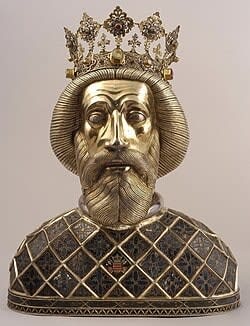
According to his own final wishes, Emperor and King Sigismund was buried not in the dynastic tombs of Bohemia or Germany, but in the Hungarian city of Nagyvárad, modern-day Oradea, beside the tomb of the ideal knightly king — Saint Ladislaus I.


