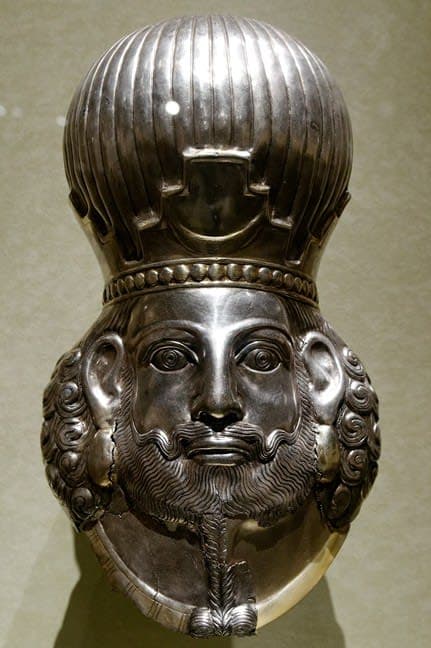

Shapur II, nicknamed the Great, ascended the throne under unusual circumstances that, from the very beginning of his life, shrouded his reign in an aura of mysticism and legend. He was born after the death of his father, Hormizd II, in 309. According to one legend, described by the Byzantine historian Agathias of Myrina with reference to Persian chronicles, his coronation took place even before his birth. The magi predicted that the heir would be a boy, and in a solemn ceremony the kidar, the royal headgear, was placed upon his mother’s womb, and the fetus was proclaimed king. This event became part of the official history of the Sasanian state and emphasized the divine predestination of his rule. However, not all historians shared this version; for example, al-Ya‘qubi and Bal‘ami asserted that Shapur was born before his accession to the throne.
In the Babylonian Talmud the mother of the future shahanshah is named Ifra Hormizd, a Jewess by origin. Despite the fact that at the time of his father’s death at least two elder brothers were alive one of whom, also named Shapur, subsequently ruled vast eastern lands it was the infant who was chosen as heir. The first ten years of his reign passed in relative obscurity, since regents and viziers governed the country, and the Sasanian Empire seemed to have no king, which immediately attracted external enemies.


The weakening of central authority, caused by the struggle for the throne and the king’s minority, led neighboring peoples to begin raiding Sasanian lands. According to the historian al-Tabari, the Turks and the Romans planned an invasion, but the first and most active to act were the Arab tribes. Forced to leave their meager lands, they crossed the Persian Gulf en masse, invaded the southern coast of Persia, and plundered coastal cities such as Reshahr and Ardashir-Khurrā. The Ghassanids also took advantage of the chaos, even reaching and plundering the western part of the Ctesiphon agglomeration of Veh-Ardashir. The threat became so serious that the capital had to be moved to the eastern bank of the Tigris.
When Shapur reached his majority (fifteen years of age), he assumed the reins of power and showed determination to restore order. He personally led military campaigns, beginning with the expulsion of the Arabs from the southern territories of the Sasanian state. His campaign covered Bahrain, Hajar, and Yamama, and according to some traditions, his troops reached Medina. Shapur II displayed exceptional cruelty toward the invaders, for which the Arabs nicknamed him “Dhu al-Aktāf” — “the possessor of shoulders.” He received this nickname because he ordered the shoulders of captives to be pierced and the prisoners to be hung by ropes. He also ordered wells to be destroyed, condemning to death by thirst those who had taken refuge in the desert. These measures allowed him to push the Arab tribes deep into the Arabian Peninsula and to strengthen Sasanian control over the Persian Gulf.
To protect against future raids, Shapur II launched large-scale construction. Along the Euphrates, powerful fortresses and watch posts were erected, including al-Anbar (Peroz-Shapur) and Ayn Tamr. He also employed the tactic of resettling conquered tribes deep within his state, which was intended to weaken them and promote assimilation. For example, the tribes of Banu Taghlib and Banu ‘Abd al-Qays were resettled in Kerman and Khuzestan. Some Arab chieftains were settled in Peroz-Shapur, where they were kept under supervision and served as allies, taking part, for example, in military campaigns against the Romans.
Shapur II’s foreign policy was aimed at restoring the borders that had existed in the time of his ancestors and at confronting the Roman Empire for control of Mesopotamia and Armenia. From 337 began the first of a series of bloody wars with Rome. Shapur II besieged the key Roman strongholds of Nisibis, Singara, and Bezabde. Despite stubborn resistance and a series of setbacks, he did not relent. In his letter to the Roman emperor Constantius II, Shapur demanded the return of Armenia and Mesopotamia, asserting that his forefathers had possessed lands as far as Macedonia.

Despite Shapur’s activity, this war brought no decisive victory to either side. The Romans successfully defended themselves in their powerful fortresses, and the Persians suffered heavy losses. By 350 hostilities temporarily ceased, as Shapur was forced to turn his attention to the eastern frontiers.
The eastern borders of the Sasanian Empire were also subjected to constant raids. The Chionites and the Saka attacked Sasanian possessions. According to some sources, the Chionites even seized much of Khorasan. Shapur II personally led a campaign to the east. By 358 he had not only defeated his eastern enemies but had also won them over, making the Chionite king Grumbates his ally. He restored Sasanian supremacy over Kushanshahr, and Persian inscriptions and coinage attest that the empire’s eastern frontier extended to Sind, Sistan, and Turan.

With victory in the east, Shapur II returned to war with Rome. In the spring of 359, together with his Chionite allies, he began a second campaign in northern Mesopotamia. Ammianus Marcellinus, a direct participant in the events, left vivid descriptions of the siege of the fortress of Amida. He described Shapur, who personally commanded the troops and narrowly escaped death from Roman arrows. Despite heavy losses (30,000 men), the Persians, after a 73-day siege, took Amida and brutally dealt with its defenders. The other Roman fortresses, Singara and Bezabde, then fell as well.
The Roman emperor Constantius II, distracted by internal problems, could not provide timely assistance, but in 360 he attempted to take revenge by sending troops into Mesopotamia. However, his attempt to retake Bezabde failed. The siege was lifted because of the onset of rains and the approaching winter. This campaign ended in Shapur II’s victory, and the death of Constantius II in 361 left the fate of Rome’s eastern provinces unresolved.
In 363 the new Roman emperor Julian the Apostate undertook a large-scale counteroffensive that became the culmination of the Roman-Persian wars. It was a grand military enterprise: Julian assembled an army of more than 60,000 men, provided it with enormous supplies of provisions and equipment, and even organized a fleet on the Euphrates. In his entourage was Shapur’s brother, Hormizd, who hoped with the help of the Romans to seize the Persian throne.
The Roman forces invaded Mesopotamia and, moving along the Euphrates, rapidly captured one fortress after another, meeting only insignificant resistance. They approached the Sasanian capital of Ctesiphon and defeated the Persian army at its walls. It seemed that victory was near, but the indiscipline of the Roman soldiers, who rushed to plunder the dead, prevented them from taking the city by a sudden assault. Despite repeated peace proposals from Shapur II, Julian stubbornly refused negotiations.
However, the Roman army soon faced unforeseen difficulties. The current on the Tigris turned out to be too strong, and the fleet, which was the main source of supplies, became a burden. Then Julian made a fatal decision: he ordered the ships to be burned, thereby depriving his army of the possibility of retreat by water. Forced to fight to the end, Shapur threw all his reserves against the Romans. As a result, Julian, finding himself in a hopeless situation, ordered a retreat in the direction of Armenia but was deceived by a false defector, who led his army into desert and waterless places.
On June 26, 363, in one of the skirmishes near the village of Tummar, Julian the Apostate was mortally wounded and soon died. His death made the position of the Romans critical.


A new emperor, Jovian, was proclaimed. Finding himself in a desperate situation, he was forced to accept the terms dictated by Shapur. On July 7, 363, when the Roman army was on the verge of perishing from hunger, Shapur displayed “nobility” and offered negotiations. Jovian, seeking to save the remnants of his army, agreed to all the Persian king’s demands. A thirty-year peace treaty was concluded, which Ammianus Marcellinus called “shameful.”
Under its terms the Roman Empire ceded to Iran five disputed districts with fifteen fortresses, as well as three strategically important cities, including Nisibis, “the strongest key of the East.” The inhabitants of these cities were allowed to leave and were resettled in Amida. Moreover, Jovian undertook not to render assistance to his Armenian allies. This treaty became a triumph for Shapur II and the largest territorial acquisition of the Sasanian state in many years.
Despite the peace treaty with Rome, Shapur II continued his expansion. Armenia and Iberia became the next targets of his conquest campaigns. Iranian intrigues led to a plot in Armenia, after which King Khosrov III and the head of the clergy were forced to flee to Rome. Although Constantius II temporarily restored Khosrov to the throne, Shapur did not abandon his ambitions.
In 364 the Persian forces under Shapur II invaded Armenia and, despite resistance, dealt it a crushing blow. Part of the Armenian nobility went over to the Persians, and King Arshak II, who had previously been an ally of Julian, was treacherously seized at a banquet, blinded, and imprisoned in a fortress, where he took his own life. The conquest was accompanied by incredible cruelty. The cities of Artashat, Vagharshapat, Van, and Nakhichevan were taken, and their population, including many Jewish families, was deported.
Especially terrible events unfolded at Artagers, where Arshak’s wife, Queen Parandzem, led the resistance. After a fourteen-month siege the fortress fell. Parandzem was delivered to Shapur II, who, wishing to humiliate her, ordered the most brutal abuses, and then had her impaled. This war dealt a mortal blow to ancient Armenian civilization, and its consequences are described in the chronicles of Faustus of Byzantium with chilling details.
A similar fate befell Iberia. In 368 Shapur II invaded Kartli, deposed King Saurmag, and placed his protégé Varaz-Bakur on the throne. Although the Romans attempted to intervene, they succeeded only in dividing Kartli into two parts: one remained under Roman control, the other under the Sasanians. In 371 the war resumed, but in 374, when the new Roman ally Pap was killed, the conflict again reached an impasse. However, the forces of both empires were diverted by new threats Rome was at war with the Goths, and Persia with the Kidarites.


The reign of Shapur II was marked by the first large-scale persecutions of Christians in the Sasanian Empire. Previously, Christian heretics persecuted in the Roman Empire were readily accepted in Persia in order to weaken the enemy. But after Christianity became the official religion of Rome, Shapur II began to perceive Persian Christians as potential allies of his enemy.
Around 340, needing funds for his military campaigns, Shapur demanded of the bishop of Ctesiphon, Simeon bar-Sabba, that all Christians pay double tax. When Simeon refused, Shapur accused him of disobedience and of having “chosen Caesar.” After this the bishop was executed. From that moment began forty years of persecution. Christian chronicles report sixteen thousand martyrs. The repressions affected all strata of society from clergy to noble grandees including even the son and daughter of Shapur II himself.
These persecutions were part of a broad plan to strengthen Zoroastrianism as the state religion. Under the leadership of the high priest Adurbad Mahraspandan, the organizational structure of the church was reinforced. Shapur II, unlike his successors, proclaimed himself a god and linked his genealogy both to the Achaemenids and to the mythical Kayanids.
However, the persecutions of nonbelievers aroused such resistance that in the end Shapur II was forced to return to a policy of toleration more traditional for Persia. The Armenian historian Yeghishe reports that Shapur ordered “that no one should do them harm, but that confidently, without fear, each should remain in his own doctrine the magus and the zindiq (Manichaeans), the Jew and the Christian.”

Shapur II, known for his conquests, also left a mark in the cultural heritage. He founded several cities, especially on the territory of the former Kushan kingdom, where he settled Roman prisoners of war. In particular, he significantly rebuilt and expanded the city of New-Shapur (modern Nishapur), which had great importance for Zoroastrians. After Nisibis passed to the Persians, Shapur settled it with people from Istakhr and Isfahan.
One of his most famous construction projects was the city of Iran-khwarrah-Shapur (“Glory of Iran Shapur”), erected on the site of destroyed Susa, whose population was exterminated for rebellion. This city was built using the labor of prisoners of war.
During his reign the center of Sasanian art shifted from Persis to the new capital, Ctesiphon. On the reliefs of this time, such as those at Taq-e Bostan, appear images of Mithra and Ohrmazd. On one of the reliefs, presumably, Shapur II himself is depicted trampling underfoot the fallen Roman emperor Julian the Apostate.
The reign of Shapur II, which lasted 72 years, became one of the longest and most important in the history of the Sasanian state. He not only restored the empire’s power after a period of weakness, but also expanded its borders, strengthened central authority, and laid the foundations for the further development of the Persian state.


