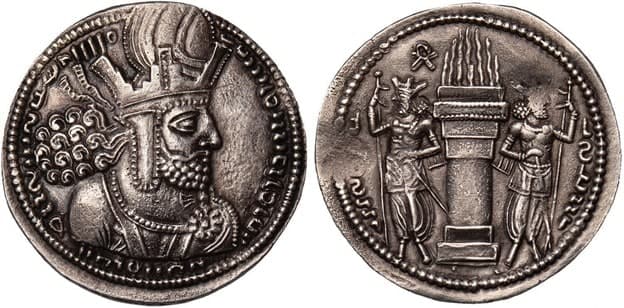

Shapur I, the son of the first Sasanian shahanshah Ardashir I, took an active part from a young age in all of his father’s military and political enterprises. He fought alongside Ardashir in the decisive battle of Hormizdagan in 224, where they crushed the last Parthian king, Artabanus V. Thanks to his wisdom, courage, and ability, he earned his father’s trust and esteem.

Ardashir I proclaimed Shapur his co-ruler during his own lifetime, as confirmed by inscriptions and historical chronicles. In 240, during the siege of the Roman city of Hatra, Ardashir personally placed the royal crown on his son’s head. After his father’s death in 243, Shapur I became the full sovereign of the Sasanian realm.
Shapur’s reign was a time of incessant warfare and great conquests aimed at expanding the borders of the Sasanian Empire. The young Roman emperor Gordian III led a massive army against Shapur. At first, the Romans won a series of victories, recapturing cities taken earlier by the Persians. However, in 244, at the battle of Misiche, Gordian’s army was defeated and the emperor himself perished.

The new emperor, Philip the Arab, was forced to conclude a humiliating peace with Shapur, paying a huge indemnity. To commemorate this victory, Shapur renamed Misiche as Pērōz-Shāpūr (“Shapur the Victorious,” often rendered Peroz-Shapur).
Ten years later Shapur launched a new war, accusing the Romans of violating the treaty. At the battle of Barbalissos the Persians utterly routed a 60,000-strong Roman army. Shapur then invaded Syria, seizing and plundering 37 cities, including Antioch, the capital of the Roman East. He resettled conquered populations into the Iranian interior, using their labor to build new cities such as Gundeshapur.
The pinnacle of Shapur I’s military success was the capture of the Roman emperor Valerian in 260. Valerian, leading a 70,000-strong army against the Persians, was encircled near Edessa and surrendered—becoming the first and only Roman emperor taken prisoner. Shapur compelled Valerian to serve him, humiliating him before his subjects. Rock reliefs at Naqsh-e Rustam and Bishapur commemorate this monumental event, depicting Shapur triumphant and the defeated emperor.


Despite his victories, Shapur faced resistance from Odaenathus, the king of Palmyra, who defeated Persian forces and recovered lands they had seized.

Shapur I continued his father’s policy of centralization. He reduced the number of vassal kingdoms, founded new cities, and carried out administrative reforms. He styled himself “king of Iran and non-Iran,” reflecting imperial ambitions.
In religious policy Shapur was known for tolerance. While supporting Zoroastrianism, he did not hinder the spread of other faiths such as Christianity, Judaism, and Buddhism. He showed favor to the prophet Mani, founder of Manichaeism, and even allowed him to preach at court.
Shapur I died in 272 or 273, leaving behind a powerful empire that successfully confronted Rome and laid the foundations for further prosperity. His reign was a golden age for Sasanian Iran.


