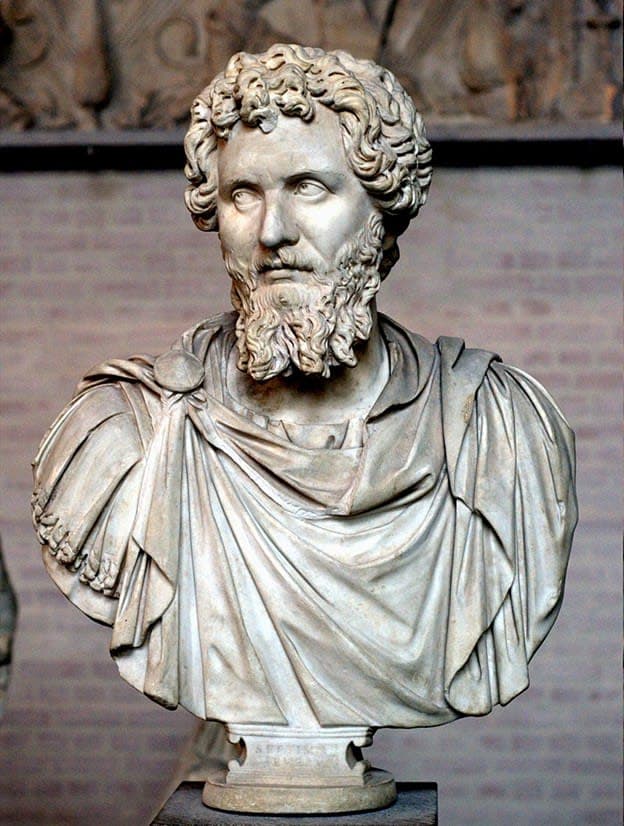
The future emperor Lucius Septimius Severus was born on April 11, 146, in the city of Leptis Magna in the province of Africa (modern Libya). His father, Publius Septimius Geta, belonged to the equestrian order; through his mother, Fulvia Pia, he had Italo-Roman roots. The Septimii were not especially influential, though two of Severus’s cousins held the consulship.
Lucius grew up in Leptis Magna, where he received his education. He spoke Punic fluently and also studied Greek and Roman literature. According to Aelius Spartianus, he was “particularly well versed” in them. Even so, he spoke with a slight accent all his life.
In 164 or 165 Severus went to Rome to continue his studies. On the recommendation of a relative, Emperor Marcus Aurelius enrolled him among the senatorial class. Little is known of his early career. There is evidence that he served as an advocate for the fiscus, but this is unconfirmed.
Severus had to postpone the quaestorship until he turned 25. The Antonine Plague, which claimed the lives of many senators, accelerated his advancement. He moved rapidly through the cursus honorum: quaestor in 169 or 170, people’s tribune in 176, and praetor in 178.


After the death of Marcus Aurelius and the accession of Commodus in 180, Severus’s career stalled perhaps because he opposed the all-powerful praetorian prefect Tigidius Perennis. He used the time to travel to Athens and then eastward, where at Apamea he met Julia Domna, the daughter of the high priest of the Phoenician sun-God. A prophecy had foretold she would marry a “king,” and Severus married her.

After Perennis was killed, Severus’s career resumed. He governed Lugdunensis (Lyonnaise Gaul), where his elder son Caracalla was born. In 189 he became suffect consul. In the summer of 191, on the advice of the praetorian prefect Quintus Aemilius Laetus, Commodus appointed Severus governor of Upper Pannonia, giving him command of one of the strongest armies in the empire.
In the 190s the Roman Empire entered a crisis. On December 31, 192, Commodus was assassinated. Publius Helvius Pertinax took the throne, but after just 88 days he was killed by the Praetorians. Didius Julianus then bought the imperial power at an auction staged by the Guard an act that provoked unrest in the provinces.

When news of Pertinax’s murder spread, three provincial governors Septimius Severus in Upper Pannonia, Decimus Clodius Albinus in Britain, and Gaius Pescennius Niger in Syria proclaimed themselves emperor. Severus, being closest to Rome, moved first. In speeches to his legions, he vowed to avenge Pertinax’s murder.
The three legions of Upper Pannonia acclaimed him emperor. He won the support of other provincial governors, including his brother Publius Geta in Lower Moesia. Severus made an alliance with Clodius Albinus by “adopting” him and naming him co-ruler with the title of Caesar, thereby securing his rear and allowing him to focus on Didius Julianus and Pescennius Niger.

Proclaimed emperor at Carnuntum, Severus marched on Rome, adroitly invoking Pertinax’s name in his propaganda and promising vengeance. His army crossed the Alps unopposed. Didius Julianus, who had purchased the throne from the Praetorians, was unprepared for war. He tried to organize the city’s defense, but his plans were sabotaged and the Guard refused to fight.
Severus did not even have to reach Rome to win power. By late May 193 his edicts were being openly posted in the capital. The Senate declared Didius Julianus an enemy of the people and proclaimed Lucius Septimius emperor. On June 1 Didius was executed, and on June 9 Severus entered Rome. He deified Pertinax and disbanded the Praetorian Guard, replacing it with soldiers loyal to him.

With Rome secured, Severus now had to face another claimant, Gaius Pescennius Niger, who controlled the eastern half of the empire. Niger was popular in the provinces, but his troops lacked the discipline and combat experience of Severus’s legions.
In 193 Severus marched east. The war centered on the Straits. Delegating command to his lieutenants, he defeated Niger’s forces in several battles. At Nicaea Niger’s army was routed and fled to Syria.
Niger’s position weakened: he lost Egypt, and many provinces changed sides. In late 194 Severus’s army forced the Taurus passes, and in the decisive battle near Issus in Cilicia Niger was crushed. He fled but was caught at the frontier and killed.
After victory Severus dealt harshly with Niger’s supporters. Niger’s wife and sons were executed, and cities that had backed him were punished. To weaken Syria, he split it into two provinces.
In 195 Severus proclaimed his son Caracalla Caesar and declared himself the adoptive son of Marcus Aurelius and the brother of Commodus, staking a claim to Antonine legitimacy.
A new civil war erupted in 196. Decimus Clodius Albinus whom Severus had earlier adopted and made Caesar proclaimed himself emperor while Severus was absent. Albinus, who enjoyed Senate support, moved his troops into Gaul and occupied Lugdunum.
In 197 Severus came west. On February 19, near Lugdunum, a decisive battle took place by some estimates involving up to 150,000 men. Albinus’s army was annihilated; Albinus himself died in the fighting, and his body was thrown to the dogs.
Severus punished Albinus’s supporters with extreme severity. Many senators and local notables were executed, and Lugdunum, which had supported him, was destroyed. These measures replenished the treasury and shored up his power.
Having reunited the empire, Severus in 197 turned east against the Parthians, who had backed Niger. He personally led a campaign against the Parthian capital, Ctesiphon. The city fell and the king fled. Enormous booty was taken, and Severus assumed the title Parthicus Maximus.


He then attempted to capture Hatra a city even Trajan had failed to take, but his forces were repulsed. Nonetheless, Severus secured a favorable peace: Northern Mesopotamia became a Roman province.
He remained in the East for two more years to settle local affairs. In 199 he went to Egypt, visited Alexandria and other cities, revived the city council, and granted Egyptians the right to sit in the Senate.
After inspecting the eastern and Danubian provinces, Severus returned to Rome in 202. He declined a triumph but staged games and distributed vast sums to the soldiers and the people. That same year he traveled to his native Africa with his family and inner circle.
Severus visited Leptis Magna and Carthage, granting the latter ius Italicum, which freed it from provincial taxes. He extended privileges to other cities and settled a veteran colony at Vaga.
Under Severus the frontiers of Roman Africa were significantly expanded and fortified. The legate Quintus Anicius Faustus built numerous forts and roads in the desert south of Tripolitania. In 203 Severus personally led an expedition against the nomadic Garamantes, driving them far into the Sahara. The frontier was pushed south and strengthened, ending the raiders’ incursions.

Severus’s last campaign was in Caledonia the northern part of Britain. He resolved to re-conquer the territories abandoned by the Romans in the 160s. Preparations were extensive: the road network in Gaul was renewed, and the fort of Arbeia (South Shields) was turned into a massive supply depot.
In 208 Severus arrived in Britain, based himself at Eboracum (modern York), and sent his elder son Caracalla to wage war. In 209 Severus and Caracalla together led the campaign. The Romans had to contend with forests, bogs, and rivers. Eventually the Caledonians sued for peace, which Severus granted on condition that they abandon control of the Central Lowlands.
That same year, however, the Caledonians, joined by the Maeatae, rose again. Severus prepared a new campaign, intending to annihilate them. According to Cassius Dio, he ordered that no one be spared. The second campaign began in 210, but the emperor, ill, stayed in Eboracum. Caracalla commanded the army but cared more for his popularity with the troops than the war. After Severus’s death, Caracalla abandoned the gains and restored the frontier to Hadrian’s Wall.

Severus greatly improved soldiers’ conditions: he raised their pay, allowed them to wear gold rings, and permitted legal marriage during service. Troops could live with their wives in vicus settlements near camps and cultivate land. These reforms made the army more loyal and effective but over time led to its “provincialization” and the emergence of a militarized peasantry.
His relations with the Senate were tense. He had taken power by force, and senators distrusted him. He executed many on charges of conspiracy, replacing them with his provincial supporters, especially Africans.
Under Severus the Senate’s political role shrank to a minimum. Governance shifted to the bureaucratic apparatus, and the praetorian prefect gained vast powers. Severus became the first emperor to hold proconsular authority even in Italy, finally equating it with the other provinces.
Among the common people, however, Severus was popular for fighting corruption and distributing money generously.
Religiously, Severus pursued syncretism, promoting the fusion of cults. He became a living embodiment of divine power on earth. Eastern cults Mithras, Hercules, Dionysus flourished during his reign.
Severus was not a ferocious persecutor of Christians, though localized persecutions occurred. He largely continued his predecessors’ policy: he did not outlaw the religion but cracked down on proselytizing. His attitude toward Judaism was friendly.
His reign saw vigorous building activity. In Rome he restored many structures damaged by fires, built the Arch of Septimius Severus and the Septizodium on the Palatine. In his native Leptis Magna he erected a forum, a basilica, and a triumphal arch.
In the winter of 211 Severus’s health deteriorated, and on February 4 he died at Eboracum (York) at the age of 65, after nearly 18 years on the throne. Before his death he advised his sons: “Live in harmony, enrich the soldiers, and ignore everyone else.”
His body was cremated and the ashes taken to Rome. After his death he was deified at the initiative of his sons.
The reign of Septimius Severus, which lasted almost 18 years, occupies an important place in Roman history. He restored order after civil war, strengthened the frontiers, and ensured an orderly succession.

Yet his seizure of power with army support set a dangerous precedent that undermined the tradition of peaceful transfer. The emperor’s bond with the army became closer and more overt, while trust in the Senate was fatally eroded.
His final advice to his sons “Live in harmony, enrich the soldiers, and pay no heed to anyone else” well illustrates that the army had become the chief pillar of his rule.


