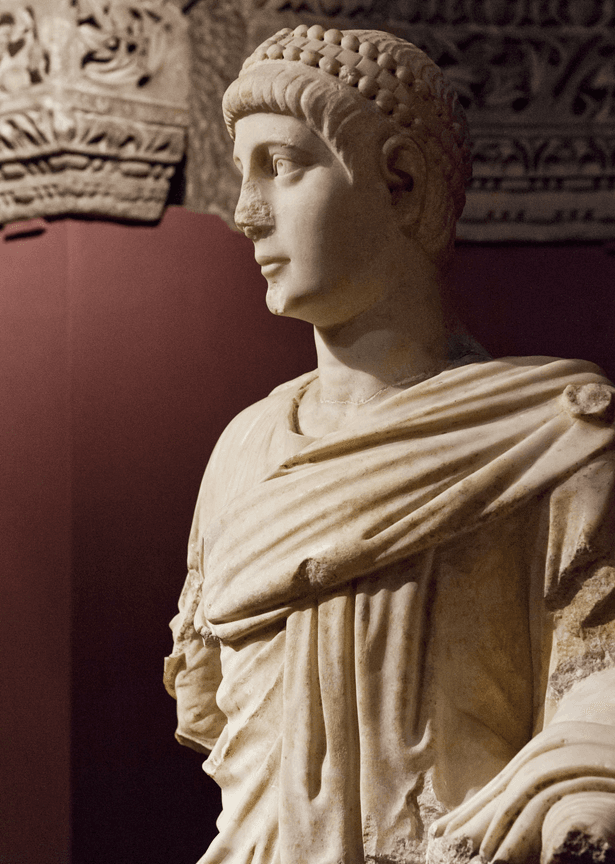

The life of Valentinian II began in 371 under rather unusual circumstances. His father, Emperor Valentinian I, was so captivated by the beauty of his mother Justina that, according to tradition, he issued a special law permitting bigamy in order to take her as his second wife while his first wife was still alive. Thus the young Flavius had not only full sisters — Justa, Grata, and Galla — but also a half-brother, Gratian, who by that time already bore the title of Augustus.

The boy’s fate changed dramatically on November 17, 375, when his father suddenly died in Pannonia during negotiations with the Quadi. At that moment, the empire found itself in a precarious position: the sixteen-year-old Gratian was far away in Gaul, while the eastern emperor Valens was in Syria. Fearing military unrest, the generals decided to play the “card of dynastic continuity.” The four-year-old Valentinian, who was living with his mother at a villa nearby, was hastily brought to the military camp at Brigetio. There, on November 22, 375, the army proclaimed the child Augustus. Gratian, showing prudence and brotherly affection, did not contest this step, and the brothers divided the spheres of influence: the child formally received Italy, Illyricum, and Africa, although real power remained in the hands of his mother Justina and the prefect Probus.

Valentinian’s childhood and youth were spent in Mediolanum (Milan), which became the scene of fierce religious disputes. Under the influence of his Arian mother, the young emperor was drawn into conflict with the powerful bishop Ambrose of Milan, the defender of the Nicene faith. The most vivid episode took place at Easter in 386, when Justina demanded that one of the churches be handed over to the Arians. Ambrose barricaded himself inside the church with the faithful, effectively challenging the imperial decree, and Valentinian, lacking any real force capable of opposing the authority of the Church, was compelled to retreat.

Meanwhile, storm clouds were gathering over the West. In 383, the military commander Magnus Maximus launched a revolt in Britain, during which Gratian was killed. Valentinian’s position became critical. Only thanks to the diplomacy of Ambrose and the military maneuvers of the Frankish general Bauto, who blocked the Alpine passes and set Huns and Alans against the enemy, was Maximus prevented from invading Italy. In return, Valentinian was forced to recognize the usurper as the legitimate ruler of Gaul.

However, in 387 Maximus, using the “defense of the true faith” as a pretext, nevertheless marched his troops into Italy. Valentinian, together with his family, fled to Thessalonica under the protection of the eastern emperor Theodosius. This alliance was sealed by marriage: the widowed Theodosius took Valentinian’s sister Galla as his wife. In 388, Theodosius defeated Maximus, who was executed on August 28 at Aquileia. Yet even after this victory Valentinian did not become an independent ruler, for Theodosius remained in Italy for another three years, directing all affairs as the de facto master, and left the peninsula only on November 10, 391, leaving with Valentinian his trusted man — the military commander Arbogast.

The last year of Valentinian II’s life turned into a psychological thriller. Settling in the Gallic city of Vienne, the emperor, now of age, attempted to assert his rights, but encountered a solid wall of resistance. Arbogast, a stern Frank, held all the threads of military and civil administration in his hands. The emperor lived the life of a private individual, shut up in his palace; not a single soldier was prepared to carry out his personal order.
Their hatred became open. On one occasion in the palace, driven to fury by the commander’s words, Valentinian tried to snatch a sword from a bodyguard in order to strike Arbogast, but he was restrained. On another occasion, the emperor handed Arbogast an order dismissing him, to which the commander simply tore up the parchment and threw it to the floor, saying: “You did not give me this command, and you will not take it away.” The desperate emperor sent letters to Theodosius and begged Ambrose to come, feeling that the noose around him was tightening.
The tragedy unfolded on May 15, 392. The body of the twenty-one-year-old Valentinian II was found hanging in his quarters in the palace at Vienne. Arbogast’s official version was suicide born of despair. But rumors spread immediately.
The historian Philostorgius described a brutal murder: according to him, bodyguards strangled the emperor while he was amusing himself by the river and then staged the scene as a suicide.
Zosimus, on the other hand, claimed that Arbogast himself inflicted the fatal wound on the emperor before the eyes of the soldiers.
Bishop Ambrose, in his funeral oration, showed remarkable diplomacy. He did not directly accuse Arbogast, calling the early death instead “a sign of sickness,” yet at the same time he elevated Valentinian’s image as that of a chaste, just, and deeply believing young man who had not yet received baptism, but had sought it with all his soul.
Thus ended the reign of Valentinian II — an emperor who, despite holding the consulship four times, never managed to step out of the shadow of his great contemporaries. His death opened the way to power for the secretary Eugenius, and then to the last unification of the empire under Theodosius the Great.


