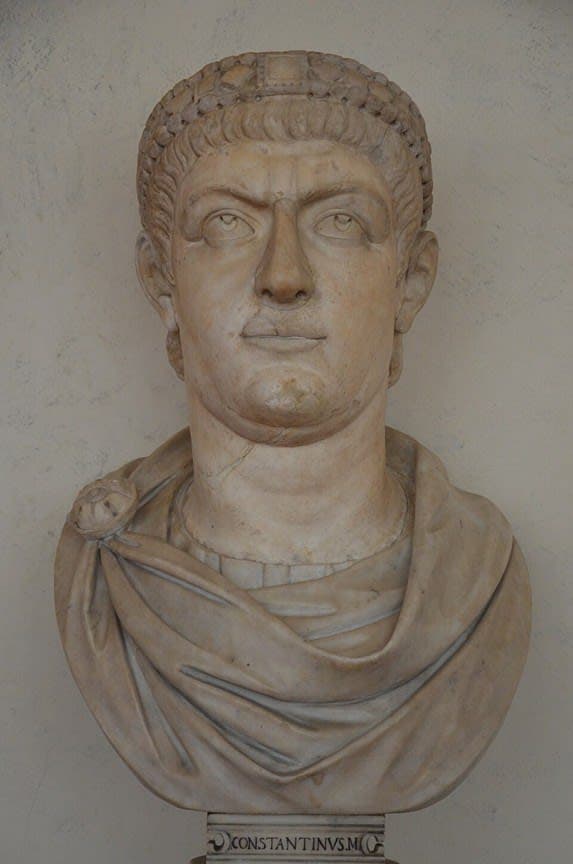
His life, which began in 321 in the South Pannonian city of Cibalae (modern Vinkovci), was inseparably bound to the army. The son of the renowned Gratian the Elder, a protector and comes of Britain, Valentinian grew up in the atmosphere of military camps. Without receiving a brilliant classical education, he learned not rhetoric but the art of survival on the frontiers.
Valentinian’s youth passed in the shadow of his father. In 340 he accompanied him to Africa, and later to Britain. Yet the political storms of the empire nearly cut short his career. After the fall of the usurper Magnentius in 353, Emperor Constantius II confiscated the property of Gratian the Elder for his alleged loyalty to the rebel. Valentinian, though not directly harmed, found himself in a difficult position. Nevertheless, his military talent was undeniable. In 357, under Caesar Julian, he fought in the great Battle of Argentoratum, and later led cavalry raids across the Rhine, burning barbarian settlements and striking fear into the Franks.


His character was harsh and straightforward, and he came into conflict with the ideology of Julian the Apostate. In 362, because of his open commitment to Christianity, Valentinian was exiled to Egyptian Thebes. Only the death of Julian and the accession of Jovian brought him back from exile. After successful service in Gaul, he was appointed tribune of the scutarii at Ancyra. It was there that news reached him of the sudden death of Jovian, which left the empire without a ruler.

When the highest officials of the empire gathered at Nicaea to elect a new Augustus, the candidacies of Equitius and Januarius were rejected for their coarseness and remoteness. All eyes turned to Valentinian. In February 364, he was proclaimed emperor. His accession was marked by a legendary episode: when the soldiers demanded the immediate appointment of a co-ruler, Valentinian, already clothed in purple, coldly rebuked them, declaring that the choice of an heir was now exclusively his prerogative.
Yet he understood that one man alone could not hold the frontiers from the Euphrates to Britain. On March 28, 364, in Constantinople, he appointed his brother Valens as co-emperor. The world was divided: Valens received the rich but troubled East, while Valentinian took upon himself the harsh West, establishing himself in Mediolanum.

Valentinian’s reign became an endless succession of battles. Already in 365, the Alemanni, outraged by the meagerness of the imperial gifts, poured into Gaul. At the same time, the revolt of Procopius broke out in the East. Valentinian made a firm decision: not to abandon Gaul in order to help his brother, but to focus on defending the western provinces. His general Jovinus inflicted a series of defeats on the barbarians, while the emperor himself crossed the Rhine in 368 and crushed the Alemanni in the bloody Battle of Solicinium.

At the same time, the empire was shaken by the “Great Conspiracy” in Britain in 367. The Picts, Scots, and Saxons virtually destroyed the Roman command structure on the island. The talented general Theodosius, father of the future emperor, was sent to save the province. By 369, Theodosius had restored order, driven the barbarians back beyond the Antonine Wall, and founded a new province — Valentia, named in honor of the emperor.
Valentinian did not merely wage war — he also built. The entire left bank of the Rhine was covered with a network of powerful fortresses and watchtowers. He personally inspected the construction, at times even attempting to build forts on enemy territory, which aroused the fury of the barbarians. In 370 he successfully repelled Saxon raids, and in 372–375 he crushed the large-scale revolt of the usurper Firmus in Africa by means of that same loyal Theodosius.
Contemporaries, and above all the historian Ammianus Marcellinus, painted a portrait of Valentinian as a man of frightening contrasts. He was muscular, fair-haired, and possessed a regal bearing and a piercing blue gaze, which often became sharp and severe in moments of rage. The emperor was gifted: he drew well, modeled in wax, and even invented new kinds of weapons.
Yet his anger was terrible. He knew no mercy in judgment, trusted dubious advisers, and often lapsed into paranoia. In religious matters, unlike his Arian brother, he maintained a prudent neutrality and did not interfere in doctrinal disputes, though he harshly persecuted Manichaeans and Donatists, often guided more by the financial interests of the treasury than by theology. It was under him that the great Ambrose became bishop of Milan.

The emperor’s end was as violent as his life. In 374, the Quadi and Sarmatians invaded Raetia, provoked by the construction of a Roman fortress on their lands. In 375, Valentinian arrived at Brigetio for negotiations. On November 17, 375, while receiving an embassy of the Quadi, the emperor flew into uncontrollable rage at their attempts to justify their raids.
“The emperor became terribly enraged… began to abuse their entire tribe in furious language… when suddenly, as if struck by lightning from heaven, he lost both breath and voice and turned a dreadful purple in the face; blood suddenly burst from his throat.”
Valentinian suffered an apoplectic stroke during his furious speech. After a long struggle, he breathed his last in the fifty-fifth year of his life. His body was laid to rest in Constantinople, in the Church of the Apostles. With Valentinian’s death, the empire lost its steel support: three years later his brother Valens would fall at Adrianople, and the world that Valentinian had defended with such ferocity would finally descend into the chaos of the Great Migration of Peoples.



