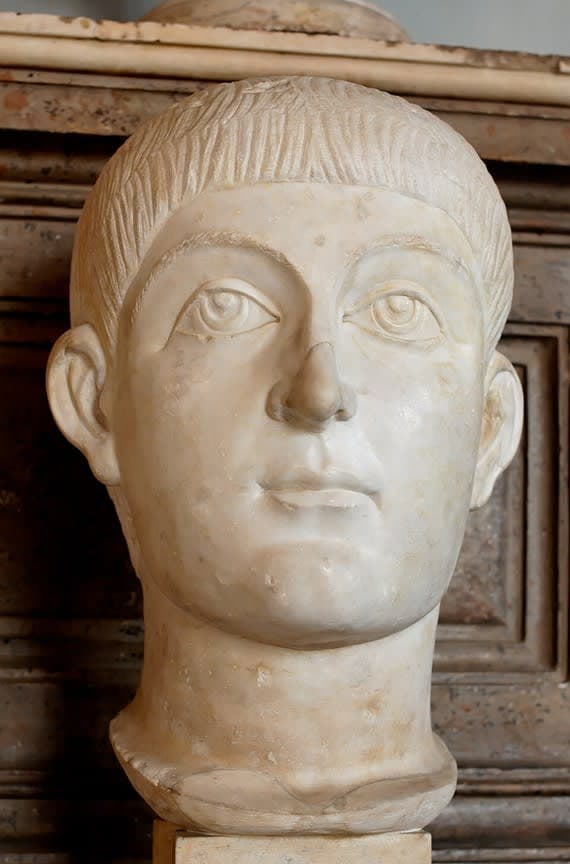

The fate of Flavius Julius Valens is the story of a man who did not seek greatness, but was forced to bear its burden in one of the darkest eras of Roman history. While his elder brother Valentinian had forged his character in the legions from a young age, Valens, born in 328 in the Pannonian city of Cibalae, long remained in the shadows. The son of the renowned Gratian the Elder, he received no higher education and likely lived the life of a provincial landowner on the family estates in Africa and Britain. Only in the 360s did he begin a military career, accompanying his brother on the fateful Persian campaign of Julian the Apostate.

When the sudden death of Jovian in February 364 left the throne vacant, the legions proclaimed Valentinian I emperor. Yet the enormous empire required two rulers. On March 28, 364, in the palace of Hebdomon, Valens was appointed co-emperor. He received the East — the lands from the Balkans to the Euphrates, including Greece, Egypt, and wealthy Syria. While his elder brother strengthened the Rhine frontier, Valens entered his capital, Constantinople, in December of the same year.
Peace did not last long. Already in the autumn of 365, while the emperor was in Caesarea, news reached him of the revolt of Procopius, Julian’s cousin. On September 28, 365, Procopius, using his connection to Constantine’s dynasty, won over the capital’s legions. Valens, a man naturally suspicious and lacking military authority, nearly broke under the strain: he was ready to abdicate and even contemplated suicide. Yet, mastering his fear, he began the struggle. The civil war went on with mixed success; Procopius seized Bithynia and nearly captured Valens himself near Chalcedon. Only by the spring of 366 did the emperor manage to turn the tide. In the battle near Thyatira, the rebels’ vanguard was defeated, and Procopius, betrayed by his own companions, was executed on May 27, 366.

Victory over Procopius exposed a new wound: the Visigoths under Athanaric had supported the usurper. In the summer of 365, intelligence had reported that wild tribes were preparing to invade Thrace. Valens decided to strike first.

In 367, the Romans crossed the Danube at Transmarisca, but Athanaric skillfully avoided battle by retreating into the Carpathians.
In 369, after three years of exhausting guerrilla warfare and natural disasters that brought the Goths to the brink of famine, Valens concluded peace with them.
No sooner had the Balkans quieted than the East flared up. The Persian shah Shapur II, taking advantage of Rome’s weakness, captured the Armenian king Arsaces II. Valens was forced to enter into a complex diplomatic and military game, trying to restore Prince Pap to the throne. In 371, at the Battle of Bagavan, Roman-Armenian forces won an important victory, temporarily stabilizing the frontier. However, internal revolts in Isauria and the uprising of the Arab queen Mavia in 375 forced Valens to seek peace with Persia. In the same year, his brother Valentinian died, and in the West his nephews Gratian and the young Valentinian II came to power.
The year 376 became the point of no return. Under pressure from the Huns, a vast mass of Visigoths under Fritigern approached the Danube. They asked for asylum in exchange for service. Valens, carried away by dreams of a two-hundred-thousand-strong army of mercenaries, made a fatal mistake and allowed them to enter.
The crossing turned into chaos. Roman officials Lupicinus and Maximus, blinded by greed, subjected the Goths to what was effectively death by starvation. Free warriors were forced to sell their children into slavery in exchange for dog meat. The inevitable explosion came at the beginning of 377, after a failed attempt on Fritigern’s life at Marcianople. The Goths rose in revolt, joining with the Ostrogoths, Alans, and even Huns. Thrace was given over to fire and devastation.
Valens, tormented by jealousy of his nephew Gratian’s military successes, decided to deal with the Goths on his own. Without waiting for reinforcements from the West, he marched out from Adrianople on August 9, 378.
The day was unbearably hot. The Romans marched eighteen kilometers under the blazing sun, exhausted by thirst and by the dust from the grass the Goths had set ablaze.
When the battle began, the Roman right wing was suddenly swept away by an avalanche of Gothic cavalry returning from foraging. The infantry found itself compressed into a narrow space where the soldiers could hardly even swing their swords. It was a slaughter. Two-thirds of the army of the East were left lying on the battlefield.
The death of Valens himself is shrouded in legend. According to one version, he fell in the thick of battle, fighting like an ordinary legionary among the ranks of the Lanciarii. According to another, the wounded emperor was carried into a rural hut, which the Goths, not knowing who was inside, piled with brushwood and set on fire. The body of the “Arian emperor” was never found.


Valens left behind a contradictory memory. He was a convinced Arian and at times harshly persecuted the Nicenes, yet he was also regarded as a capable administrator. Under him, the famous aqueduct in Constantinople was built, and his secretary Eutropius composed the Breviarium — a short history of Rome — so that the provincial emperor might orient himself in the past of his empire.
However, the catastrophe at Adrianople overshadowed all his achievements. Contemporaries compared this defeat to the Battle of Cannae, calling it the beginning of the end. After Valens, the empire would never be the same again: the barbarians had not merely entered its borders — they had become a part of it, a part Rome could neither digest nor expel.


