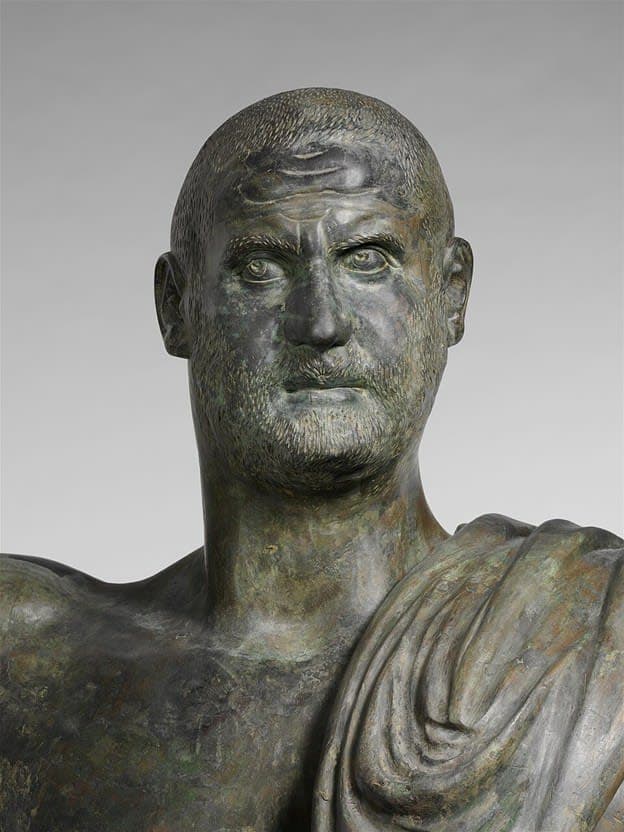
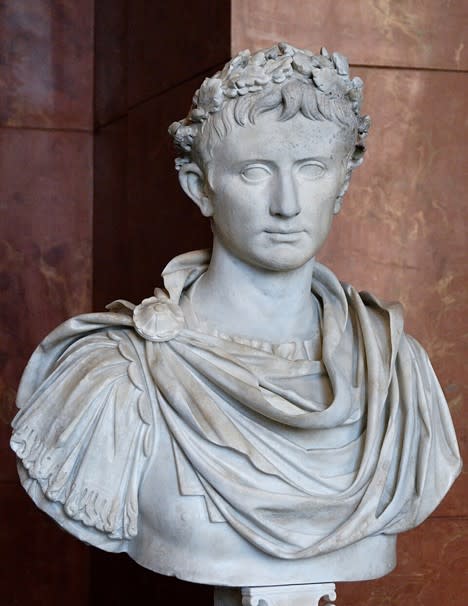
The future emperor was born around 206. His homeland was Umbrian Perusia, modern Perugia, and he came from an ancient and respected Etruscan family. Gallus was Roman aristocracy through and through: his ancestors were probably among the first settlers of the colony founded under Octavian Augustus. Gaius Vibius Trebonianus Gallus was married to Afinia Gemina Baebiana, who bore him a son, Volusianus, and a daughter, Vibia Galla.
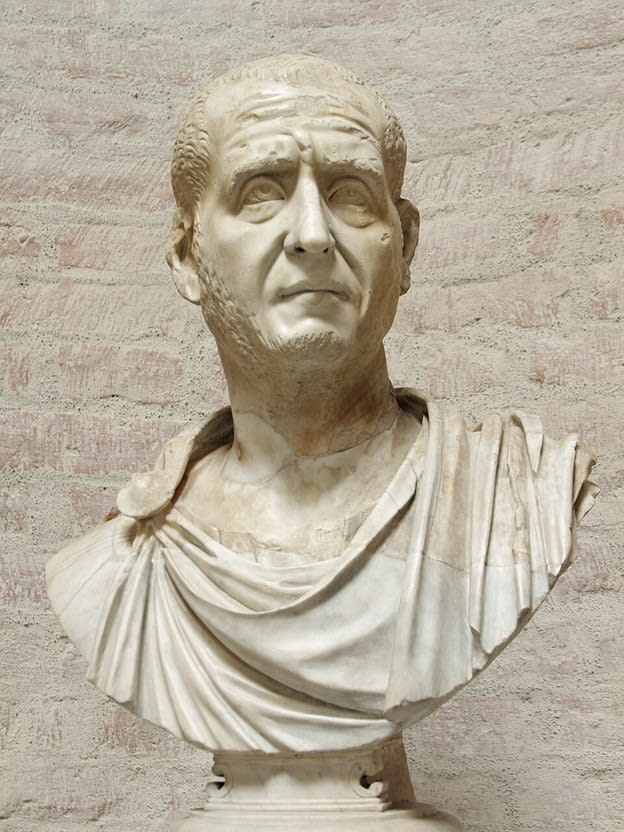
His path to power was classic for a man of his circle: senatorial rank and the office of suffect consul, presumably around 245. By 250, Gallus already held the key post of legatus pro praetore of Moesia, a strategically important region on the Danube frontier, which in those years had turned into a boiling cauldron of barbarian invasions.
The years 250–251 became a time of great trial for the empire. The Gothic king Cniva crossed the Danube, besieged Nicopolis and Philippopolis, and inflicted a series of painful defeats on the Romans. Emperor Decius Trajan, together with his son Herennius Etruscus, personally led the counteroffensive. At that time, Trebonianus Gallus commanded the reserve forces at Oescus.

The decisive moment came in June 251 at the Battle of Abrittus. It was one of the most disgraceful defeats in Roman history. Decius and his son were killed, and the army was almost destroyed in the marshes. It is here that the main historical mystery arises: the Byzantine historian Zosimus directly accuses Gallus of conspiracy. Allegedly, Gallus entered into an agreement with the Goths and gave them a signal to lure the emperor into the swamp.
“The barbarians completely drove the Romans into the marsh... All of them, together with all their troops, were swallowed by the quagmire,” wrote Zosimus.
However, modern historians are skeptical. It is unlikely that the legionaries would have proclaimed as emperor a man through whose fault their comrades had died. Most likely, Gallus became an “emperor against his will,” accepting power at a moment of complete chaos at the age of forty-five.
The first thing Trebonianus Gallus did was conclude peace with the Goths, a peace that contemporaries considered shameful. He allowed the barbarians to leave with enormous plunder and noble captives, promising them an annual payment of tribute. But Gallus had no choice: the army had been bled dry, and rivals were waiting for him in Rome.
Upon returning to the capital, Gallus showed unexpected nobility — or political cunning. He adopted Hostilian, the only surviving son of the fallen Decius, and proclaimed him Augustus and co-ruler. He initially made his own son Volusianus Caesar. Interestingly, his wife Afinia never received the title of Augusta — probably because Gallus did not want to offend Decius’s widow, Herennia Etruscilla, who retained influence. In this way, he tried to glue the fractured empire back together by uniting the old and new dynasties.

Gallus’s reign coincided with the beginning of a terrifying epidemic known as the “Plague of Cyprian.” The disease, which came from Ethiopia, tormented the empire for a decade and a half. In 251 it reached its peak, mowing down cities and legions. One of its first victims was the young co-ruler Hostilian, after which Volusianus was immediately elevated to the rank of Augustus.

During this period, Gallus showed himself to be a merciful ruler. He organized proper funerals at state expense even for the poorest citizens of Rome, earning the sincere love of the urban plebs. While coins with the inscription PAX AETERNA — “Eternal Peace” — were being minted on the frontiers, in Rome itself the emperor fought daily against the consequences of the plague.
While Gallus was fighting the plague in Rome, a lion awakened in the East — the Sasanian king Shapur I. The pretext for war was the flight of the Armenian prince Tiridates under Roman protection. In 252, the Persians dealt the Romans a crushing blow at the Battle of Barbalissos, where, according to Persian inscriptions, 60,000 Romans were killed.

The consequences were catastrophic:
Nisibis and Circesium fell.
Shapur I captured Antioch — the jewel of the East.
Persian detachments plundered Syria and Cappadocia.
The defense of the East fell on the shoulders of local leaders. In Emesa, the high priest Samsiceramus proclaimed himself emperor — Uranius Antoninus — and managed to repel the Persians. There are versions that Volusianus personally traveled east to organize the defense, but the scale of the Persian success was such that the authority of the central government was finally undermined.
The end of Gallus’s reign came suddenly in 253. The governor of Moesia, Marcus Aemilius Aemilianus, tired of paying tribute to the Goths, refused to fulfill the terms of the treaty and defeated the barbarians on their own territory. The enthusiastic soldiers, longing for victories, proclaimed Aemilianus emperor.

Gallus and Volusianus began hastily gathering troops. They called on Publius Licinius Valerianus for help with the German legions, but he was in no hurry. In August 253, near Interamna, about 100 kilometers from Rome, Gallus’s legionaries, seeing the numerical superiority of Aemilianus’s forces and disappointed in their leader, mutinied. Father and son were killed by their own soldiers.
Traditionally, Trebonianus Gallus was considered an incompetent ruler who “did nothing glorious,” as Eutropius wrote. However, modern studies by R. Hanslik and M. Christol offer a different view:
Road reconstruction: Epigraphic evidence testifies to active road construction throughout the empire.
One-front strategy: Gallus understood that Rome could not fight the Goths and the Persians at the same time, so he bought peace on the Danube in order to prepare for war with Shapur.
Humanism: His efforts to combat the plague were unprecedented.
Trebonianus Gallus was a typical “soldier emperor” who fell victim to circumstances — epidemic disease and the fickleness of the legions. His attempt to stabilize the state through diplomacy and the adoption of Decius’s heir was reasonable, but time did not give him the chance to bring these initiatives to completion. After his death, he was first condemned to damnatio memoriae, and later, under Valerian, deified.


