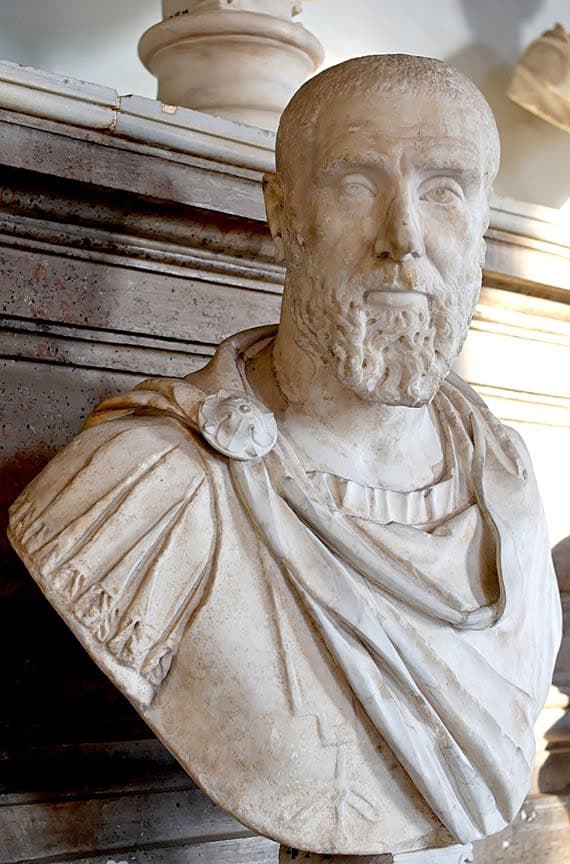
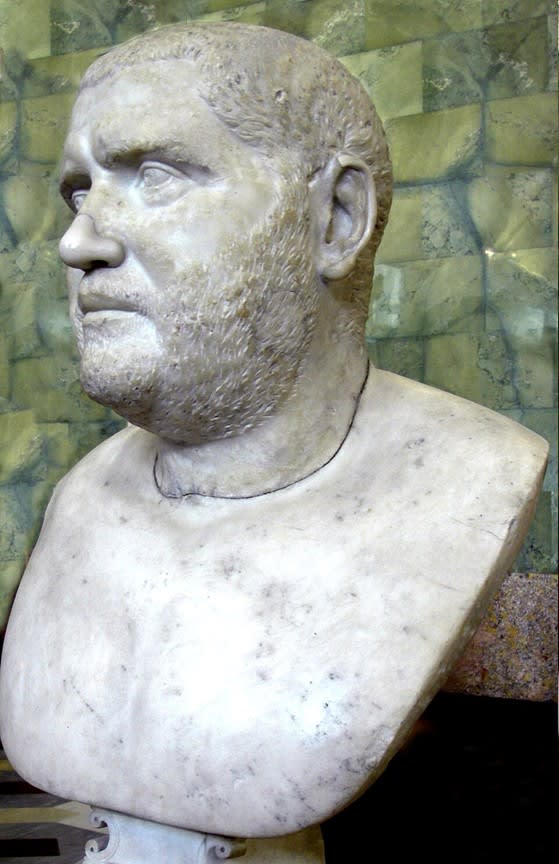
The question of Pupienus’ origins remains a stumbling block for historians to this day. John Zonaras claims that when Marcus Clodius was proclaimed emperor in 238, he was already seventy-four years old, which would place his birth in 164. However, modern scholars such as M. Grant believe that he was younger — a little over sixty. His name almost always appears first in official documents, emphasizing his seniority over his co-ruler Balbinus.
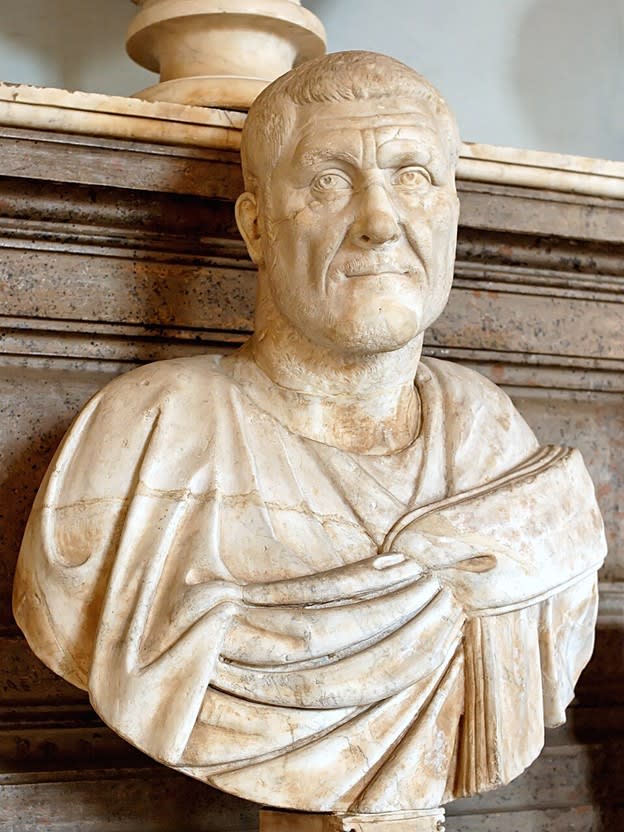
The biography of Pupienus is full of contradictions. On the one hand, Julius Capitolinus, in the Historia Augusta, portrays him as a “man of the people,” claiming that his father, Maximus, was a simple blacksmith or cartwright. On the other hand, Herodian insists on his impeccable patrician origin. The truth likely lies in R. Syme’s theory: Pupienus came from the Etruscan city of Volaterrae and belonged to a noble family that received patrician status during the reign of Septimius Severus. Stories about his poverty in childhood may have been deliberate falsifications by later authors who wished to humiliate his influential descendants in the fourth century.
Pupienus did not waste time on empty exercises in rhetoric. His life was devoted to “military valor and severity.” His cursus honorum was impressive:
Military tribune and praetor: the early stages in which he hardened his character.
Proconsul of three provinces: Bithynia, Achaea, and Gallia Narbonensis — although these details are disputed, they emphasize the scale of his personality.
Legate in Germany, around 210: here he earned a reputation as a just but stern commander, remembered by soldiers decades later.
Suffect consul, in 205 or 217, and ordinary consul, in 234: the peak of his civil career.
Prefect of Rome: in this office, he became famous for such severity that he earned the nickname “the gloomy one.”
In early 235, the death of Alexander Severus brought Maximinus Thrax — the “barbarian on the throne” — to power. By 238, hatred of Maximinus had reached its limit. After the tragic deaths of Gordian I and his son in Africa, the Senate faced the imminent invasion of Italy by Maximinus.
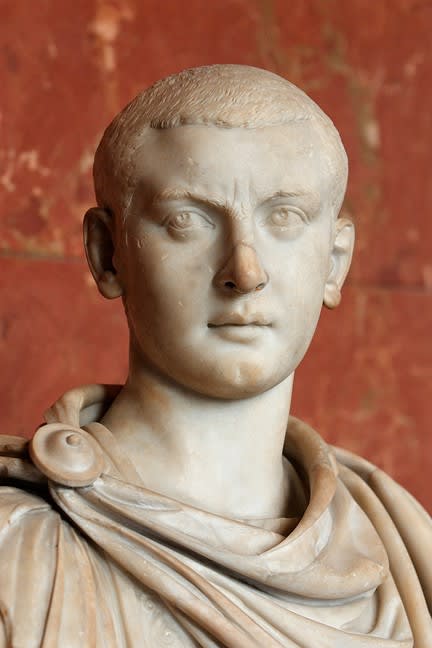
In an atmosphere of desperation and determination, the senators gathered in the Temple of Jupiter Capitolinus. A commission of twenty men, the vigintiviri, was created, and from among its members two new emperors were chosen by vote — Pupienus and Balbinus. This was a unique experiment: two Augusti with absolutely equal rights, including the title of Pontifex Maximus. The Senate attempted to revive the republican idea of collegiality, so that one emperor would always restrain the ambitions of the other.
However, the people of Rome met the Senate’s chosen men with hostility. Pupienus was remembered as an excessively strict prefect. The crowd demanded that power remain with the family of Gordian. To calm the revolt, the emperors had to bring forward the thirteen-year-old grandson of Gordian I and proclaim him Caesar.
The division of duties between the co-rulers was clear: while Balbinus tried to maintain order in turbulent Rome, Pupienus went north to confront Maximinus’ legions. Meanwhile, Maximinus was already besieging Aquileia — the “key to Italy.”
Pupienus acted with calculation. He did not enter into direct battle, but coordinated the defense of the country: the harbors were closed, communications were cut, and the provinces received secret orders to defect from the tyrant. The siege of Aquileia dragged on, and Maximinus’ army began to starve. In the end, soldiers of the Second Parthian Legion killed Maximinus and his son.
When Pupienus arrived in Ravenna, he met an enemy army that had already been defeated. Showing wisdom, he did not carry out reprisals, but paid the soldiers their wages and sent them back to their stations. The heads of the Maximini were sent to Rome as trophies. Pupienus entered the capital as a triumphator, amid the clamor surrounding the gilded statues erected in his honor.
Despite outward harmony — coins bore inscriptions about the “mutual love of the Augusti” — tension grew between Pupienus and Balbinus. Balbinus took pride in his nobility; Pupienus, in his military successes. But the main threat came from the Praetorians. The Guard hated the Senate’s appointees and feared the German bodyguards whom Pupienus had brought with him.
The end came during the Capitoline Games. The Praetorians burst into the imperial palace. At this critical moment, Pupienus and Balbinus continued to argue: Balbinus prevented the German guard from being summoned, fearing that Pupienus would use them to seize sole power. The soldiers seized both rulers, dragged them through the entire city while beating and humiliating them, and brutally murdered them. Their joint reign lasted only ninety-nine days.
Pupienus Maximus remained in memory as a man of stern, almost archaic Roman temper. Busts of the time depict him with a thick wavy beard, deep wrinkles on his forehead, and a massive back of the head — an appearance in which the weight of state responsibility can be read.
“His facial expression was serious and irritable; he was tall in stature and very strong in body,” writes Julius Capitolinus.
Although his reign was brief, Pupienus proved that the Senate was still capable of putting forward a leader able to organize the defense of Italy and defeat its most dangerous enemy. His death marked the collapse of the last serious attempt to establish an elective senatorial monarchy in Rome, transferring power to the young Gordian III and finally plunging the Empire into the age of military domination.


