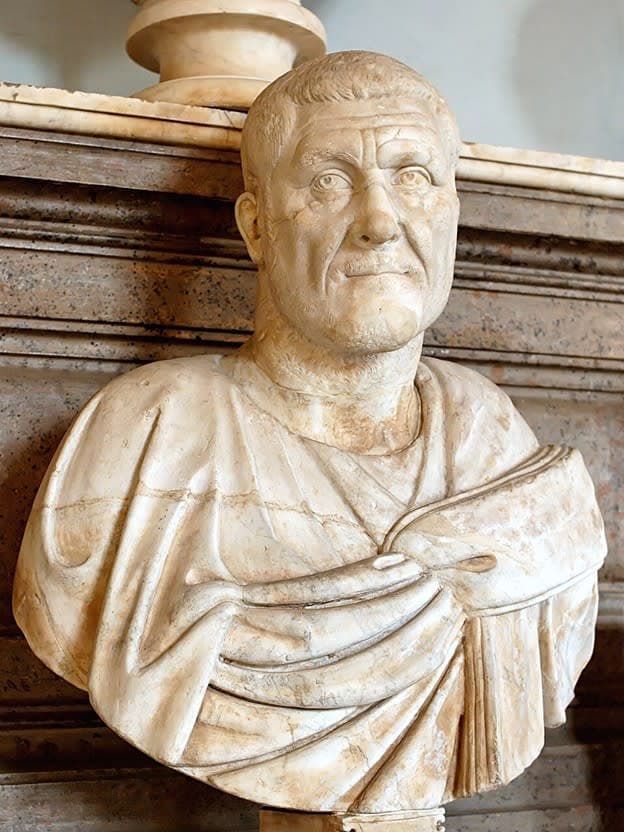

The story of Gaius Julius Verus Maximinus begins in the misty foothills of Thrace or across the plains of Lower Moesia around 172 or 173. Historians, however, still argue fiercely over the dates: some, such as the historian R. Syme, place his birth a decade later, while A. Lippold favors a period between 175 and 180. His origin is shrouded in myths that sometimes border on fantasy. Fourth-century chroniclers gave him the nickname “Thrax,” or “the Thracian,” to distinguish him from later namesakes, but the real confusion was introduced by the Gothic historian Jordanes. He claimed that the future emperor’s father was a Goth named Micca, while his mother was an Alan woman named Ababa. Although modern scholarship treats these names skeptically, seeing them mostly as an attempt to emphasize the ruler’s “barbarian” nature, philological analysis allows for their authenticity within Germanic and Scytho-Iranian onomastics.

Whoever his ancestors may have been, Maximinus grew up into an almost supernatural being. Julius Capitolinus describes him as a giant about two and a half meters tall, possessing strength capable of putting mythical heroes to shame. It was said that in his youth he was a simple shepherd who led local young men in fights against bandits. His path to the summit began with an episode resembling a Homeric epic. In 193 or 194 — according to other versions, in 196 — Emperor Septimius Severus, while in Thrace at games held in honor of his son Geta, noticed the young giant, who was easily defeating one opponent after another. Struck by his power, Severus took him into his personal cavalry, opening for the shepherd the door to the world of high politics and endless wars.

Maximinus’ military career was direct and relentless. Under Caracalla, he rose to the rank of centurion and probably to that of primipilus, the senior officer of a legion. His loyalty to the Severan house was so great that after Caracalla’s murder, he demonstratively left the service, despising the new emperor Macrinus. However, with the accession of Elagabalus, he returned, becoming a tribune of the Praetorian Guard. Life at the court of the effeminate priest-emperor was torment for the harsh Thracian: Elagabalus showered him with mockery, forcing Maximinus to seek seclusion on his Thracian estates.

The true flowering of his career came under Alexander Severus. Herodian writes that, after passing through every possible army rank, Maximinus was given command over camps and entire provinces. He may have been prefect of a legion in Egypt or governor of Mauretania Tingitana between 222 and 235. He was respected both for his combat experience and for his personal courage, displayed during the Persian campaigns. That is why, in 234, when storm clouds gathered on the Rhine frontier, Alexander had no choice but to entrust Maximinus with the training of recruits raised in Pannonia.

This choice proved fatal. While Emperor Alexander, under the influence of his mother Julia Mamaea, tried to negotiate with the Alemanni using gold, the soldiers, who saw this as cowardice, turned their eyes to their instructor. In late February or early March 235, a mutiny broke out near Mogontiacum. The Pannonian legionaries forcibly draped the purple robe over Maximinus’ shoulders. Alexander Severus and his mother were murdered in their tent, and for the first time in its history the Roman Empire received a ruler who had never been a senator and had risen from the very bottom.
Maximinus Thrax became an emperor who understood only one language — the language of war. Having received recognition from the Senate, which confirmed his power in March 235 only out of fear of the legionaries’ swords, he did not go to Rome. The frontier awaited him. He immediately purged the court of the late Alexander’s advisers, dissolved the senatorial council of sixteen, and established a regime that historians would call a military dictatorship.
The first years of his reign were marked by a series of brilliant but bloody campaigns. In the summer of 235, he crossed the Rhine, restoring the ruined fortifications of the Taunus and burning barbarian settlements. In one battle, where the Romans clashed with Germanic tribes in the marshes of Baden-Württemberg, Maximinus personally charged into the bog on horseback, dragging his wavering soldiers after him. For these exploits, he received the title “Germanicus Maximus,” and in 236 his son Maximus was proclaimed Caesar.

Yet the whole empire had to pay for these military triumphs. Maximinus needed enormous funds. His financial policy turned into open plunder: municipal funds intended for food supplies were confiscated, temple treasures were melted down, and imperial procurators were given the right to collect taxes with unprecedented brutality. Even the rural population, which, according to M. Rostovtzeff’s theory, should have supported “their” emperor, groaned under the exactions, as shown by the famous petition of the inhabitants of Scaptopara in 238. In addition, Maximinus launched persecutions against the leadership of the Christian Church, seeing them as supporters of the old regime; it was under him that Pope Pontian was exiled to die in the mines of Sardinia.

The crisis erupted in early 238 in Africa, where desperate young men killed a greedy procurator and proclaimed the elderly Gordian emperor. Rome immediately took up the banner of rebellion, declaring Maximinus an enemy of the people. Although the African revolt was quickly crushed by the legate Capelianus, who remained loyal to Maximinus, the Senate had already managed to choose its own rulers — Pupienus and Balbinus.
When Maximinus, who was in Sirmium, learned of the betrayal, he flew into indescribable rage. He led his huge, battle-hardened army into Italy. But fortune turned away from the titan. His path was blocked by Aquileia — a key port of the north, which shut its gates and prepared to die. The defense of the city was led by Tullius Menophilus and Rutilius Pudens Crispinus. While the people of Aquileia bravely repelled the assaults, Maximinus’ army began to disintegrate. Lack of food, endless rains, and the flooding of the Sontius River undermined the morale of the legionaries.
The end came in May 238. Soldiers of the Second Parthian Legion, whose families were being held near Rome as hostages by the Senate, resolved to commit the deed. Bursting into the imperial tent during the midday rest, they killed Maximinus and his son Maximus. The heads of the “soldier emperor” and his heir were sent to Rome, where they were displayed to public jubilation.
In ancient historiography, Maximinus remained a caricatured villain, a “barbarian on the throne,” whose rule Zosimus and Herodian described as “crude tyranny.” The Senate imposed damnatio memoriae — condemnation of memory — upon him, systematically destroying his images. Modern historians, however, view him differently. His victories on the Rhine and Danube gave Gaul and Illyricum decades of peace, while his straightforward patriotism contrasted with the indecision of his predecessors.
Maximinus Thrax became the first in a long line of “soldier emperors,” whose rise marked the end of the classical Principate. He was a man of his age — brutal, energetic, and absolutely devoted to the interests of the army. His death did not stop the crisis, but merely confirmed that from then on Rome’s fate would be decided not in the Senate, but on the battlefields, where the strength of one’s fist mattered more than noble birth.



